Maine community colleges optimistic about tuition-free future after cost cuts, surging support
Feb 13, 2026 | 5:00 am ET
Description
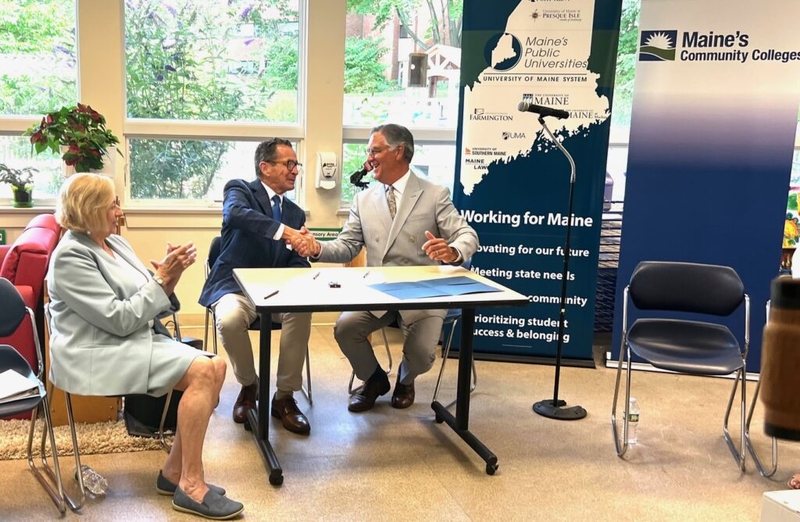
Maine Gov. Janet Mills (left) applauds as UMaine System Chancellor Dannel Malloy and David Daigler, president of Maine’s community college system, announce the new Transfer ME partnership. (Photo by Eesha Pendharkar/ Maine Morning Star)
After months of limbo, the Maine Community College System is optimistic that the state Legislature will make the free college pilot permanent.
Last session, the Legislature did not fund Maine’s free community college program — a last-dollar scholarship that pays for a 100% of tuition and fees for recent high school graduates — beyond the class of 2025, making the future of the pilot program uncertain. It also removed language making the program permanent. At that time, some lawmakers questioned the cost and popularity of the scholarship, leaving the system unable to promise free tuition to future students.
But in the months since, administrators have responded to legislators’ questions, demonstrated the program’s popularity, and reduced its annual cost by $2.5 million. All those changes are contributing to the belief that Maine’s community colleges will likely be able to remain free, according to President David Daigler.
“The program is incredibly popular with voters, and I think legislators will begin to feel that pressure,” he said. “Voters from both sides of the aisle fundamentally believe that this is a good thing for Maine. It’s a good thing for our young people, and it’s a necessary thing for our businesses.”
What’s at stake as Maine weighs the future of free community college
Last fall, while the future of the scholarship was uncertain, the system contracted a survey of more than 600 Mainers across the political spectrum. More than 80% of respondents said they support the free college initiative, with 63% in strong support, and only 9% said they somewhat or strongly oppose it. Compared to previous years’ polling, support for the program has increased, the report found.
Since its establishment in 2022 in the wake of the COVID-19 pandemic, the scholarship has allowed all recent high school graduates to attend one of Maine’s seven community colleges for free, even if they don’t qualify for federal financial aid. The program led to increased enrollment in community colleges and contributed to an increase in transfer students attending the University of Maine System. More than 23,000 students have participated in the free community college program since it started, with nearly 2,000 continuing their education through the public universities and other four-year institutions.
Many community college students previously told Maine Morning Star they thought they could never afford to go college before the program.
For the second year in a row, Gov. Janet Mills included language in her supplemental budget request to make free college permanent, calling it “a highly successful program for Maine students.” She also included $2.5 million in one-time funding the Legislature did not allocate last session to fully fund the program for 2025, Daigler said.
“The free community college program has made a life changing difference for thousands of Maine young people,” Mills said in her State of the State address last month. “Let’s make community college free in Maine permanently!”
Mills’ commitment along with the changes to the program means the Maine Community College System is hopeful the scholarship will be available to class of 2026 and beyond. If the scholarship is approved by the Legislature on a permanent, ongoing basis, “it gives us the confidence of knowing that we can go out and say to future graduating classes, you have a commitment from us,” Daigler said.
“It gives us the confidence of knowing that we can go out and say to future graduating classes, you have a commitment from us.”
But, the system will still have to explain that the program will have to be approved and funded by the Legislature for future years before guaranteeing admission, he added.
How Maine’s free community college program may be changing
The Maine Community College System worked with Gov. Janet Mills to propose changes to make the program less expensive and more effective while prioritizing Maine students. To qualify, high school graduates would have to prove Maine residence, or have lived in the state for at least 12 consecutive months immediately prior to the date of admission. Previously, students had to be living in Maine while enrolled, which allowed people from out of state to move to Maine and qualify for the scholarship.
This comes after the heads of the budget committee asked the system last fall to estimate how much it cost to provide free college to out-of-state students. Only 4% of the student population is made up of out-of-state students, the system said in its response.
Qualifying students would also now have slightly less time — three years instead of four — to complete a two-year associate degree.
“We’ve known for a long time that the faster you can get a degree, the more likely you are to get a degree, so it should also help with student outcomes,” system President David Daigler said.
The free college scholarship would also only cover 100% of tuition, rather than both tuition and fees. Full-time tuition is $2,880 per year, and fees are $1,276 per year.
- 1:37 pmThis story was updated to clarify the future of the scholarship program.
Augusta, ME