WA governor wants to require FAFSA for high school graduation
Jul 14, 2026 | 7:00 am ET

Description
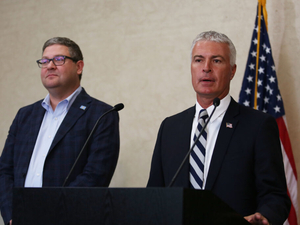
Gov. Bob Ferguson speaks at Renton High School on Friday, Sept. 19, 2025, ahead of signing an executive order launching the Washington Completes FAFSA Campaign. (Photo courtesy of governor's office)
High school seniors in Washington would need to complete student aid paperwork to graduate, under a proposal Gov. Bob Ferguson announced Monday.
If students didn’t want to fill out the Free Application for Federal Student Aid, they could sign an agreement to opt out. Ferguson will press for lawmakers to approve the requirement during the next legislative session, which begins in January.
Around half of Washington families qualify for higher education financial aid, according to the state’s Student Achievement Council. But last year, Washington ranked 47th among states for the number of high school seniors who completed the FAFSA.
“Washington state is literally the most generous state in the entire country for providing financial assistance,” Ferguson said during a press conference. “Here’s the bad news: in order to access those funds, you’ve got to complete this form.”
Students can unlock funding for higher education either by completing the FAFSA or the Washington Application for State Financial Aid.
Students from families with incomes below a certain threshold are eligible for the Washington College Grant, where tuition and fees are covered by the state at any of its public universities. Students in Washington who lack permanent immigration status are eligible for state financial aid, but not federal.
Raising FAFSA completion rates has been a priority for Ferguson since he took office last year.
In September, he created the Washington Completes FAFSA campaign and convened an advisory board to identify application barriers and recommend strategies to improve access. Since then, the completion rate for the class of 2026 has surpassed last year and moved the state up to 40th in the nation.
“Let’s be honest. 40th is not gonna get the job done,” Ferguson said. “More and more states are requiring young people to complete the FAFSA in order to graduate.”
A handful of Washington schools already require students to complete the application before graduating, he noted. College Place School District, for example, has a 74% completion rate.
The advisory board recommended schools expand support for completing the application during and after school hours, as well as coordinate with local organizations to spread messaging about the importance of the form. During a June meeting, some board members pointed out that schools need more funding to provide those extra resources.
The Washington State School Directors’ Association hasn’t taken a position on Ferguson’s proposal yet. But executive director Tricia Lubach said she’s already heard concerns from school board members.
“Every time something new is imposed upon a school district, it costs money,” Lubach said. “The public education system in Washington is under pretty significant financial strain.”
Another concern, she said, is that by requiring students to fill out FAFSA to graduate, some students could have their diplomas withheld.
Sen. Lisa Wellman, D-Mercer Island, who chairs the Senate Early Learning and K-12 committee, backs Ferguson’s proposal and doesn’t foresee it being expensive.
“There are many students that do not know that they actually have money available to them if they would just file for it,” she said.
“The idea would be that this is part of the high school and beyond plan,” which is already a graduation requirement, Wellman added.
State Superintendent Chris Reykdal, too, is supportive of Ferguson’s efforts to increase the FAFSA completion rate, but he’ll be asking the Legislature to consider a different plan.
Last week, Reykdal announced a proposal that would require high school seniors to take a year-long course preparing them for life after graduation.
The Postsecondary Launch Course would combine civics and financial literacy. Students would learn how to vote, build a resume and how to complete the FAFSA.
“Young people are taking on loans and credit card debt without knowledge of the implications,” Reykdal said. “They don’t always know what to add to their resume, or how to register to vote. We can fix that.”
Reykdal shared the proposal with the state Board of Education, which is working to update graduation requirements. The board will decide whether to include Reykdal’s proposal in draft requirements they expect to finalize next month.
Olympia, WA