Kaua‘i Mayor’s Race: Rapozo Leads Carvalho In Campaign Cash
Jul 15, 2026 | 6:01 am ET
Description
Photo courtesy of Honolulu Civil Beat
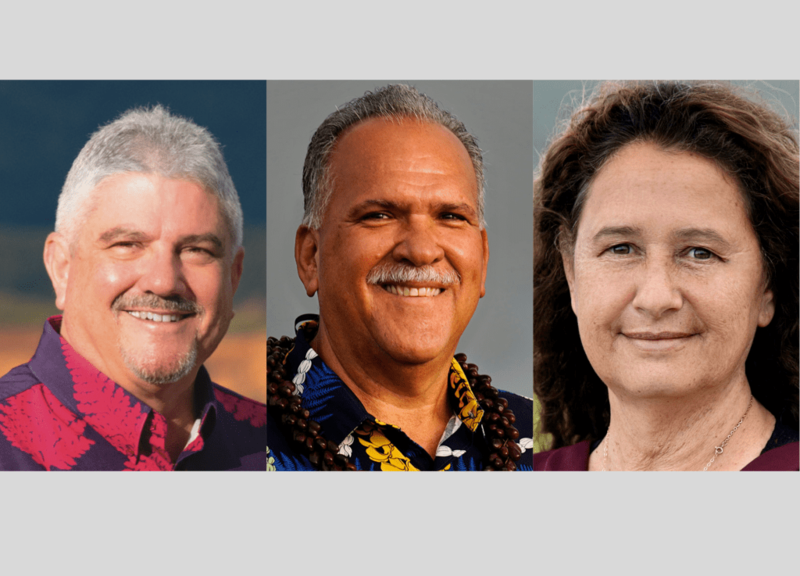
Kaua‘i County Council Chair Mel Rapozo is outraising and outspending fellow council member and former Mayor Bernard Carvalho Jr. in the race to become the island's next chief executive.
Their finances are followed by council member Felicia Cowden, who comes in at a distant third, according to the candidates’ most recent campaign finance reports.
Six candidates are vying to replace term-limited Mayor Derek Kawakami, who is running for lieutenant governor. Ballots will be mailed out to Kaua‘i voters starting Thursday, and the top two candidates will advance to the Nov. 3 general election.
Between April 25 and June 30, the most recent reporting period, Rapozo brought in $49,842 while Carvalho, who was Kaua‘i’s longest-serving mayor, raised $10,048, and Cowden raised $9,070.
“Usually someone who had been the chief executive would have the networks and contacts to raise the most money,” said Colin Moore, a political scientist at the University of Hawai‘i. “So this is a little unusual.”
Catholic Charities Kaua‘i Community Director Laura Lindsey brought in $827 and businessman Megeso-William Denis brought in $216. Michaela Widener, who works at the Beach House in Po‘ipū, told the Campaign Spending Commission that she intends for her total contributions and expenditures during this election to be $1,000 or less, so she is only required to file a financial report after the general election.
Moore said mayoral candidates in small counties like Kaua‘i generally need $100,000 to run competitive campaigns. That’s vastly different from races in Honolulu, where candidates need a lot more money to buy expensive media advertisements.
Small counties have the advantage of enabling candidates to campaign door to door, attend community events and host talk story sessions — all of which are free ways to get their names out.
“All three of the major candidates have extensive social networks to rely on,” Moore said of Rapozo, Carvalho and Cowden.
Cowden and Lindsey’s campaigns have more expenses than they have the cash for. Cowden’s campaign has a deficit of nearly $3,300, which is driven by a $12,500 loan she carried over from her past runs for council, where she has served since 2018. Lindsey has a deficit of roughly $816.
Moore said Cowden is basically running a no-money race but still expects her to be competitive. He cites a poll of 200 likely Kaua‘i County primary voters by Tulchin Research for Pacific Resource Partnership that found that Cowden was only 2 percentage points behind Carvalho.
“It’s very likely that Carvalho and Rapozo head on to the runoff, but you know there could be a surprise because money, I think, is a less useful indicator of eventual electoral success in the smaller counties than on O‘ahu,” Moore said.
Altogether, the race has so far brought in $278,000 during this election period, which began on Nov. 6, 2024 and covers through June 30. A little over half of that amount has gone to Rapozo, whose nearly $143,000 is close to the roughly $180,000 he raised when he last ran for mayor in 2018. He supplemented his campaign with a $10,000 loan in 2025. Kawakami won his second mayoral term with nearly $210,000 in contributions.
Cowden brought in nearly $19,000 in contributions so far this election. Her largest donors are Roger Burch, Jeffrey Lindner and Shanti Enterprises. Burch is CEO of Pacific States Industries, a California-based forest products and building materials company, and Lindner is an agricultural land developer who unsuccessfully ran for council in 2024. Shanti Enterprises runs the Hanalei Day Spa.
Carvalho ran for lieutenant governor in 2018. Although he wasn’t successful, several of his major donors have stuck with him in the mayoral race, helping him bring in roughly $114,000 so far this election.
Those donors include Jeffrey and Chynna Stone, CEO and accountant of The Resort Group, the master developer for the 9,000-acre Princeville Resort; Bert T. Kobayashi Jr. of law firm Kobayashi Sugita & Goda; H. Burkley Showe of general contractor Malama Construction; and Craig, Paul and Kyle Watase of Mark Development, which manages eight rental properties on Kaua‘i.
Carvalho lost financial support from executives of Kaua‘i-based Unlimited Construction Services and Grove Farm, as well as former Kaua‘i Mayor Maryanne Kusaka, to Rapozo’s campaign. Grove Farm CEO Don Horner, Executive Vice President Shawn Shimabukuro and retired CEO Warren Haruki cumulatively contributed $7,816 to Rapozo’s campaign.
Moore said it’s hard to say what caused those donors to switch, noting that Rapozo and Carvalho haven’t differentiated themselves much during their current campaigns.
A former Kaua‘i police officer and private investigator, Rapozo’s largest donations come from Nan Shin, Fooney Freestone and Ryan Nakaima of Honolulu-based general contracting company Nan, Inc. Shin is the founder, Freestone is the president and Nakaima is the vice president. Nan earlier this summer purchased 280 acres near Līhu‘e from Grove Farm to build an operations facility.
Rapozo and Carvalho were the only Kaua‘i mayoral candidates that accepted money from political action committees. The PACs of the Hawai‘i Regional Council of Carpenters, Local Union 1186 IBEW, Hawai‘i Government Employees Association, Masons Local 630, Bricklayers and Allied Craftworkers, Hawai‘i Laborers' & Employers Cooperation and Education Trust and Hawaii Operating Engineers Industry Stabilization Fund all backed Carvalho. Rapozo received support from the Plumbers & Fitters Local 675 and the IBEW Local Union 1186, 1357 and 1260 PACs.
In terms of expenditures, Rapozo and Carvalho are far outspending Cowden and their other opponents. Rapozo has spent nearly $45,000 on banners, campaign mailers and other forms of advertising, plus nearly $40,000 on his fundraisers, meet and greets, and campaign meetings.
Carvalho has spent roughly half those amounts for similar purposes, though he outspent Rapozo in travel and lodging costs to meet with supporters on O‘ahu. About $12,100 of Cowden’s spending has gone toward social media posts, banners and signs, and advertisements.
Read their Candidate Q&As here.
Civil Beat's reporting on Kauaʻi is supported in part by a grant from the G. N. Wilcox Trust.
Honolulu, HI