Many Candidates For Hawaiʻi Legislature Favor Changes To Business As Usual
Aug 04, 2026 | 6:01 am ET
Description
Photo courtesy of Honolulu Civil Beat
The outcome of elections are often interpreted to mean that voters either wanted change or were comfortable with the status quo.
Hawaiʻi won’t know the current public sentiment until Saturday’s primary election results are announced, of course.
But many of the challengers running for the Hawaiʻi Legislature have already indicated they would support several fundamental modifications to how politics and government work.
They include supporting term limits at the Legislature, where some incumbents have held office for four decades. Hawaiʻi governors and lieutenant governors have term limits, as do county mayors and council members.
There also is a strong appetite for restoring public trust, something that has been damaged since the 2022 convictions of two top state legislators for taking cash bribes to influence legislation. That corruption case continues, with two other former top lawmakers and two agency heads now under indictment for bribery-related allegations that happened around the same time.
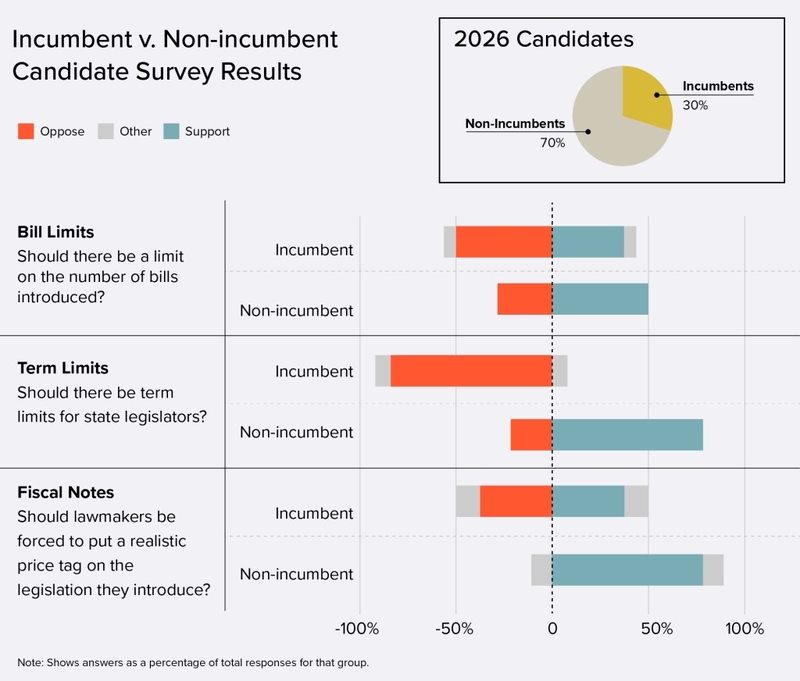
Civil Beat’s analysis is drawn from the candidate questionnaires that we published for the primary election. It’s a pretty large sample: We received 104 responses from the 155 registered legislative candidates, or 67% of the total.
The survey is skewed toward challengers because more than twice as many non-incumbents responded as office holders. Incumbents in Hawaiʻi tend to win reelection, so whether anything will change remains to be seen.
And in some cases, the candidates avoided directly answering the questions put to them or responded in a way that made it difficult to place them neatly into a yes or no category.
Still, change may be in the air, especially if challengers are successful. Here’s what we found.
Term Limits
Civil Beat asked this question of all candidates for the state House and Senate: “There are no term limits for state legislators in Hawaiʻi, so incumbents tend to win. Would you seek to change that? Why or why not?”
Term limits in some form might have their place, most said, but incumbents highlighted the value of experience over the need for turnover.
“After my first year in office, I have a greater appreciation for how much time it takes to understand the legislative process and effectively navigate state government,” said Rep. Joe Gedeon, a Republican who replaced the late Gene Ward in April 2025. “Experience, institutional knowledge have real value. At the same time, term limits can bring fresh perspectives, prevent complacency, and reduce the concentration of power. I am open to discussing reasonable term limits, but voters should continue to have the final say.”
More experienced legislators, however, say circumstances have influenced their views.
“I used to support term limits because I thought it would bring in fresh perspectives, but since I’ve been elected, there's been significant turnover in a lot of seats in the House bringing in new voices,” said Rep. Adrian Tam, a Democrat who was elected in 2020.
One challenger, Reno Abihai (a Democratic candidate for House District 28), was nuanced in his response: “Rather than focusing solely on term limits, I would support reforms that increase transparency, strengthen public accountability and give voters better information about a legislator's performance so they can make informed decisions when voting.”
But two other longtime House Democrats were adamant that term limits are a bad idea.
“I do not support term limits which would effectively disenfranchise constituents who wish to re-elect a long-serving legislator,” said Rep. David Tarnas, who served for four years in the 1990s and was reelected in 2018. “Term limits decrease the power of elected officials and increase the power of unelected agency officials, staff and lobbyists.”
And this came from Rep. Dee Morikawa, in office since 2010: “No, because voters have a chance to vote a House incumbent out every other year. I see that as my job evaluation.”
Public Trust
Another question to candidates had to do with what has been in the news a lot this year: “The 2026 session was also overshadowed by an issue of public trust: $35,000 in the brown paper bag given to an ‘influential’ state lawmaker. What do you think the Legislature needs to do going forward to rebuild public confidence in state government?”
The bulk of candidate Q&As were returned two weeks before news broke of the indictments of Lt. Gov. Sylvia Luke and four others in that major public corruption investigation, which continues.
Nonetheless, Rep. Matthais Kusch defended how his colleagues have responded to the scandal.
“I think the Legislature has made huge gains, especially the House,” said Kusch, who was appointed to his seat in 2024. “Since Speaker (Nadine) Nakamura started it's more open, she is trying new things, collaborating more, none of which ever gets much notice.”
Others said that a new slate of lawmakers was already helping restore trust.
“I believe we are on the right track with a new generation of leaders committed to transparency, accountability, and ethical government,” said Rep. Andrew Takuya Garrett, who was elected in 2022. "Ultimately, trust is earned through consistent actions, not words.”
But several challengers said not enough has been done.
“Create an independent Public Integrity Unit with subpoena power,” Anthony Makana Paris, a Democrat who is again running for a House seat. “Suspend officials under major investigation, require regular ethics training, protect and reward anonymous whistleblowers, and publish a public dashboard of complaints, investigations, and outcomes so the public can track accountability.”
Meantime, John Mizuno, a former representative who later served in the Green administration and is now running for House District 29, said this: “Both the House and Senate must establish a fast-track procedure to initiate a special investigative committee to timely address credible allegations of corruption by any elected official under their purview.”
Bill Limits
There was a broad spectrum for and against among both incumbents and non-incumbents for this question.
“Over 3,000 bills are introduced every session and there is always frantic horse-trading in the final days of session,” we asked. “Do you think there should be a limit on the number of bills introduced to enable more meaningful debate?”
Yes, said Tanya Yamanaka Aynessazian, running for a state Senate District 2 seat. She also added another idea that she supports:
“I support reducing duplicate and competing bills, extending the legislative session, and ending the ability of a single committee chair to kill a bill.”
And here’s what House District 23 candidate Victor Muh had to say: “Hawaiʻi already has enough laws on the books; we should enforce what exists, review what is not working, and repeal or fix outdated laws. New bills should show a clear public need, fiscal impact, constitutional basis, and whether current law already addresses the issue.”
House Rep. Terez Amato disagrees.
“There is in fact a limit on the number of bill introductions by House members. The Senate has unlimited bill introductions and the Governor’s (Executive) package has no limit. I don’t like overregulation. Elected officials should choose their bills carefully. I do.”
There might be some room for comprise, suggested Sen. Mike Gabbard.
“No,” he said about limits to bill introductions. “But, I’m open to discussing reforms that improve the legislative process. The goal should be quality over quantity.”
Gabbard's emphasis on improving the process was echoed in some form in two-thirds of all the answers in this category.
Fiscal Notes
Lastly, Hawaiʻi is the only state that does not require a fiscal analysis for all those bills, leaving lots of folks — including legislators — oblivious to what bills might cost taxpayers.
“Should lawmakers be forced to put a realistic price tag on the legislation they introduce?” we asked.
Generally, most candidates said yes whether they were in or out of office.
“I support creating a dedicated legislative fiscal analysis office or agency that reviews every bill and provides clear, realistic cost estimates before it moves forward,” said House District 26 candidate Janel Fujinaka. “Lawmakers should not be voting in the dark.”
Agreed, said Rep. Amy Perruso, noting that it’s already happening.
“This session, the House Finance Committee began piloting fiscal notes on selected measures, an important step toward greater transparency and accountability, and I am convinced that better fiscal information will lead to better policymaking and more informed public debate.”
Sen. Chris Lee responded with "more information is always helpful! That said, those who are most prepared going into session already ask an appropriate agency for an analysis and price tag for a bill they are pushing."
But at least one candidate suggested it might best to outsource the calculating.
“We would need to have independent fiscal notes done by a nonpartisan entity not connected to the Legislature or Executive Branch, or else it’d be just another form of a rubber stamp,” said Danny de Gracia, running for House District 39.
Honolulu, HI