Not So Public: Kaua‘i Council’s Testimony Policy Leaves Public In The Dark
Aug 04, 2026 | 6:01 am ET
Description
Photo courtesy of Honolulu Civil Beat
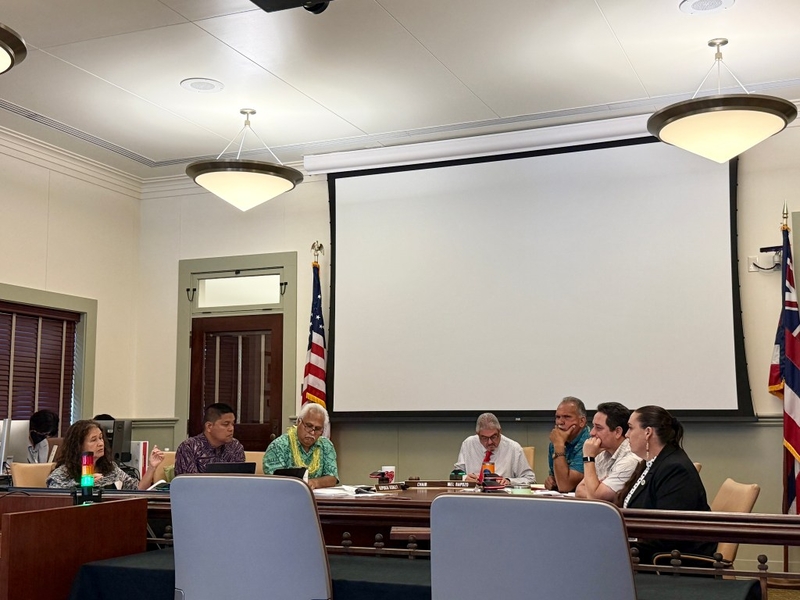
Kaua‘i County Council members announced during last Wednesday’s meeting that they had received 172 letters of testimony on a resolution that encourages the administration to pursue curbside recycling. The public, however, was left in the dark about what was said in those letters, which usually include individuals, companies and groups advocating for or against proposed legislation and the reasons behind their positions.
This is the only county council in the state that does not post written testimony online, and instead requires citizens to submit records requests to view them. The councils for Honolulu, Maui and Hawai‘i counties, as well as the Legislature, routinely post thousands of pages of written testimony on their websites.
Government transparency advocates Camron Hurt, Hawai‘i state director for Common Cause, and Douglas Meller, a volunteer with the League of Women Voters of Hawai‘i, said written testimony should be easily accessible to the public.
“It should be absolutely available,” Hurt said, "and there is no credible reason why it’s not."
Written testimony, he said, can help community members see how much the public is engaging with an issue before a council meeting and shows who is interested in the issue. Sometimes, that testimony can show that interest is coming from lobbyists or special interest groups outside Hawaiʻi.
Being able to see written testimony ahead of a council meeting can improve public discourse, Meller said, by helping those testifying at the meetings respond to earlier public comments.
Jennifer Brooks, staff attorney with the state Office of Information Practices, said Kaua‘i’s practices “raises some questions.” The office renders opinions on matters related to the Sunshine Law, the state's open meetings law, and Uniform Information Practices Act, the public records law, through an appeals process.
She said that if an appeal were to come in about the Kaua‘i County Council’s practices, the office would want to look at whether the testimony is being distributed to council members before the meeting, rather than at the meeting. If that’s the case, testimony would likely be considered part of the council’s board packet.
Under Hawai‘i Revised Statute 92-7.5, board packets consist of meeting-related documents that are distributed to board members before a meeting. Such packets must be distributed to board members and made publicly available in the board’s office. Boards are also required to accommodate requests for electronic access to the packets and post the board packet on its website as soon as practical.
Kaua‘i County Council agendas and related materials — collectively considered their agenda packets — are posted on its website six days before each meeting. Those notices tell citizens to send written testimony to [email protected] or deliver them to the Council Services Division office.
“It’s possible the answer would be, 'Oh they don’t distribute it until the meeting itself so it’s not technically part of the board packet at all,'” Brooks said.
She added that while board packets must be distributed to members and made public at least three full business days before a meeting, there’s no such state-mandated deadline for testimony.
Council Chair Mel Rapozo deferred comment to the county clerk, and declined to respond to follow-up questions.
Lyndon Yoshioka, the county’s deputy clerk, said written testimony submitted electronically is automatically sent to council members. Written testimony received through the mail or delivered to the division’s office are distributed to council members during each meeting.
It’s not a common practice to receive records requests for written testimony. He said it only happens two or three times a quarter and nearly all requests are fulfilled the same day.
“Online posting of public testimony is a practice the council will consider," he said, "especially as technology advances to provide workable methods of achieving this.”
Another question that OIP would ask is whether the council feels it can’t reasonably redact information in testimonies before the meeting. Under state law, documents that the board can’t reasonably finish redacting before three business days prior to a meeting are not considered to be part of board packets.
Brooks added that changes have been made to the Sunshine Law’s board packet provisions several times over the last five years, which makes things confusing for the state’s various boards, including the county councils.
The requirement to post board packets online, for example, was added in a 2024 law. A 2025 law changed the deadline for making board packets available for public inspection from two business days before a meeting to three.
“It’s not unheard of for boards to just have kind of missed a change in the law,” Brooks said.

Honolulu, HI