Judge: Laurel gas plant decision is up to Yellowstone County
Feb 05, 2024 | 5:55 pm ET
Description
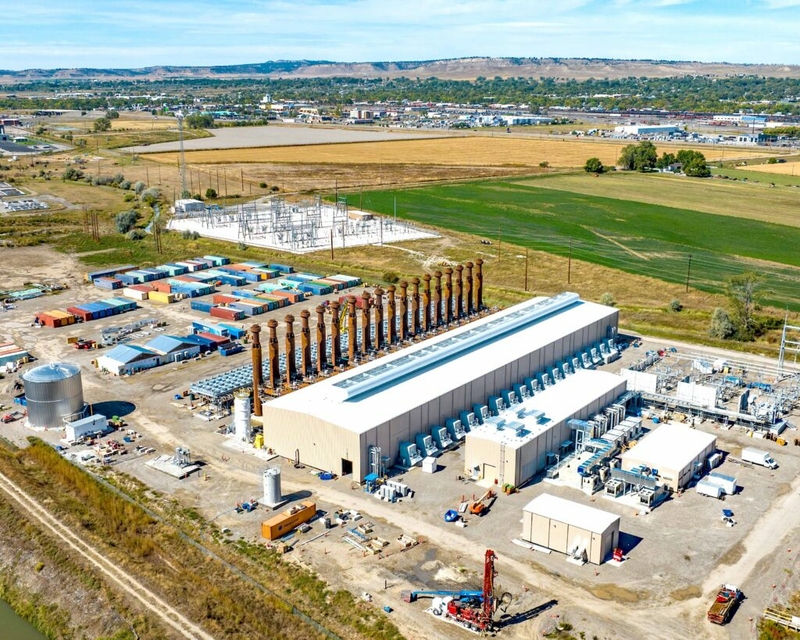
The Laurel Generation Station power plant in Laurel Montana as seen in September 2023. (Aerial photography by Ed Saunders)
In a long-running dispute about a methane-fired electricity plant being built near Laurel, a Yellowstone County district court judge has said the decision on zoning the property belongs to the county alone.
NorthWestern Energy, the state’s largest public utility, has partially constructed an 18-turbine, 175-megawatt plant within a mile of the Laurel City limits. The energy company says additional power generation is needed for the largest county in the state, which is also home to three oil refineries and a host of other industrial businesses.
Although the plant is outside city limits, jurisdiction over zoning authority in this case was in question.
Groups of residents and several other conservation organizations have fought against the plant’s permitting, arguing that officials weren’t following proper zoning laws, and the greenhouse gases emitted by the turbines would violate the state constitution’s guarantee of a “clean and healthful environment.”
The plant and its zoning have been debated for several years in a three-party dispute among the residents who live nearby, the City of Laurel and Yellowstone County. At the heart of the debate was whether Laurel or the county had the final say on zoning in the area.
On Monday, Judge Jessica T. Fehr said that the decision rests completely with Yellowstone County, and that it has repeatedly exercised its jurisdiction in the unincorporated areas and subdivisions nearby.
Laurel and the county had different interpretations of state law that were before Fehr.
Laurel had asserted that it had powers to regulate zoning on lands that were nearby — within a mile-and-a-half of city limits. The county had said that it believed it had the power to regulate the land, which is unincorporated and remains part of the county, not annexed. The issue had been winding its way through a joint city-county planning commission while the court process had played out. That commission was still in the process of making recommendations and hearing residents. The city-county planning commission is advisory, though.
Fehr said that Montana makes clear that once a county exercises zoning control or makes subdivision plans that zoning then becomes the prerogative of the county alone, and that Laurel has no say in the matter, except to make recommendations or have hearings via the joint city-county planning commission, which is non-binding.
“The City of Laurel has no jurisdictional authority over the property at issue in this matter,” Fehr said. “Any disputes regarding land uses for the property at issue in this matter are properly resolved within Yellowstone County and its jurisdictional authority, unless and until such time as Yellowstone County formally ceded is jurisdictional authority to the City of Laurel, through properly-noticed means and appropriate legal mechanisms.”
In her ruling, Fehr said that cities can exercise “extraterritorial jurisdiction” on land that’s either adjacent or nearby a city, according to state law. However, that power ends once a county has adopted zoning or subdivision regulations, which Yellowstone County has done.
“The county has retained its jurisdictional control over subdivision approvals and regulations,” Fehr said.
In a 23-page decision, Fehr also cited numerous examples of where Yellowstone County had exercised its control on zoning and subdivisions, even on some land owned by residents living on or near Thiel Road where the plant is being built.
Instead, Fehr clarified that the county still maintains control of zoning and subdivision issues, but authorizes the city-county planning board to make “planning recommendations” and hear issues related to zoning.
When contacted by the Daily Montanan on Monday, organizations representing the plaintiffs and property owners said that they were still analyzing what the ruling will mean going forward. Nearly three weeks ago, the city-county planning board ordered a work session to examine more of the issues with residents. Now, with Fehr’s ruling, it’s unclear if those work sessions will continue, or if the matter will be appealed.
Anne Hedges, with the Montana Environmental Information issued the following statement after Fehr’s ruling:
“This litigation was always intended to clarify who is responsible for rezoning the agricultural land outside of the city of Laurel. While we believe the city of Laurel has the right and obligation to determine its future growth, the court disagreed. That doesn’t change the fact that NorthWestern failed to receive approval to build a large industrial plant on agricultural land and neither the city nor county wanted to be responsible for the parcel in question. Now we have clarity – it is the County’s job to listen to the city/county planning board and determine if the zone change is in the best interest of the city of Laurel and the neighbors to the plant. NorthWestern and the County could have avoided this conflict if they had taken responsibility and requested the land be properly rezoned years ago. But NorthWestern didn’t ask and the County refused to weigh in. Now that the growth policy process is in the works we hope that the planning board does its job and listens and incorporates the community’s concerns about NorthWestern’s project and the impact it will have on those in the area that expected this land to remain agricultural.”
A spokesperson with the Northern Plains Resource Council said the group was disappointed by Fehr’s decision.
“It’s disappointing that NorthWestern Energy created this legal mess by knowingly building an industrial methane-fired plant on land zoned for agricultural use. While we disagree with the merits of this ruling, having some legal clarity over zoning issues for this area is instructive,” said Mary Fitzpatrick, a Northern Plains Resource Council member who lives in Billings. “Given this order, it is now crucial that a new growth policy is developed for the area immediately outside of Laurel that fully considers the needs and concerns of impacted Laurel and Yellowstone County residents. Public participation standards must be met so that we can have a meaningful say in whether this community wants NorthWestern’s project and the hundreds of tons of dangerous pollution it would emit each year.”
Helena, MT