Ferguson opens the door to redistricting, slightly, in wake of Supreme Court ruling
May 22, 2026 | 6:07 pm ET
Description
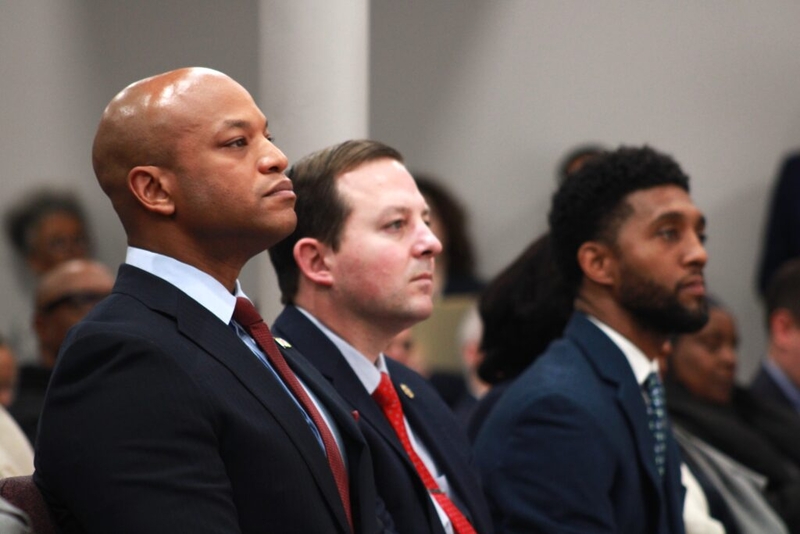
Gov. Wes Moore (D), Senate President Bill Ferguson (D-Baltimore City) and Baltimore Mayor Brandon Scott (D), from left, at a 2024 news conference. Moore and Ferguson have butted heads over redistricting this year, but Ferguson said Friday he is reconsidering the issue. (File photo by Danielle J. Brown/Maryland Matters)
Saying “the rules have changed” since the U.S. Supreme Court last month “gutted the Voting Rights Act,” Maryland Senate President Bill Ferguson (D-Baltimore City) said Friday he’s talking with Democratic senators about calling a special session to address the state’s congressional district map.
The comments, first reported by WYPR, represent a stark change for Ferguson, who stood in the way of two House-passed plans to redraw the state’s congressional maps during this year’s legislative session. Those bills were pushed in response to redistricting by Republican states angling for partisan advantage ahead of this fall’s elections.
Ferguson said at the time that he feared reopening the redistricting process now could lead to a court fight that might ultimately cost Maryland Democrats one of the seven U.S. House seats they currently hold, out of Maryland’s total of eight.
That changed April 29, when the Supreme Court ruled in Louisiana v. Callais that congressional districts drawn to consider race of the voters were unconstitutional gerrymandering. In the days following, “Southern legislatures are already using that ruling to wipe out minority districts,” Ferguson said.
Trump, US House speaker prod GOP states to redistrict after voting rights ruling
“Maryland must respond as the ground shifts under us,” Ferguson said in a statement released by his office Friday afternoon. “I’m in active conversations with my caucus about a special session and constitutional amendment to address the 2022 Maryland court redistricting decision and new U.S. Supreme Court VRA [Voting Rights Act] decision, with the aim of putting this before Maryland voters in November.”
What Ferguson is likely talking about is asking voters to approve a constitutional amendment that would take effect for the 2028 elections.
Gov. Wes Moore (D) welcomed Ferguson’s new stance, but said Maryland needs “to be able to move aggressively on it.” He said he would like to see any special session include the map presented last year by a special Redistricting Advisory Committee, and approved this spring by the House, that was expected to give Democrats an 8-0 sweep of the state’s congressional districts.
Ferguson snuffed the House bill by sending it to the Senate Rules Committee, where it was never brought up for a vote.
“I think they were watching our democracy being robbed in front of our faces, and I think Maryland needs to be able to respond,” Moore told Maryland Matters during a stop Friday in Western Maryland. “So I’m glad to hear the Senate president is willing to have a conversation about it.
“I think it needs to include the maps, because I think that … if we are going to be serious about responding in this moment, then I think we need to take seriously the fact that the RAC [Redistricting Advisory Committee] did a bunch of work, and then I’m looking forward to next steps,” Moore said.
The calendar could well work against Moore’s plan. Maryland’s primary elections are June 23, just a month away, and lawmakers would barely have a month after that to approve a constitutional amendment, vet the language and get it to the printer in time to get mail-in ballots out for the Nov. 3 general election.
Changing district maps now could also mean rescheduling the primaries, or holding a second round, not to mention the administrative hurdles of getting ballots printed and distributed and potential legal challenges. But Moore was undaunted, pointing to Republican-led states that have upended their processes in order to shove through redrawn maps.
Moore said he would like to keep his options open.
“We are watching how states around the country are blowing up their entire process to rig the rules. We are watching how a president of the United States is trying everything in his power to be able to alter the way the November elections are going to work, and then beyond,” Moore said in Westernport.
“And so I think that we need to get together and we need to take this moment seriously. And I think all the options should be on the table,” he said.
Ferguson said he is still talking to his caucus, but that he expects they will “meet after the primary to prepare.”
In his WYPR interview, he said he does not want a repeat of what happened in Virginia “when they tried to go too fast and skip steps.” Democrats in the commonwealth were able to put a redrawn congressional map on this spring’s ballot and voters approved it by a comfortable margin, but it was overturned by the Virginia Supreme Court two weeks ago, and the U.S. Supreme Court last week declined to hear the case.
“We must do this right, without risking what we have already won,” Ferguson said.
Annapolis, MD