As litigation continues, 21 candidates qualify for August Alabama congressional primaries
May 22, 2026 | 7:33 pm ET
Description
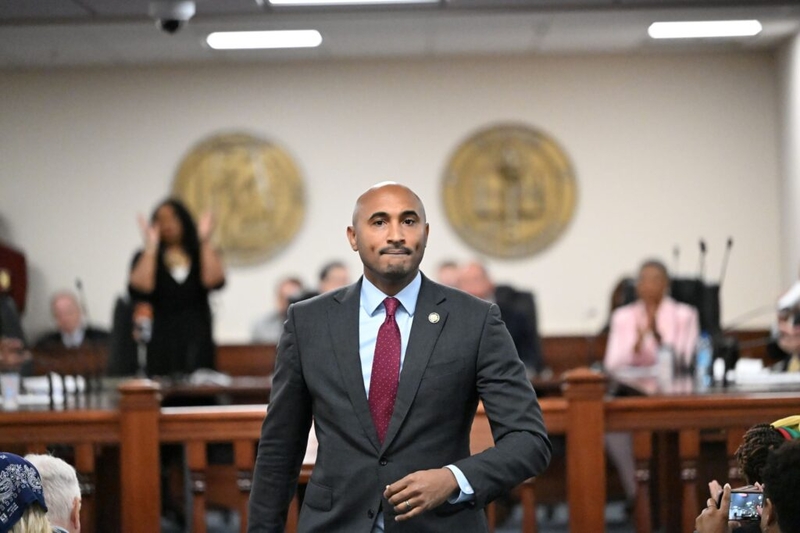
U.S. Rep. Shomari Figures, D-Mobile, leaves the lectern after speaking to an Alabama Senate committee on May 7, 2026 at the Alabama Statehouse in Montgomery, The congressman is one of 21 candidates who have qualified to run in a special primary election in August for Alabama's 1st, 2nd, 6th and 7th Congressional Districts. (Brian Lyman/Alabama Reflector)
At least 21 people have qualified to run in special primary elections on Aug. 11 for Alabama’s 1st, 2nd, 6th and 7th congressional districts, even as litigation challenging the district lines continues.
Fourteen Republicans and seven Democrats will run in the four districts. U.S. Reps. Terri Sewell, D-Birmingham, who represents the 7th Congressional District; Shomari Figures, D-Mobile, who represents the 2nd and Gary Palmer, R-Hoover, who represents the 6th, are the only incumbents in the special primary.
There are four Republicans running in the 1st Congressional District, six Republicans running in the 2nd Congressional District, and two Republicans running in the 6th and 7th Congressional Districts.
Only one Democrat will be on the ballot in the 1st, 2nd and 7th Congressional Districts. Congressional District 6 has four Democrats running for the nomination.
Gov. Kay Ivey set the elections last week after the Supreme Court overturned a 2023 ruling that blocked the state from using a legislatively-drawn map the court previously ruled as a racial gerrymander. In April, the nation’s high court ruled in Louisiana v. Callais that plaintiffs challenging legislative maps as racially discriminatory under Section 2 of the Voting Rights Act had to prove intent to discriminate, a significantly higher standard that effectively weakens the law.
Plaintiffs in Allen v. Milligan, the federal case that led to the 2023 map being tossed, are seeking to stop the state from reverting to the 2023 map, arguing that it still violates the Voting Rights Act, even under the new standard. Primaries took place in the affected districts on Tuesday. If the court deems the 2023 map lawful, Alabama Secretary of State Wes Allen said in a May 13 press conference votes in the affected congressional districts would be invalidated ahead of the August primaries.
Reverting to the older map will likely put Figures’ re-election in jeopardy. Voting in Alabama is racially polarized; white Alabamians tend to support Republicans and Black Alabamians tend to support Democrats. Should the state revert to the prior voting boundaries, the Black Voting Age Population (BVAP) in the 2nd Congressional District will drop from about 49% to under 40%, making it significantly harder for Democrats to win.
Tabitha Isner, vice chair of the Alabama Democratic Party, said in an interview Friday that the process of this special election has been causing confusion but has motivated some to go out and vote.
While statewide voter turnout for Tuesday’s primaries was only 23%, Democratic counties including Jefferson, Montgomery and Greene counties saw an increase in voter turnout during the May 19 primary. Republican leaning areas such as Baldwin, Shelby and Cullman counties all saw decreased voter turnout for Tuesday’s election.
“All of this is extremely confusing for voters, and it has reminded voters that the desire for political power can result in actions that are not in the best interests of the people, and I’m happy to see that that has motivated a lot of voters to become more interested in the process than they were previously, but I still wish we had avoided all of this,” Isner said.
Sewell has no Democratic primary challengers. Two Republicans — Ammie Akin and David Perry — running for her seat. Changing the map would reduce the BVAP in her district from 52% to 50.6%. Isner said she thinks Sewell will be re-elected.
“Her district is not likely to change in a significant enough way to threaten her ability to hold on to it,” Isner said.
Rep. Scott Stadthagen, R-Hartselle, the chair of the Alabama Republican Party, was unavailable for an interview.
There are at least five candidates, four Republicans and one Democrat, running to represent Alabama’s 1st Congressional District. The seat was left open after U.S. Rep. Barry Moore, R-Enterprise, announced he was running for U.S. Senate. Lucas Burger, Jerry Carl, John Mills and Austin Sidwell.
Carl served as a U.S. Rep. from 2021 until 2025 when he was defeated by Moore for the seat.
The race for Alabama’s 2nd Congressional District is also crowded. There are six Republicans qualified to run for the seat currently held by Figures. Figures qualified to defend his seat in the 2nd Congressional District under the Legislature-approved map during the final hour of qualifying.
“After careful deliberation, we decided to run in the district that includes the majority of the counties I currently represent, and that provides the best opportunity to continue representing the people of Alabama,” Figures said in a statement Friday afternoon.
Among those running is Alabama Rep. Rhett Marques, R-Enterprise.
Attempts to reach Marques weren’t immediately successful. Marques, who originally ran in the state’s 1st Congressional District, said in a social media post on May 11 that he would be running for the 2nd Congressional District following the Supreme Court’s ruling.
“Under the new maps, I am a candidate in District 2, and I am running hard to be the next Congressman from this district to deliver President Trump’s agenda by supporting Senator Britt and the rest of the Alabama delegation in making life more affordable for hardworking Alabama families and fighting tirelessly for our Christian conservative values,” the post said.
Other Republican candidates running for the seat include Hampton Harris, Christian Horn, David Matthews, Joshua McKee and James Richardson.
Case Dixon, a physical therapist, is the only Republican candidate who qualified to face Palmer in Alabama’s 6th Congressional District. Democrats Jacob Bouma-Sims, Ashtyn Kennedy, Maurice Mercer and Keith Pilkington all qualified to represent the seat.
“Gary Palmer is someone that we are eager to replace, and recent primary election results show that there is an opportunity in District 6 if we are willing and able to capitalize on it, so I’m excited that there are lots of folks seeing that possibility and wanting to contribute to making a difference,” Isner said.
Montgomery