Judge blocks new HUD funding restrictions for Housing First initiatives
Dec 19, 2025 | 3:41 pm ET
Description
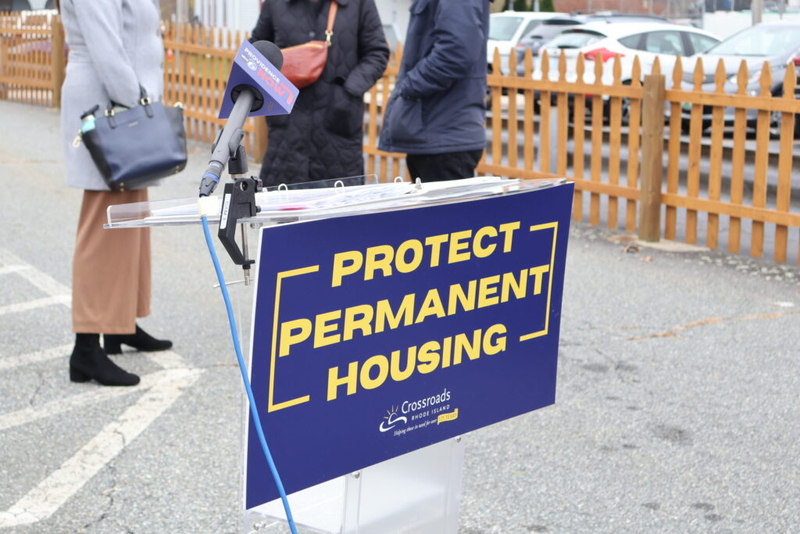
The Trump administration suddenly withdrew its federal policy change reducing funding for permanent supportive housing on Friday, Dec. 8, 2025. (Photo by Nadia Engenheiro, Half Street Group)
A U.S. Department of Justice attorney informed a federal Rhode Island judge Friday morning that the Trump administration intends to issue a new funding notice for homeless support services before the end of the business day.
That news posed a potential obstacle for Judge Mary S. McElroy, who was considering a request to block the U.S. Department of Housing and Urban Development (HUD) from revamping funding priorities for its Continuum of Care grant program.
A group of democratic-led states, along with another coalition of communities and homeless care providers, sought a preliminary injunction after HUD issued a Nov. 13 Notice of Funding Opportunity (NOFO) that would have capped how much of the $3.9 billion grant program could be used for permanent supportive housing at 30%.
HUD has previously directed approximately 90% of Continuum of Care funding to support permanent supportive units as part of its “Housing First” philosophy, according to the lawsuit from the coalition of states.
“Why today by the close of business?” McElroy asked John Bailey, a U.S. Department of Justice attorney representing HUD, during the roughly 90-minute virtual hearing that began at 10 a.m. “The timing seems to be strategic.”
But after a five-minute recess, the first-term Trump appointee ruled to temporarily block the now withdrawn notice of funding opportunity for federal fiscal 2025 grants, noting the harm a lack of action could inflict. HUD withdrew the contested notice on Dec. 8, an hour before McElroy’s first hearing on the lawsuits.
“The withdrawal of the operative NOFO and the delayed and conditional replacement guarantee funding gaps,” she said. “And we don’t know what the agency intends to do.”
Previously, HUD embraced the “Housing First” philosophy, which prioritizes getting people quickly into safe, stable housing ahead of other treatment and enforcement with no preconditions. Instead, the Trump administration wants the majority of grant funding to go toward transitional housing with work requirements.
A coalition of states co-led by Rhode Island Attorney General Peter Neronha filed suit over HUD’s latest funding notice on Nov. 25. On Dec. 1, a group of cities and nonprofits led by the National Alliance to End Homelessness and the National Low Income Housing Coalition filed a separate 85-page lawsuit. The coalition includes Crossroads Rhode Island and Youth Pride as well as the County of Santa Clara, California, Washington’s King County, and the cities of San Francisco, Boston and Cambridge, Massachusetts, Nashville, and Tucson, Arizona.
Plaintiffs argue the Trump administration violated the Administrative Procedure Act by rescinding the initial two-year grant notice and crafting a new set of rules many care providers argue will leave 170,000 Americans homeless, including about 1,000 in Rhode Islanders.
Bailey argued Friday that the agency has the broad authority to make changes in order to comply with the president’s executive orders.
“The government is acting reasonably,” Bailey said.
McElroy contested that the directive is a policy change, which would require an act of Congress or more formal rulemaking as set in the Administrative Procedure Act.
“HUD can’t decide tomorrow that it doesn’t want to house homeless people,” she said. “There are parameters set forth by Congress — that’s sort of how our system works. And you have to follow them just like I do.”
Attorneys for the Trump administration argued the joint cases were moot now that HUD has withdrawn the funding notice.
Kristin Bateman, an attorney representing local communities and nonprofits and a senior counsel with Democracy Forward, argued that withdrawal still left a critical funding gap for homeless services starting early next year. Most federal fiscal 2024 grants start to expire in January.
“This is causing serious, serious harm to plaintiffs and their ability to carry out their missions” she said. “Individuals, families with children, veterans, victims of domestic violence are going to lose their housing in the middle of winter.”
Rhode Island’s network of care providers is spared from that early funding lapse.
Sarah Saint Laurent, coordinator for the state’s Continuum of Care, told Rhode Island Current that the earliest contract tied to the federal fiscal 2024 grants ends in March.
HUD can't decide tomorrow that it doesn’t want to house homeless people. There are parameters set forth by Congress — that’s sort of how our system works. And you have to follow them just like I do.
McElroy said the preliminary injunction will remain in effect until a “lawful” funding notice goes out. While the wait for a new funding notice continues, the coalition of cities and nonprofits issued a statement doubting there will be any change.
“The Trump-Vance administration has suggested it would double-down on its unlawful and unreasonable effort to kick people out of housing and back into homelessness with a new policy shift,” the coalition stated. “We will continue to pursue this case and remain dedicated to protecting proven solutions to homelessness and the hundreds of thousands of people who rely on this housing support.”
HUD says reforms overdue
The Housing First philosophy is not without its critics. Pallet, the Washington state-based company that built ECHO Village, Rhode Island’s first community of tiny temporary shelters in Providence, published a recent blog post suggesting that HUD’s overhaul could bring more accountability in ensuring the formerly unhoused get help beyond just a place to live.
Amy King, Pallet’s CEO, told Rhode Island Current Friday she understands providers’ frustrations over the administration’s overhaul, but noted not all organizations properly use grant funds.
“We have to figure out a good way to supplement and support good service providers and put the bad ones out of business,” she said. “And there’s a lot of them — the homeless industrial complex is real.”
A 2021 Harvard University study found that while most people in permanent supportive housing remained housed in the first year, retention dropped sharply over time — with only about 12% still housed after 10 years.
HUD has promised to craft a new notice with potential “technical corrections” a department spokesperson told Rhode Island Current in an emailed statement, adding that the agency stands by its initial changes.
“The department remains fully committed to making long overdue reforms to its homelessness assistance programs,” the spokesperson said.

Providence, RI