Iowa State University researcher to track how menopause stages affect the brain
May 25, 2026 | 2:00 pm ET
Description
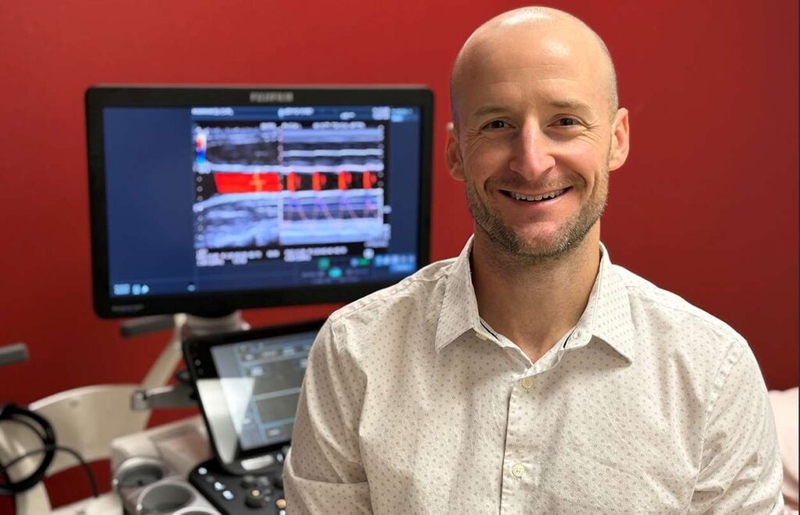
Iowa State University assistant professor of kinesiology and health Wesley Lefferts has launched a study into how the stages of menopause impact the vascular system in the brain. (Photo courtesy of Iowa State University)
An Iowa State University professor is leading the charge to better detail the changes to brain health women see as they go through the different stages of menopause.
Wesley Lefferts, ISU assistant professor of kinesiology and health, is the principal investigator of “BRAin & VAscular health across menopause,” also known as the BRAVA study. As the study works to connect with women going through pre-, peri- and post-menopausal stages, Lefferts said more and more attention is being paid to the less-outward side of changes brought about by menopause.
“There’s been a lot of scientific statements coming up in the American Heart Association, and things like that, as well as some focus groups and panels at NIH, all regarding improving health outcomes across the menopause transition and understanding the true implications of that,” Lefferts said. “So I think it is an area that we’re going to be able to make some large advances in and hopefully capitalize on the momentum that we have at the moment.”
Both organizations Lefferts mentioned are funding his research, with a three-year, nearly $300,000 grant from the American Heart Association and a two-year, $405,000 grant from the National Institutes of Health’s National Institute on Aging. Both grants were awarded in July and August 2025, respectively.
The National Institute on Aging describes menopause as “the stage of a woman’s life when her menstrual periods stop permanently, and she can no longer get pregnant,” with perimenopause — the transition into menopause — and menopause introducing symptoms like hot flashes, trouble sleeping, joint and muscle discomfort, changes in mood and concentration.
When symptoms begin and how long they last can vary greatly from person to person, and the National Institute on Aging stated online menopause can change someone’s bone density, heart health and physical function. Those who have gone through menopause are more likely to have a stroke or develop a heart disease or osteoporosis.
Lefferts has been gathering data “across the aging lifespan” since his time earning his Ph.D., he said, from people ages 18 to 85. He noticed in studying age-related changes in brain blood flow patterns that the arteries in women’s brains are less protected from blood flow patterns that can cause damage to the brain.
After observing this, Lefferts said he worked to get more data from middle-aged men and women and revisited his study later. He found that around 50 years old — the median age for menopause — there is a “nonlinear increase” in “how kind of discontinuous the blood flow is within the brain in women.”
“That observation, coupled with some of the other vascular health metrics that I had access to within that data set, really suggested that right around that menopause transition, there’s some things going on with the vasculature that may be altering blood flow patterns in the brain and contributing to why men and women’s brains age differently,” Lefferts said.
Much is not known about cardiovascular effects and their impact on the brain during the perimenopausal stage, Lefferts said, partly because it is a period when there is a lot of variability of symptoms. He argued that perimenopause is probably the most important part of the menopause process to study since it is what transitions people from pre- to post-menopausal states.
The goal is to enroll close to 370 people in the study, which Lefferts said will start with online questionnaires. Participants still experiencing a menstrual cycle will track their cycle to ensure study when their estrogen is high, and the team will measure heart functions, cerebrovascular health, blood pressure, sex hormones and cognitive functions at an assessment later on.
Subjects will also bring a fitness bracelet home to track sleep and physical activity, Lefferts said, and the study will also factor in lifestyle behaviors, medications and other things that could impact the menopausal transition.
While grant funding will only support a cross-sectional look at this topic, with a singular visit from study participants, Lefferts said he hopes to find the funding to track subjects over time and create a longitudinal study.
“We’re going to have access to a lot of data that, if we can look at this longitudinally and identify what behaviors or medications might be critical to helping slow down that aging process throughout the menopause transition, that would potentially improve the brain aging trajectories,” Lefferts said.
Des Moines, IA