Board of Regents ‘leaning in’ to AI while planning to regulate its use at South Dakota universities
May 23, 2026 | 8:30 am ET

Description
South Dakota Board of Regents member Jeff Partridge participates in a meeting in December 2023 at Brookings. (Makenzie Huber/South Dakota Searchlight)
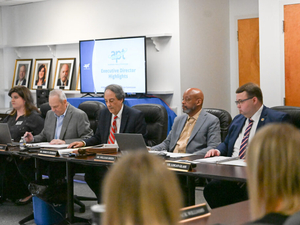
South Dakota universities are “leaning in” to artificial intelligence, state Board of Regents President Jeff Partridge said at a Wednesday meeting in Custer.
The system that oversees the state’s public universities plans to formulate regulations for AI use throughout 2026 and 2027, focusing on how the technology should be governed; how to teach students, faculty and staff to use it; and how to implement it into curriculum and research.
Board members said the plan will help prepare students to use AI ethically and effectively once they graduate.
“We want to lead in this area with our students,” Partridge said. “We’re excited for them to be career-ready, AI prepared and technology prepared.”
South Dakota public university tuition rising at least 2.4%, with some steeper hikes
Starting this summer, the Board of Regents plans to implement a “systemwide strategy” to use AI, spokeswoman Shuree Mortenson said in an emailed statement.
The board’s information technology team will work with a committee to select “a systemwide technology solution to be implemented and utilized across the system,” according to the document presented on Wednesday.
AI is already being used at the campus level within the system, Mortenson added. South Dakota State University launched an AI center this spring. President Barry Dunn said during a town hall last month that different approaches to AI use by universities could create educational disparities in the state.
The systemwide strategy isn’t about “taking over” the work that specific schools have done, Mortenson said, but rather “making it work together better over time.”
“As part of this plan, the system will look at where using shared tools or solutions would be a good idea, especially when there are advantages in terms of how much it costs, how secure it is, or how consistent it is,” Mortenson said.
The system plans to build the underlying infrastructure this summer — such as security, data management and design — and roll out tools to users in the fall. No final decisions have been made, Mortenson said.
The plan also calls for a pilot program this fall using “agentic AI” — technology that can act independently, such as with scheduling and processing forms — to reduce administrative workload.
Rules governing AI use across the system — covering data privacy, ethical guardrails and alignment with the university system’s mission — will be recommended to the board by its October meeting.
Each campus will use its existing teaching support center to train faculty on using AI in the classroom and handling students’ AI use in coursework. AI is expected to be integrated into curriculum by fall 2027, based on recommendations from the system’s academic affairs council at the Board’s December meeting.
Board members acknowledged hesitancy among faculty and students. No one spoke against the plan at the meeting, though Partridge acknowledged the use of AI “in some areas” makes board members “uncomfortable” as well.
“You just kind of want to do it right and you want to be very engaged, but at the same time we’re moving forward,” Partridge said.

Pierre, SD