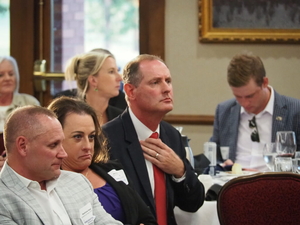
On a Thursday morning last May, about a hundred people gathered in the atrium of the Ohio Capitol building to join in Christian worship. The “Prayer at the Statehouse” was organized by an advocacy group called the Center for Christian Virtue, whose growing influence was symbolized by its new headquarters, directly across from the capitol. It was also manifest in the officials who came to take part in the event: three state legislators and the ambitious then-lieutenant governor, Jon Husted.
After some prayer and singing, the center’s Christian Engagement Ambassador introduced Husted, asking him to “share with us about faith and intersecting faith with government.” Husted, a youthful 57-year-old, spoke intently about the prayer meetings that he leads in the governor’s office each month. “We bring appointed officials and elected officials together to talk about our faith in our work, in our service, and how it can strengthen us and make us better,” he said. The power of prayer, Husted suggested, could even supply political victories: “When we do that, great things happen — like advancing school choice so that every child in Ohio has a chance to go to the school of their choice.” The audience started applauding before he finished his sentence.
The center had played a key role in bringing about one of the most dramatic expansions of private school vouchers in the country, making it possible for all Ohio families — even the richest among them — to receive public money to pay for their children’s tuition. In the mid-1990s, Ohio became the second state to offer vouchers, but in those days they were available only in Cleveland and were billed as a way for disadvantaged children to escape struggling schools. Now the benefits extend to more than 150,000 students across the state, costing taxpayers nearly $1 billion, the vast majority of which goes to the Catholic and evangelical institutions that dominate the private school landscape there.
What happened in Ohio was a stark illustration of a development that has often gone unnoticed, perhaps because it is largely taking place away from blue state media hubs. In the past few years, school vouchers have become universal in a dozen states, including Florida, Arizona and North Carolina. Proponents are pushing to add Texas, Pennsylvania, Tennessee and others — and, with Donald Trump returning to the White House, they will likely have federal support.
The risks of universal vouchers are quickly coming to light. An initiative that was promoted for years as a civil rights cause — helping poor kids in troubled schools — is threatening to become a nationwide money grab. Many private schools are raising tuition rates to take advantage of the new funding, and new schools are being founded to capitalize on it. With private schools urging all their students’ families to apply , the money is flowing mostly to parents who are already able to afford tuition and to kids who are already enrolled in private schools. When vouchers do draw students away from public districts, they threaten to exacerbate declining enrollment, forcing underpopulated schools to close . More immediately, the cost of the programs is soaring, putting pressure on public school finances even as private schools prosper. In Arizona, voucher expenditures are hundreds of millions of dollars more than predicted, leaving an enormous shortfall in the state budget . States that provide funds to families for homeschooling or education-related expenses are contending with reports that the money is being used to cover such unusual purchases as kayaks, video game consoles and horseback-riding lessons.
The voucher movement has been aided by a handful of billionaire advocates; it was also enabled, during the pandemic, by the backlash to extended school closures. (Private schools often reopened considerably faster than public schools.) Yet much of the public, even in conservative states, remains ambivalent about vouchers: Voters in Nebraska and Kentucky just rejected them in ballot referendums .
How, then, has the movement managed to triumph? The campaign in Ohio provides an object lesson — a model that voucher advocates have deployed elsewhere. Its details are recorded in a trove of private correspondence, much of it previously unpublished, that the movement’s leaders in Ohio sent to one another. The letters reveal a strategy to start with targeted programs that placed needy kids in parochial schools, then fight to expand the benefits to far richer families — a decadeslong effort by a network of politicians, church officials and activists, all united by a conviction that the separation of church and state is illegitimate. As one of the movement’s progenitors put it, “Government does a lousy job of substituting for religion.”
In the early 1990s, Ohio’s Catholic bishops faced a problem. For more than a century, religious education had been deeply entrenched in the state; in Cleveland, the parochial system was one of the largest in the country. For decades, though, the Church’s urban schools had been losing students to suburban flight. To keep up enrollment, many were admitting more Black students, often from non-Catholic families. But these families typically could not afford to pay much, which put a strain on church budgets.
Catholic leaders elsewhere faced the same challenge, but Ohio’s bishops had an advantage. The new Republican governor, George Voinovich, was a devout Catholic who went to Mass multiple times a week, an expression of a faith that was inherited from his Slovenian American mother and deepened by the loss of his 9-year-old daughter, who was struck by a van that ran a red light. An unpretentious Midwesterner who loved fishing in Lake Erie, Voinovich had worked his way up from state legislator to mayor of Cleveland before becoming governor in 1991.
In office, Voinovich corresponded frequently with the state’s most prominent bishops, in Cleveland, Columbus and Cincinnati. Their letters, which are collected in Voinovich’s papers at Ohio University, show a close and collaborative relationship. The bishops wrote to thank Voinovich for the regular donations that he and his wife made to the church, which ranged as high as $2,000. They traded get-well wishes and condolence notes. “The last two times I’ve seen you you looked a little tired,” Voinovich once wrote to Anthony Pilla, the bishop of Cleveland. “Please take care of yourself.”
Most of all, they strategized about increasing state funding for Catholic schools. As a legislator, Voinovich had worked to launch a set of programs that helped private schools pay for administration, special education, transportation and other services. His support for these expenditures, which by the early ’90s amounted to more than $100 million, stood in contrast with his aggressive efforts to cut the rest of the budget. At one point, he banned peanuts and other snacks from official state flights. Legislators passed around a story about seeing him pluck a penny out of a urinal.
But Voinovich saw spending on parochial schools as fundamentally different, driven by his belief in the value of a Catholic upbringing. “If we could reconstitute the family and get everyone into Church, about 60% of the problems we are confronted with would go away,” he wrote to James Griffin, the bishop of Columbus. “I can assure you that the money you spend to deal with all the problems confronting the community is much better spent than the way government would spend it.”
Soon after Voinovich became governor, he and the bishops began discussing another way to fund Catholic schools: vouchers. The notion of publicly funded subsidies for private schools wasn’t totally new. After courts ordered school integration in the South, in the 1950s, some municipalities helped finance “segregation academies ” for white students. At around the same time, the economist Milton Friedman argued that education should be subject to market forces, in part by paying parents to send their children to a school of their choosing. But no city or state had funded a true voucher initiative.
For the state government, there was an obvious risk to funding Catholic schools; the Ohio Constitution says that “no preference shall be given, by law, to any religious society.” Voinovich and his aides worried not only about political repercussions but also about the potential for legal challenges from groups like the ACLU. In April 1991, Voinovich intimated to Pilla that he was recruiting proxies who could obscure their alliance. “We are quietly lining up ‘heavy hitters’ in the business community and are trying to identify someone in the legislature who would be willing to become our advocate,” he wrote.
Voinovich had an ideal partner in David Brennan, a well-connected local businessman. A towering presence at 6-feet-5 (not counting his customary cowboy hat), Brennan had attended Catholic school in Akron before earning degrees in accounting and law, and made a fortune forming corporations for doctors seeking tax benefits. When Voinovich ran for governor, Brennan was a major fundraiser for the campaign. Now he started cultivating allies, donating heavily to a Republican from the Cincinnati suburbs who was a promising sponsor of voucher legislation, as reported by the Akron Beacon Journal, which covered the early voucher push .
In May 1991, Voinovich and Brennan met to discuss creating a commission on school choice, which Brennan would chair. Soon afterward, the bishops provided 18 suggestions for possible members. Six of them ended up on the commission — with no mention of the fact that they had been selected by the church.
As word of the commission spread, it raised concerns. The following spring, an executive at Procter & Gamble, one of the state’s largest employers, urged Voinovich to couch “this sensitive issue” in a broader effort at school reform. “Vouchers on their own could lead to unnecessary divisiveness,” he wrote. The head of the Ohio teachers’ union warned that unilateral action “could explode any chance at building a statewide consensus.” Voinovich responded that he was prepared for discord: “I am confident that whatever recommendations they come back with, it will be difficult for the Ohio Federation of Teachers to support.”
The commission was moving fast. Brennan “is doing an outstanding job,” Voinovich wrote to Pilla. “He is on a mission from God.” Voinovich and Brennan took care to disarm political objections. One briefing document argued that any plan the commission produced “must be substantially tilted in favor of low income parents and children” and must require private schools to administer the same proficiency tests as public schools. By year’s end, the commission produced its recommendation: Ohio should create a voucher pilot program.
Representative C.J. Prentiss monitored the commission’s work with foreboding. Elected to the Ohio House in 1991, Prentiss had distinguished herself as a leading defender of public education and was steeped in the struggle for school integration. Her father had belonged to the Congress of Racial Equality, and after Prentiss graduated from Cleveland’s Marshall High School — where she was one of six Black students — she attended the 1963 March on Washington. Later, she joined local battles against school segregation, during which she met Michael Charney, a white teacher and union activist who became her third husband. She taught for a while in the Cleveland suburb of Shaker Heights and served on the State Board of Education. In 1993, she and other Black officials in Cleveland condemned Voinovich’s plan. “It is difficult to see how subsidizing private schools will improve public education,” she said. “Private schools have selective entrance requirements, serve only private purposes, and are not accountable to the public.”
Brennan deflected the criticism, noting that the plan was still provisional: “We believe when the education choice bill reaches the final stages, these fine legislators will feel differently than they do today.” In fact, he and Voinovich knew that it would be tough to secure backing for a stand-alone voucher bill; school board members, teachers and administrators were already sending letters to legislators to object. In May 1994, Voinovich contacted Brennan to strategize about how to slip a voucher pilot into the next state budget. “We are going to have to crawl before we walk,” he wrote. “I believe if we can really get it underway in one or two districts during my second term, we will have accomplished more than what [has] been accomplished thus far.”
A few weeks later, Voinovich’s assistant for education policy, Tom Needles, sent him a strategy brief on a forthcoming lunch with the bishops. “The Catholic Conference will continue to maintain a low profile in terms of its formal position on voucher legislation,” Needles wrote. “At the same time, the Conference recognizes that parent organizations in each diocese will play a very active role in lobbying for its passage.” On the last day of January 1995, voucher proponents paid for six buses to carry some 300 children and parents from Cleveland to the Capitol in order to lobby legislators. As parents walked from office to office in the Statehouse, one declared, “The public schools are preparing Black children for prison, the welfare office or the graveyard. As a Black parent, that’s unacceptable.”
Prentiss and a state senator from Cleveland decided to address the throng. With the parents visibly angry, she knew better than to dismiss concerns about their children’s schooling. “There is a crisis,” she acknowledged. “The question before us is, how do we improve the public schools?”
The bishops, though, were far more organized, with efforts unfolding parish by parish across the state; a list in Voinovich’s papers records hundreds of phone calls and letters to legislators, making the case for vouchers and inviting them to visit local parish schools. Voinovich urged them to do still more. “I really need your help and would appreciate being kept informed as to what is being done so I can convey that to the leadership in both the House and Senate,” he wrote to Daniel Pilarczyk, the archbishop of Cincinnati, in February 1995. The next month, Pilarczyk responded with another list of the church’s actions, including some 20,000 letters sent to legislators.
Two weeks later, Voinovich let Pilarczyk know that the House had not only increased funding for Catholic schools but also authorized a “limited scholarship program in the City of Cleveland.” The program would start small, with several thousand vouchers worth about $2,200 apiece. Yet Voinovich recognized that it was a “significant pilot project.” At the time, the only other city that allowed private school vouchers was Milwaukee, and the initiative there had initially barred religious schools from participating. Cleveland’s program, in contrast, had been designed from the start to benefit Catholic schools.
In June, the budget won final approval. Six bishops wrote Voinovich to express their gratitude. “Everything we asked you to do was included in your budget,” they told him. “Without your leadership and gentle nudging of legislative leaders, none of this would have been possible.”
Prentiss and Charney quickly grasped the pilot’s import. “This is the beginning of the end for public education,” he told her, only half joking. Prentiss resolved to monitor the program to make sure that the money was spent as intended. After one voucher recipient, an Islamic school, was found to have housed students in unsafe buildings, she successfully sponsored a bill requiring schools that received vouchers to meet the same minimum standards as public schools.
Meanwhile, Prentiss kept pushing for public school reforms: all-day kindergarten, smaller classes, mentorships for at-risk boys. She and Charney were encouraged by test results showing that kids in public schools were performing at least as well as those with vouchers at Catholic schools.
In 1998, Voinovich was elected to the United States Senate; Needles, his aide, went to work as a lobbyist for Brennan. And the push for vouchers entered a new phase, as an aggressive generation of proponents took up a battle in the courts.
In both Ohio and Wisconsin, opponents, led by teachers’ unions, were challenging the programs on the grounds that they violated the separation of church and state. The Wisconsin Supreme Court upheld vouchers; a federal appeals court in Ohio ruled against them.
The U.S. Supreme Court took up a First Amendment challenge to vouchers, based on one of the Ohio cases, in February 2002. Robert Chanin, a lawyer for the National Education Association, told the court, “Under the Cleveland voucher program, millions of dollars in unrestricted public funds are transferred each year from the state treasury into the general coffers of sectarian private schools, and the money is used by those schools to provide an educational program in which the sectarian and the secular are interwoven.” Chanin noted that virtually all the students in the voucher program were attending religious schools, rather than secular private schools.
But Justice Sandra Day O’Connor, the likely swing vote in the case, interrupted to pick up on a point made by a state attorney who’d defended the vouchers. In evaluating Cleveland’s choice program, shouldn’t the court consider not only private schools but also other options available to students, such as public magnet schools and charter schools?
The question caught Chanin off guard. The issue was the constitutionality of private school vouchers, yet O’Connor was evoking public school options. The state pressed its advantage, with its lawyer stressing the limited scope of the pilot: “It didn’t take too much money away from the public schools, but gave enough for a limited program that is targeted to the most needy, to the poorest of the poor.”
On June 27, 2002, the Court announced that it had ruled, 5-4, in favor of the Ohio program , arguing that it was “part of a broader undertaking by the State to enhance the educational options of Cleveland’s school children.” Clint Bolick, a leading lawyer on the pro-voucher side, declared on the Supreme Court plaza, “This was the Super Bowl of school choice, and the children won.” Later, he and others gathered at the office of the Institute for Justice, a conservative organization, and toasted with Dom Pérignon.
Protesters gathered in February 2002 when the U.S. Supreme Court heard arguments about the constitutionality of Ohio’s voucher program. (Credit: Mark Wilson/Getty Images)
Prentiss was on vacation with Charney in Washington state when she got word of the ruling. “PBS NewsHour” invited her to come to a studio in Vancouver and record a response, but she was too upset to think about what she would say on camera. “I’m not going to be the one,” she told Charney. “Let them get a lawyer.”
After the Supreme Court ruling, the momentum in seeking alternatives to traditional public schools shifted to charter schools — publicly funded institutions that are administered separately from school districts. Many Democrats had championed charters in the ’90s as a more palatable way to offer school choice, and Republicans had adopted the idea, too; Brennan, the chairman of Voinovich’s school choice commission, launched a for-profit charter school venture.
In 2005, with charters threatening to cut into parochial school enrollment, Ohio’s Catholic bishops secured a crucial expansion of vouchers beyond Cleveland: a new statewide program called EdChoice, which offered vouchers to students assigned to schools that were judged to be failing, many of them in Columbus and Cincinnati.
Prentiss stayed in the legislature until 2006, becoming the second Black woman to serve as Senate minority leader. Up until the end, she led the resistance to vouchers. As she left the legislature, though, an impassioned advocate for vouchers came in: a Republican representative named Matt Huffman.
Huffman was a lawyer from Lima, a small industrial city in western Ohio. Like Prentiss, he had grown up among activists, but with different political aims. His father, a lawyer and a county prosecutor, took a case against a local cinema that was showing “obscene” movies all the way to the U.S. Supreme Court; his mother co-founded one of the state’s first pregnancy crisis centers after abortion was legalized.
Huffman was the fifth of nine children, all of whom went to Catholic schools. This was possible, he said later, because the parish schools were so affordable in those days. But, as tuition climbed (partly to cover the salaries of lay teachers who replaced nuns), the student body skewed wealthier. “The middle class was pretty much shut out of alternatives in education,” he told the Columbus Dispatch in 2022.
One of Huffman’s brothers became the principal of a Catholic elementary school. Huffman, after following his father into law, served as a fundraiser for Lima Central Catholic High. He also got involved in local politics, rising to president of the City Council. In 2000, he endorsed a young former Ohio State wrestling coach named Jim Jordan as he ran for the state Senate. Jordan, who is now one of the most stridently conservative members of the U.S. House of Representatives, later returned the favor by backing Huffman’s campaign for the state legislature.
By this point, school choice was becoming Huffman’s overriding priority. In Lima, he participated in a standing gin rummy game with the Rev. David Ross, a local Catholic priest, and Leo Hawk, the owner of a metal-forming company, who, in Ross’ recollection, repeatedly pressed Huffman on the issue. “Leo Hawk was very influential in terms of trying to inculcate him with ‘Let the parents decide where to spend their tax dollars,’” Ross told me. “Leo was very forceful in those gatherings.” (Hawk could not be reached for comment.)
During Huffman’s first four years in the legislature, the governor was a Democrat, and the focus was on protecting existing vouchers. But after the Republican John Kasich took office, in 2011, Huffman proposed a significant expansion: making vouchers available to middle-class Ohio families, too, regardless of whether they were in a failing district. “This is starting down the path of looking at funding education in a fundamentally different way,” he said.
The proposal met with impassioned resistance. Opponents pointed to a report in the Plain Dealer that showed voucher students had performed worse than students at the public schools that they would have attended. Among the critics were public school administrators in Lima, where hundreds of students were already receiving vouchers because a few local schools were rated as failing. The exodus of students resulted in a loss of hundreds of thousands of dollars in state revenue. As Lima’s school superintendent at the time, Karel Oxley, explained to me: Even if a class lost students, the school still had to pay for their classroom and teacher. To complicate matters, the students who left tended to be motivated kids from stable families, while special-needs students stayed. This made it harder for public schools to improve their poor test scores. “You have to have your A-team to help the school be as good as possible, but the A-team moves over to the other school,” Oxley, who also served as president of the state superintendents’ association, said. “It’s almost impossible to catch up.”
Oxley is herself Catholic, and consults for a Catholic school in retirement, but she testified against vouchers at a committee hearing around this time. She recalled that Huffman was adamant. “There was nothing I could have said that would have allowed him to see that he might be stripping resources from the greater community,” she told me. “He said, ‘You pay taxes, I pay taxes. Why can’t my taxes go toward my children’s school?’ I said, ‘Because you chose that private school.’ He said, ‘That doesn’t make sense, Karel. My taxes should pay for my child’s education.’” (Huffman did not respond to requests for comment.)
Huffman settled for a partial victory: In 2013, the state allowed EdChoice vouchers for families with incomes up to twice the poverty line in any district. It was a step forward, but Huffman wanted the program to be available to wealthier families, and it would take another ally to help him realize his full ambition.
Phil Burress was always candid about what had brought him to Citizens for Community Values: He was a former pornography addict. Burress had fought the addiction from the age of 14, until he finally swore it off, at 38. “I became a Christian that day,” he told me. From then on, he said, he was a “better father and husband” and “started speaking out about things that are wrong.” His background gave him insight into the enemy. “You have to look at your communities through the eyes of a pornographer and stay ahead of them,” he once told reporters.
Burress, a former organizer with the Brotherhood of Railway and Airline Clerks, joined Citizens for Community Values in 1983. By then, the organization, which started as a Cincinnati prayer group, had devoted itself to fighting pornography and strip clubs, including various enterprises belonging to Larry Flynt, who launched his Hustler brand in Ohio. In 1990, it gained national prominence by leading the opposition to an exhibit of Robert Mapplethorpe photographs at Cincinnati’s Contemporary Arts Center. Not long afterward, Burress took over as president. “We are not some radical, right-wing, fundamental bunch of Bible-thumping nuts out there yelling and screaming,” Burress said at the time. “We do our homework.”
The group grew under Burress — by 1997, it claimed to have 25,000 supporters — and started taking on nationwide causes, such as pressuring hotels to stop offering pay-per-view porn. In 2004, it led a successful petition drive for an amendment banning same-sex marriage in Ohio, a factor in George W. Bush’s narrow win over John Kerry there. “I was thinking, No way we can get that many signatures,” Lori Viars, a conservative activist in the Cincinnati exurbs, told me. “But we ended up doing it.”
The victory attracted more funding, which the group used to hire full-time lobbyists in Columbus. Its top issues were abortion, same-sex marriage, gay rights and, increasingly, school choice. Though the members were mostly evangelical, not Catholic, they shared the conviction that the public should pay for kids to attend religious schools. Still, Burress told me, the group struggled to persuade legislators to expand voucher access. “We could not get any traction whatsoever,” he said. What changed matters was “electing the right people to office.”
In 2017, Matt Huffman arrived in the state Senate. He had served the maximum eight years in the House and, like many other Ohio legislators, simply ran for the other chamber. In the Senate, school choice remained his primary cause. That year, he sponsored a bill to expand eligibility for vouchers to families that made as much as four times the poverty level. Catholic leaders were thrilled. “I don’t think I’ve ever seen a legislator who did more for school choice,” a former employee of the Catholic Conference of Ohio, the church’s public policy arm, said. “He’s just been a rock.”
Huffman still faced resistance from public school officials, but he now had influential assistance from Citizens for Community Values. In 2016, Burress was succeeded by a new director, Aaron Baer, who signaled a more expansive mission. Baer was a 29-year-old graduate of Ohio University, a hip-hop enthusiast raised by a single parent. “This is a Christian conservative movement for the next generation,” he told the Dispatch. “We talk about poverty, human trafficking, opioids, while still talking about marriage.” The organization moved its headquarters to Columbus and gave itself a forthright new name: the Center for Christian Virtue. Burress welcomed the change. “I was glad to see them admit that without God we’re nothing,” he told me.
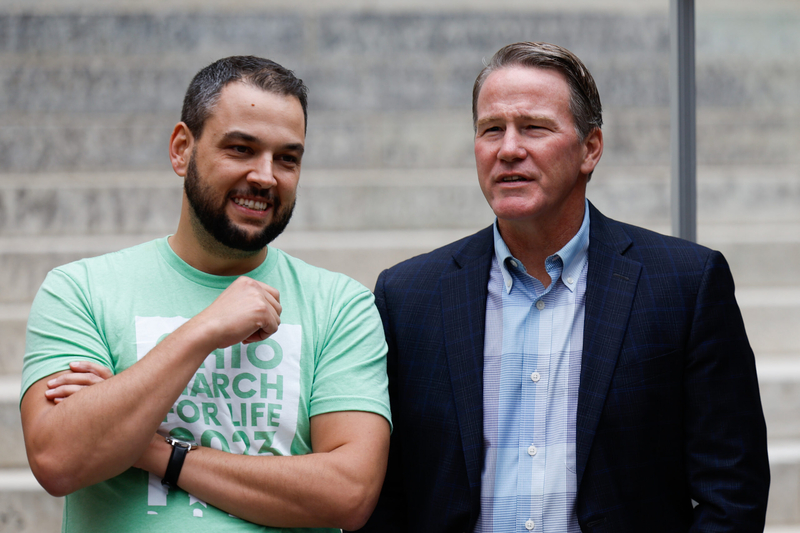
COLUMBUS, Ohio — OCTOBER 06: Aaron Baer, the president of Center for Christian Virtue (left) takes a photograph with Republican Ohio U.S. Sen. J.D. Vance and Peter Range, CEO of Ohio Right to Life at the Ohio March for Life rally against November’s Issue 1 reproductive rights amendment, October 6, 2023, outside the Statehouse in Columbus, Ohio. (Photo by Graham Stokes for Ohio Capital Journal. Republish photo only with original article.)
Baer and Huffman were unlikely allies. Huffman liked to do impersonations and had a profane streak; he was once forced to apologize for making an off-color joke at an office party. But on vouchers they were effective partners, with Baer far more willing to advocate in public than the bishops were. In the next couple of years, Baer fought to get the state to define “failing” schools as broadly as possible, and called out suburban districts, many of which opposed vouchers, when they resisted accepting students from struggling city schools.
By early 2020, Huffman was still trying to make the case for a major voucher expansion. That January, he met with a few dozen public school officials in western Ohio. Craig Kupferberg, the superintendent for Allen County, which includes Lima, told me that he’d raised his hand and asked Huffman, “Have you put anything in the bill to stop the David Dukes of the world from starting up their own private schools and having our tax dollars fund their hateful ideology?” Kupferberg recalled that Huffman had looked at him “like I was from outer space” and said, “What stops homeschooling parents from doing any of that?” (Never mind that vouchers weren’t going to homeschooling families.) Then Huffman embarked on a lengthy complaint about how many people viewed Catholicism as a cult.
Now-Ohio House Speaker Matt Huffman, R-Lima, oversees a Senate session when he was Senate president. (Photo by Graham Stokes for Ohio Capital Journal. Republish photo only with original story.)
Huffman’s proposal stalled again that term. But, two months later, the pandemic arrived and schools closed. After nearly a year, about a third of Ohio’s 609 districts still hadn’t returned to full in-person instruction. The holdouts included many of the largest districts, Cleveland and Columbus among them.
The state’s parochial schools, in contrast, had mostly reopened after a few months. The Catholic Conference of Ohio highlighted students’ educational gains in the legislature. “A lot of legislators appreciated what we did for children, because a lot of legislators were frustrated, too,” the former conference employee said. “We were sort of a beacon in the COVID era.” It helped proponents that many legislators had their own children in Catholic schools. Although Catholics account for only about 17% of the state’s population, they constitute more than half of the Senate and a third of the House.
As the pandemic wore on, school closures inspired similar outrage in other states. They “sparked a parent revolution, because families saw that school systems didn’t care about them all that much,” Corey DeAngelis, a leading voucher proponent, said on “The Megyn Kelly Show,” last May. “This is the silver lining of the pandemic.”
Many parents were alarmed by virtual instruction. It was not just that lessons conducted by Zoom seemed frustratingly inadequate; they also offered a glimpse of what their children were being taught, which in some families caused consternation over a perceived progressive agenda. Viars, the Cincinnati-area activist, noticed a surge of interest in Christian schools. “The books being pushed on these little kids were so objectionable,” she said. “It was really sexually explicit material for little kids. We heard that a lot: ‘No, these kids should not be seeing any of this.’”
In May 2021, two Republican representatives in Ohio introduced a “backpack bill,” which would give every family voucher money to spend as they saw fit: $7,500 for each high school student and $5,500 for each younger one. At a press conference announcing the bill , Baer stood beside its sponsors. “In the pandemic, we saw the need to have innovative and different learning environments,” he said. “You had some families who, because their local public schools decided not to open for in-person education, they were forced into an online environment that wasn’t ideal for them.”
The bill went a step further than Huffman had before; whereas he had pushed for vouchers for all but the wealthiest families, the backpack bill included everyone. It was a bold move, but proponents had a new advantage: earlier that year, Huffman’s Republican colleagues had elected him president of the Senate. In that role, not only was he able to push for vouchers — he could also block efforts to reform Ohio’s redistricting system, which had produced maps heavily slanted toward the GOP. By 2022, the Senate had 25 Republicans and eight Democrats; the House was split 64 to 35. “We can kind of do what we want,” Huffman told the Dispatch.
Yet Huffman and his allies decided not to advance the backpack bill through regular legislative channels, which would require stand-alone votes in both chambers. Opposition lingered, even within their own party: Some rural Republicans were conscious that there were few private schools in their districts, and so their constituents’ tax dollars would go toward vouchers used mostly by wealthy suburbanites. And, if more private schools did open in rural areas, that would drain enrollment from public schools that often served as centers of the community.
Instead, Huffman and his counterparts used a maneuver that would have been familiar to George Voinovich: they slipped an expansion of vouchers into the budget, a 1,200-page document that they sent to Gov. Mike DeWine just before the deadline. Families with incomes of up to 450% of the poverty level would qualify for full payments: $8,407 for high school students and $6,165 for younger ones. These sums came close to covering tuition at many Catholic schools, and far exceeded what many public districts received in per-capita funds from the state. Even families making more than that income threshold, which was $135,000 for a family of four, would qualify for some funding. “Every student in Ohio will be eligible for a scholarship worth at least 10% of the maximum scholarship, regardless of income,” Huffman’s office said.
More than 30 years after Voinovich and the bishops proposed vouchers as a solution for underprivileged children in a single city, public subsidies for private school tuition were now universal in Ohio, covering tens of thousands of families. “We’re going to have the money to pay for it,” Huffman said afterward. “I hope more people take advantage of that if they want to.”
C.J. Prentiss died last April at 82. She had spent her retirement with Charney in a cottage on Lake Erie, in Ashtabula County. In her final years, declining health kept her from engaging much in the battle over public education. But she did have a confrontation with Huffman when she returned to Columbus for a Senate reunion in 2022. Several speakers had been chosen for the event, and when Prentiss saw that they were all white she asked Huffman about it. According to Charney, Huffman responded that he didn’t have enough time to line up others. “Don’t lie to me,” Prentiss said, and walked away.
That same year, a coalition of school districts, now numbering more than 200 , filed suit against the voucher expansion. The suit alleged that the program exacerbated racial segregation, by essentially allowing private schools to select their own students; 90% of the new voucher recipients are white, in a state where only about two-thirds of students are. The suit also alleged that the vouchers violated two principles of the state constitution: a bar against religious control of public school funds and a promise of an adequate education for all. A judge denied the state’s motion to dismiss the case; a trial is expected in the coming months.
Among the districts that joined the suit is the one in Lima, Huffman’s home town. Virtually all the students enrolled in Catholic schools there now receive vouchers. Enrollment at these and other parochial schools has not increased dramatically; as is true across the state, they have limited capacity, so they accept only those students they prefer. This undermines the narrative that vouchers allow families to escape their public school. But public schools still suffer. Kupferberg, the superintendent, estimates that in his county the voucher expansion is costing schools millions of dollars a year. Federal pandemic relief aid has helped mitigate the damage, but that is coming to an end. “We’re starting to feel the impact,” Kupferberg said.
Meanwhile, some private schools are raising tuition, knowing that vouchers allow families to pay more. In Centerville, south of Columbus, the principal of Incarnation Catholic School told parents last year that it would no longer offer a discount for families that had multiple students enrolled there. “Our parishioner tuition rate is nowhere near the true cost to educate,” she wrote. “This increased revenue will allow us to increase teacher and staff salaries, address deferred maintenance, and hire additional staff.”
Huffman and his allies are pushing for more. Huffman (who has now moved back to the House, and was recently elected speaker) inserted funding for new construction at private schools into the last state budget, with an eye toward creating private school options in rural areas. Also on the table is legislation to create education-savings accounts for families with children in unregulated private schools that now can’t receive vouchers.
For these coming fights, the Center for Christian Virtue is stronger than ever. The organization has assembled a network of dozens of religious schools, which pay the center $5 per enrolled student, up to $3,000 per school, to lobby on their behalf. In effect, the state’s religious schools can now use some of the public money they receive to advocate for the flow of funding to increase.
Between 2020 and 2022, the center’s revenue more than tripled, to $4.2 million. It used some of the money to purchase two buildings opposite the statehouse — one previously owned by the Dispatch — for a total of $2.35 million, giving it space to accommodate a staff that has grown to 20. (The Center for Christian Virtue did not respond to a request for comment.)
In early October, the center held a policy conference, called the Essential Summit, at the Greater Columbus Convention Center. A main topic of discussion was Christian education, with sessions led by the executive director of the Center for Biblical Integration at Liberty University, the college founded by the Rev. Jerry Falwell. One session would address the question “How should we plan for teaching knowing that humans are inherently corrupt?” Another asked, “Why do Christian educators have the most dignifying approach to all humans?”
Huffman was slated to join a discussion with the president of Hillsdale College, a small Christian school in Michigan that has become a powerful incubator of conservatism. Also in attendance was Kevin Roberts, the president of the Heritage Foundation, which produced the policy blueprint for the second Trump administration. The plan, called Project 2025, includes a strong endorsement of vouchers, and Roberts’ presence was an affirmation of Ohio’s role as a model for the school choice movement. In Florida, the number of voucher recipients approached half a million this school year, up 74%. (The state distributes the same voucher — about $8,000 — regardless of income.) In Texas, Gov. Greg Abbott helped to defeat nearly a dozen anti-voucher Republicans in state legislative primaries last year. He had $10 million in campaign funding from Jeff Yass, a Pennsylvania hedge fund billionaire who has made expanding vouchers his central policy goal.
At the convention center, conference staff turned me away, even though I had paid to register. I hung around as attendees emerged from the morning session, their tote bags filled with brochures for Christian schools, investing advice and health coverage. Many of the event’s discussions were aimed at religious schools that were now supported with public funds. But, as I was about to approach Roberts, security guards blocked the path and told me to leave.