Initiative to open Oregon primaries may have stalled, but work to end election injustice continues
Jun 29, 2026 | 3:45 pm ET
Description
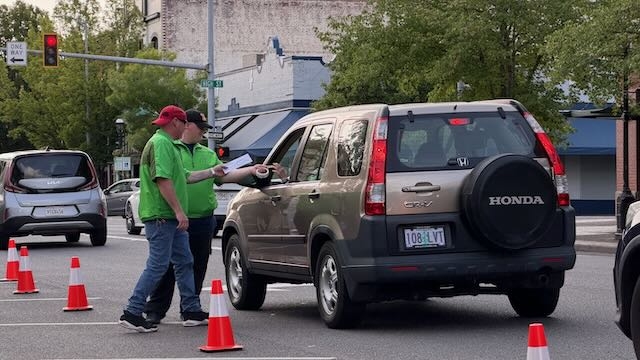
A Marion County voter turns in their ballot at a drive-thru drop site outside the county clerk's office on Tuesday, May 19, 2026. (Photo by Laura Tesler/Oregon Capital Chronicle)
Oregon’s statewide election last month exposed yet again the injustice of our partisan election system.
Injustice is a strong word. But it’s clearly an injustice to bar our largest group of voters — those who choose not to join a political party — from participating in our primary elections as candidates and voters.
Under our closed primary system, nonaffiliated voters are treated as second-class citizens when it comes to selecting members of Congress, the Legislature and our top statewide offices, including governor. They can’t become candidates for any of these offices in a primary election, nor do they have a say in who the state’s major party voters send on to the general election.
In last month’s primary election, voters who are members of the Democratic and Republican parties could write a check for $25 to become candidates for the Legislature. 99 Democrats and 97 Republicans did just that. Another 28 Democrats and 32 Republicans wrote checks for $100 or $150 and became candidates for Congress and governor. All had their names on the ballots in May’s primary election conducted at the expense of Oregon taxpayers.
Yet nonaffiliated voters, taxpayers too, had no such options. They couldn’t write checks of any amount to gain access to the primary ballot. Nor could they make use of an alternative system to qualify as candidates by collecting signatures for the primary. They faced a closed door with a No Entry sign for nonaffiliated voters interested in competing for our most important elected offices.
Then, nonaffiliated voters were shut out of voting for these offices in the May election whose Democratic and Republican winners will now receive top billing in November’s general election.
Oregon has been running elections this way for most of our lifetimes. But during our lifetimes, we’ve seen a steady decline in the proportion of voters who choose to affiliate with the Democratic and Republican parties – a trend which has accelerated in recent years. Nonaffiliated voters in Oregon now exceed 1.1 million, more than each of the major parties.
The major parties in Oregon are no longer “major.” In 1970, 98% of Oregon’s registered voters were members of the Democratic or Republican parties. Today, only 32% of registered voters in Oregon are Democrats; only 24% are Republicans.
They can’t say, as they could decades ago, that the choices their members make to put two names on the leader board in our general elections represent the choices of the voters overall. But Democratic and Republican party leaders like it this way, as their closed primaries allow them to maintain control over our election choices in spite of their diminishing numbers.
There is nothing in Oregon’s Constitution that favors this process; it’s a creation of the Legislature. But all members of the Legislature are, with rare and usually temporary exceptions, members of the major parties that benefit from this system and have little incentive to change it — unless the voters demand that they change it.
We filed an initiative last year to take to the voters a proposal to open up Oregon’s primary system. Our Voters Fairness Act would have established equal voting rights for nonaffiliated voters to select two nominees from a field of nonaffiliated, Democratic and Republican candidates for the general election ballot, while leaving minor parties free to conduct their own nominations at their own expense as they do now.
Unfortunately, our proposal became embroiled in partisan wrangling over a ballot tile that obscured its major purpose. With a misleading ballot caption and little time to collect the signatures needed to qualify for the November election, we decided to halt our effort for the 2026 ballot.
But we are going back to the drawing board. And, our goal going forward remains the same: Establish equal rights for nonaffiliated voters in all of our taxpayer-funded elections.
There are a number of ways to accomplish this. In addition to the proposal we drafted last year, we are now considering other ways to ensure all voters can participate fully and equally in taxpayer-funded elections.
We will encourage the Legislature to take up this matter in the 2027 session and, if necessary, we’ll look to the ballot again in 2028. Otherwise, Oregon will continue to conduct our elections for our most important public offices the way we did last month — unjustly excluding our largest group of voters from full participation in our democracy.
Learn more and sign up for updates at www.voterfairness.com.
Salem, OR