25 Democratic-led states sue Trump administration over Medicaid work requirements
Jun 29, 2026 | 4:56 pm ET

Description
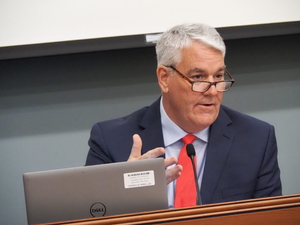
Rhode Island Democratic Attorney General Peter Neronha in Providence earlier this year. Rhode Island is one of 25 Democratic-led states plus the District of Columbia that have sued the Trump administration over its new work requirements for people who get their health insurance through Medicaid. (Photo by Christopher Shea/Rhode Island Current)
Twenty-five Democratic-led states plus the District of Columbia have sued the Trump administration over its new work requirements for people who get their health insurance through Medicaid.
At issue is a “medically frail” designation that the states say is too narrow and will make it too difficult for ill and disabled people to remain on Medicaid.
They’re challenging the administration’s guidance on who can be exempt from the work requirements included in the so-called One Big Beautiful Bill Act, the broad tax and spending measure President Donald Trump signed a year ago.
Medicaid is the publicly-funded health insurance for people with low incomes. Under the One Big Beautiful Bill Act, states that have expanded Medicaid eligibility to more adults under the Affordable Care Act — 40 states plus the District of Columbia — must require those adults to prove they’re working, going to school or serving their communities for at least 80 hours a month to receive Medicaid. Georgia, Tennessee, and Wisconsin, which have used federal waivers to expand their Medicaid programs, are also subject to the new work rules.
The new lawsuit specifically targets new federal guidance that narrows the definition of who can qualify as “medically frail,” a key exemption used to excuse Medicaid recipients from work requirements if they have serious disabilities or illnesses. The guidance came in the form of an interim final rule published this month by the U.S. Department of Health and Human Services and the Centers for Medicare and Medicaid Services (CMS).
States face tight timeline as feds unveil new Medicaid work requirement rules
The Democratic attorneys general and governors who are plaintiffs in the suit claim the feds surprised them with this new rule months after they’d already been working with CMS on how to implement the work requirements.
“This eleventh-hour attempt to further narrow protections for medically frail Medicaid recipients seeks to punish those who cannot fend for themselves,” said Rhode Island Attorney General Peter Neronha, a Democrat, in a statement.
“Further, this Administration is once again attempting to sidestep Congress by unlawfully reinterpreting the law, and coercing the states to rush to implement their last-minute changes or face penalties,” he said.
To qualify as “medically frail” and therefore exempt from work requirements, the new guidance says, a Medicaid recipient must have a significant health condition and be significantly impaired in their ability to work. It’s a distinction the states say Congress did not make in the One Big Beautiful Bill Act.
The states also claim the new guidance violates federal law by ignoring evidence that work requirements cause people to lose coverage due to red tape.
For example, Arkansas tried instituting work requirements for Medicaid recipients in 2018, during Trump’s first term. A federal judge halted the policy less than a year later, after 18,000 adults had lost coverage. Studies later found that Arkansas’ work requirements didn’t increase employment. A recent analysis from the Urban Institute projects that 3-7 million people could lose coverage because of the new work requirements.
Supporters of the new work rules say they are sufficiently flexible and that the category of who qualifies as “medically frail” remains broad.
“This rule helps Americans build skills and independence through work, education, job training, or community service, creating new opportunities for themselves and their families,” said Dr. Mehmet Oz, director for the Centers for Medicare & Medicaid Services, in a statement earlier this month announcing the new guidance.
The lawsuit says states have already invested significant resources into implementing the new work requirements based on the original law’s language and prior federal guidance. They’re staring down an August 31, 2026, deadline for notifying Medicaid recipients about changes to the “medically frail” designation, a timeline the states say is not workable. They face financial penalties for not meeting the deadline.
States are expected to put the new work requirements into place by January 1, 2027, though the feds could choose to grant them temporary extensions through 2028.
The lawsuit was filed by the attorneys general of Arizona, California, Colorado, Connecticut, Delaware, the District of Columbia, Hawaii, Illinois, Maine, Maryland, Massachusetts, Michigan, Minnesota, Nevada, New Jersey, New Mexico, New York, North Carolina, Oregon, Rhode Island, Vermont, Virginia, Washington and Wisconsin, as well as the governors of Kentucky and Pennsylvania.
Stateline reporter Anna Claire Vollers can be reached at [email protected].