Incumbency gives Democrats an edge in Michigan Supreme Court races
Oct 27, 2026 | 4:00 am ET
Description
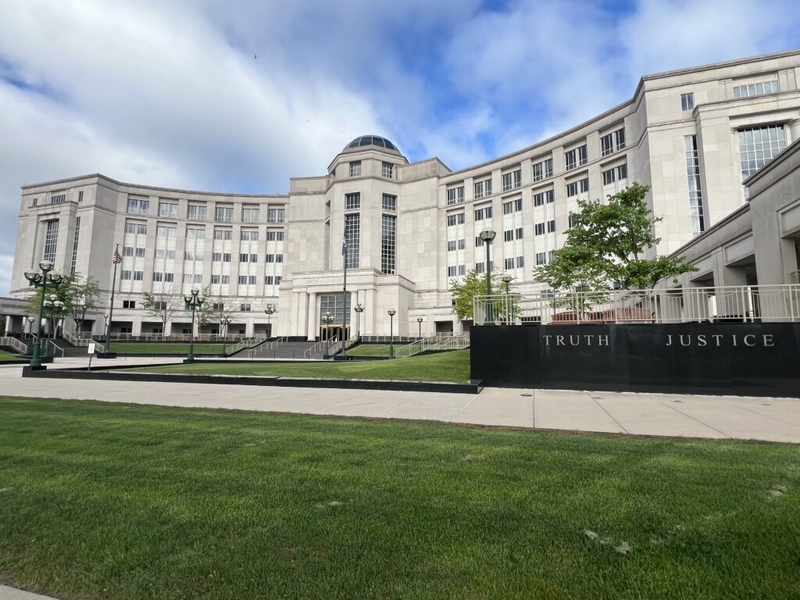
Michigan Supreme Court / Hall of Justice | Photo by Jon King
On Nov. 3, Michigan voters will elect two justices to the Michigan Supreme Court. Though those races are listed as nonpartisan on the ballot, all six candidates on the ballot were nominated by political parties.
Michigan Supreme Court Chief Justice Megan Cavanagh and Justice Noah Hood, both nominated by the Democratic Party, are up for reelection. They face four challengers: Republicans Casandra Morse-Bills and Michael Warren, and U.S. Taxpayers Party nominees Thomas Howe and Jody White.
Because the elections are nonpartisan, explained Mitchel Sollenberger, a professor of political science at the University of Michigan-Dearborn, candidates tend to be less well-known or advertised to the public. Sollenberger noted, however, that in recent election cycles, both the Democratic and Republican parties have done a much more effective job of sending out mailers and putting out ads for their nominated candidates.
But though both parties have worked to inform voters which candidates on the ballot belong to their party, Sollenberger explained that, across states with judicial elections like Michigan’s, incumbents tend to have a significant advantage.
“Typically what you see is the voter, if they don’t know if it’s a Republican or Democrat, the voter is picking the incumbent,” he said. “You typically see the candidate being retained. You don’t see the challenger winning.”
Currently, Democratic justices hold a 6-1 majority on the state’s highest court. Justice Brian Zahra is the court’s only Republican and with a decisive liberal majority, he is often the sole dissenter on important court decisions.
Even if both Democratic incumbents lose in November, Democrats would retain a majority on the court, but with a narrower margin. In a 4-3 court, a single justice’s vote could determine the outcome of a decision.
Sollenberger highlighted a number of such decisions in recent years, in which having a slimmer majority might have flipped the decision entirely.
That includes Attorney General v. Eli Lilly and Company, which defined the application of the Michigan Consumer Protection Act, as well as People v. Parks, which considered the “cruel and unusual punishment” statute in the state constitution in relation to life sentences without parole for young adults.
All six candidates recently participated on a virtual candidate forum hosted by the League of Women Voters of Michigan.
Hood is the newest justice on the Supreme Court, having been appointed by Gov. Gretchen Whitmer in 2025 after then-Chief Justice Elizabeth Clement, a Republican, left the court. He is the only current justice on the court who has not yet been elected or reelected following an appointment to the court.
Prior to joining the Supreme Court, Hood — a graduate of Harvard Law School — served as a judge of the Michigan Court of Appeals for three years, and before that was a circuit court judge on the Third Judicial Circuit of Michigan.
Both Republican nominees, Morse-Bills and Warren, are circuit court judges.
Warren has been a judge in Michigan’s Sixth Judicial Circuit Court in Oakland County since 2002. He is a graduate of the University of Michigan Law School and served on the state Board of Education prior to his time as a judge.
Morse-Bills, a graduate of Cooley Law School, is currently the presiding judge in Michigan’s 23rd Judicial Circuit Court, which covers Alcona, Arenac, Iosco and Oscoda counties in rural northern Michigan. She was elected to that court in 2018 and reelected in 2024.
Howe and White, the nominees from the U.S. Taxpayers Party, have a unique obstacle — they would not be eligible to serve as Supreme Court justices under Michigan law if elected in November, as neither is licensed to practice law in Michigan.
Under Michigan state law, any justice or judge in a state court “must be persons who are licensed to practice law in this state,” and “To be qualified to serve as a judge of a trial court, a judge of the court of appeals, or a justice of the supreme court, a person shall have been admitted to the practice of law for at least 5 years.”
That requirement does not prevent them from campaigning or from their names appearing on the ballot, but would prevent them from assuming the office.
Sollenberger noted that, especially in a race where candidates are not labeled by party affiliation — and where the ballot will not note that these candidates are ineligible to hold the office for which they are listed — it is likely that some voters will cast their ballots in support of Howe or White without knowing this.
That means that those candidates would split the non-incumbent vote with the Republican candidates, making it an even further uphill climb to unseat the Democrats in a race that already heavily favors incumbents.
Sollenberger also noted the important context of the gubernatorial race in the balance of the state Supreme Court — in the event of any vacancy, the governor is able to appoint a replacement in a process that generally moves quickly. When Hood was appointed, for example, he assumed office on May 27, 2025, just over a month after Clement officially resigned from the court.
Lansing, MI