Child welfare adviser wrapping up his work this year
Oct 27, 2026 | 4:30 am ET

Description
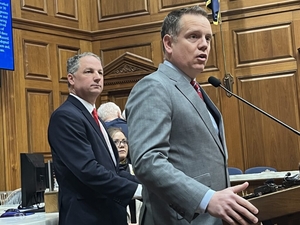
Indiana Department of Child Services Director Adam Krupp. (Photo courtesy of DCS)
Special adviser Adam Krupp will likely wrap up his state employment by the end of the year after he completes a comprehensive evaluation of the state’s child welfare system.
The report is a follow-up to a 2018 assessment, conducted by the Child Welfare Policy and Practice Group, which was used to make key reforms.
Krupp left his post as head of the Indiana Department of Child Services in April, following a three-month medical leave. He transitioned to a special advisor role for Gov. Mike Braun on abuse and neglect issues while keeping his annual salary of $210,000.
New DCS Director Jennifer Dorfmeyer also makes $210,000.
“I get that a lot of people have criticized the role. They have questions about the role,” Krupp told the Capital Chronicle. “It helps if we look at this as an investment as opposed to an expense or a cost.”
“It’s a heartbreaking circumstance when you’re observing things that you know need to be fixed, but the day-to-day can be so overwhelming that that improvement gets stalled, or those strategic initiatives and priorities get put on the shelf for another 30, 60, 90 days because another crisis pops up,” he said. “Well, this role has allowed me to step away from all of that and just focus on what do we need to do and how are we going to get it done.”
Krupp files a weekly status report with the governor’s office on his activities. The reports indicate the majority of his 37-hour workweeks are being spent on the updated assessment he is crafting.
Other highlights include:
- Meeting with experts on how to responsibly incorporate artificial intelligence into the agency
- Reviewing legislation and consulting with lawmakers
- Internal meetings with Dorfmeyer and other DCS staff
- Meeting with foster parents to discuss their experience with the system
- Reviewing monthly data on key performance indicators
Krupp said the most significant deliverable will be the comprehensive assessment, which is set to be hundreds of pages long.
“At a really high level, this is not designed to be critical of the past,” he said. “This whole exercise is: how do we make the system better? Because at the end of the day, as I always said as director, it’s about the best interests of the children, and they’re our most vulnerable population.”
He said it’s time to revisit the high-level assessment of the agency; examine where the data is trending and offer dozens of recommendations for the future. Some of those changes can be implemented internally, and others would have to be greenlit by the General Assembly.
In a statement the governor said he “grateful for Adam’s service and his commitment to Hoosier children,” adding, “I look forward to reviewing his final report and recommendations as to how our state can continue to serve and protect our most vulnerable.”
Krupp has also been looking at ways to harness AI: vetting the cost, implementation timelines and uses. He noted immediately that he doesn’t mean allowing AI to make child welfare determinations. Instead, it’s using AI to reduce paperwork and data entry so that caseworkers can spend more time with families and kids in the field.
He said there are programs now that can forecast staffing needs based on rising caseloads and even considering major plant shutdowns in a region of the state. Another tool is using AI to mine large files to identify possible kinship placements.
“You’ve got eight years of notes, you’ve got 11 case managers, and there are names scattered throughout this case management file for that child or that family,” Krupp said. “We want to find a kinship placement. That might take a case manager like a week to do. AI can do it in 60 seconds.”
Indianapolis, IN