Georgia Republicans are trying to court Latino voters. National politics are complicating things.
Oct 27, 2026 | 4:00 am ET
Description
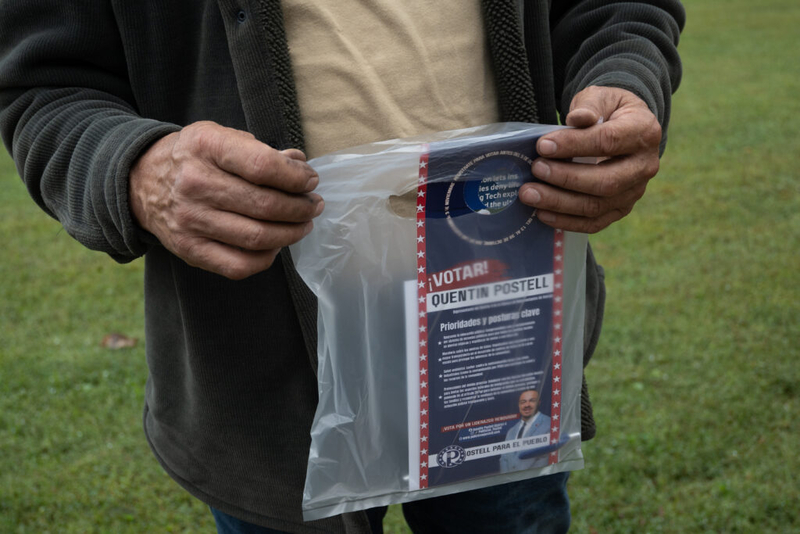
Dalton resident Roberto Paramo holds a campaign pamphlet in Spanish given to him by a Democratic canvasser. Ignacio Perez/Georgia Recorder
DALTON, Ga. – Mary Dennard canvassed alone through one of Dalton’s neighborhoods on the eve of Hurricane Isaias. The other canvassers, who speak Spanish, canceled due to the weather. Her blue shirt peeked out from under her windbreaker, reading “Somos vecinos, we are neighbors,” and Dennard carried Spanish language pamphlets to leave with Latino voters or at unanswered doors.
Nearly a quarter of registered voters in Dalton’s Whitfield County are Latino, according to data from the secretary of state office. And the northwest Georgia county had the seventh most Latino voters in the state as of 2024, according to a report from GALEO, a nonprofit working to increase civic engagement among Hispanics in Georgia.
Today, Republicans and Democrats are making a play for Latino support in the midsize city of Dalton. Grassroots engagement and targeted campaigning are part of an effort on both sides of the aisle to boost Latino turnout and win Hispanic votes ahead of the midterms.
In a battleground state with tightening margins, Georgia’s Latino voters have the potential to affect the outcome of the governor’s race in November. With polls showing the two candidates, Democrat Keisha Lance Bottoms and Republican Rick Jackson, within striking distance of each other, a two or three percentage point swing in either direction could make all the difference.
About 5% of Georgia’s more than 8 million registered voters are Latino, according to the most recent data from the Georgia Secretary of State’s office. Over the past decade the number of active Hispanic voters has grown by 210%, or 267,614.
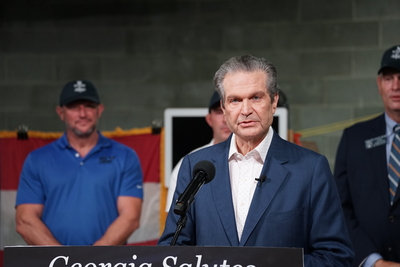
Jackson and Bottoms have made attempts to reach this growing voter bloc in Whitfield County and across the state alongside efforts from local political parties.
In August, Jackson hosted an event in Dalton at a restaurant owned by former Latino city council member Nicky Lama before a rally in town. Earlier that month he attended Cumming’s yearly Latin festival.
“He understands that American dream, the reason that a lot of Latinos come here, and he will protect that American dream. And so that’s a message that is resonating a lot with the Hispanic voters we’ve been talking to,” Stefanie Zaenker, advisor to the Libre PAC, a conservative-leaning Latino group that endorsed Jackson.
That same week, Bottoms arrived in Dalton with a slew of other candidates running on the Democratic ticket. In a speech she spoke about making Georgia a welcoming state for immigrants and said that, as governor, she would be a check on federal immigration enforcement activity. Bottoms later spoke directly to Hispanic voters in an interview with Univision Atlanta, stressing her plans to address affordability.
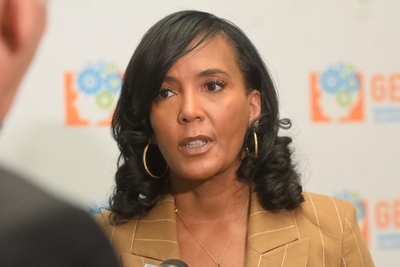
“The Latino community is one of the fastest-growing communities in the state of Georgia. So we can’t think about Georgia without thinking about our Latino community,” Bottoms said. “All of our communities should feel that they have a buy-in and feel that the American dream is within reach for their families as well.”
Bottoms held a campaign event Thursday in Atlanta with Latino leaders, reiterating her commitment to push back on the Trump administration’s immigration policies.
What impact will Trump’s immigration policies have on the midterms?
At the local level, county political parties table at Latino community events, host panels, sponsor a local soccer team and send out bilingual canvassers, placing Hispanics in the middle of a tug-of-war of talking points and cultural appeals.
But while Republican President Donald Trump made gains with Latino voters in 2024, there are signs that this support could be unraveled as his administration’s aggressive immigration enforcement. In Georgia, immigration enforcement agents have arrested thousands of people.
A Republican state lawmaker who represents Dalton, Kasey Carpenter, said he fears the increased immigration enforcement could turn away formerly Republican-voting Hispanics in the area. Carpenter’s state House district has the most registered Latino voters of any state house district.

“I always tell people, even though they are checking nine out of 10 boxes with our party, that one box, if you take somebody’s aunt or uncle or cousin or grandmother and haul them off to a country they haven’t seen in 25 years, it’s hard pressed to worry about kitchen table issues and private property rights and all the things Republicans hold near and dear,” Carpenter said in an interview.
The state Republican party, Carpenter said, should decouple itself from Washington and the increase in federal immigration enforcement and instead stress their accomplishments in the state. Otherwise, he said the gap between Democratic and Republican support among Latinos stands to widen.
One of Dalton’s voters who supported Democrats in 2024 is Bryan Aguilar. The politically active 26-year-old said his biggest concern lies with the country’s immigration system. The state needs to stop local law enforcement cooperation with federal immigration officials, Aguilar said. At the federal level, Aguilar would like to see lawmakers streamline new pathways to citizenship.
Aguilar said he believes candidates who don’t try to understand Latinos make blanket statements about immigrants to justify their views.
“It’s coming from a place without facts to back up their claims,” Aguilar said. “It’s rather incendiary language about immigration they use.”
Representatives of both major parties are attempting to win over Latinos, often through proposals to curb the cost of living and even cultural appeals.
“I don’t know why any Spanish person or any Hispanic person would ever be a Democrat because their policies do not align with most Hispanic’s morals that they have and their religious beliefs,” Jackie Harling, chair of Northwest Georgia’s 14th Congressional District GOP, said after a panel discussion in Dalton in August that was hosted in part by the Libre Initiative.
Dennard, vice chair of the Whitfield County Democrats and canvas organizer, strongly disagrees.
“What this administration is doing to the community of Latinos and people of color is just reprehensible in my opinion. I think that’s going to help the Democrats and hurt the Republicans in the election,” she said in an interview.
Energizing a growing minority
Georgia’s Hispanic population may be growing, but that doesn’t translate into greater political influence automatically.
A little more than half of registered Latinos turned out to vote in Georgia in 2024 and 2020 according to GALEO’s voter report. According to data from the Georgia Secretary of State’s office, 72.9% of all registered voters participated in the 2024 election.
“In local elections here, few Hispanics vote despite Dalton’s population being majority Latino,” Rod Miller, first vice chairman of the Whitfield County Republican Party who has led the local party’s attempts to reach Latino voters, said by phone.
Latinos’ lower turnout rate can have several causes. Those who didn’t grow up in the U.S. may be unfamiliar with the voting process. Because most counties in Georgia do not have election materials in Spanish, others might not feel confident enough in their English to go to the polls. Finally, Hispanics as a whole are generally younger than non-Hispanics, says Charles Bullock, a political science professor at the University of Georgia.
“We know the older you are the more likely you are to vote. That low turnout is endemic among young voters whatever their ethnicity or background,” Bullock said. “Voting is habit forming. If you start voting, vote consistently, then you’re probably doing it the rest of your life.”
At the city and county level, a lack of Hispanic representation among elected officials doesn’t help either. Despite the fact that more than half of the population in Dalton is Hispanic, currently no one in office is Latino, a statistic local groups want to change.
“We are hoping to develop Hispanic Republican candidates who will energize their community to greater levels of participation,” Miller said.
America Gruner, president of the Coalition of Latino Leaders in Dalton, a nonpartisan civic organization, said the outreach to Hispanic voters needs to extend beyond election season. Her group, for example, works year round to increase civic participation through information sessions, candidate forums, canvassing and vote together walks, Gruner said.
Gruner said when she speaks with Hispanics in the area, many don’t know what offices are up for election or the names of candidates. Candidates only seek out Latino residents when there are elections, she said, and they want their vote.
“They aren’t going to motivate me to get out to vote because there isn’t anything I can relate to, right?” Gruner said, “They should get to know our needs and at least include something that says, ‘yes they listen to us, yes they know us, yes this is a thing I’m interested in fighting for.’”
Atlanta, GA