‘I finally won something here in Vermont’: Jury acquits gun-range owner of assault
May 28, 2026 | 7:48 pm ET
Description
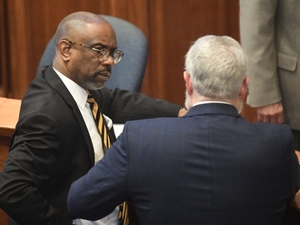
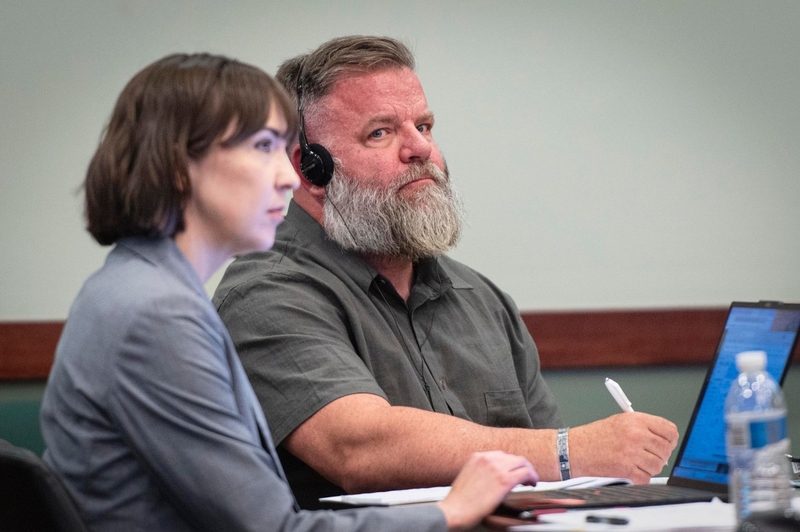
Daniel Banyai, the former owner of a shooting range and paramilitary training site in Pawlet, looks on as the prosecutor speaks during Banyai’s trial in Rutland County Superior criminal court in Rutland on Thursday, May 28, 2026. Banyai is facing charges stemming from a 2024 altercation with Pawlet Constable Thomas Covino. Photo by Glenn Russell/VTDigger
RUTLAND — A Rutland County jury has acquitted the owner of Slate Ridge, a former gun range and paramilitary-style training facility in West Pawlet, of assaulting a constable more than two years ago.
The verdict Thursday afternoon is the most recent legal turn for Daniel Banyai, whose national-headline-making battles have played out in criminal, civil and environmental courts in Vermont for several years.
The criminal trial Thursday stemmed from Banyai’s arrest in March 2024, when he was accused of assaulting Pawlet Constable Thomas Covino during a traffic stop in Pawlet.
Rutland County State’s Attorney Ian Sullivan argued during the trial that Banyai assaulted Covino after repeatedly refusing to get out of the pickup truck, in which he was a passenger, so he could be arrested on a warrant.
Christopher Davis, Banyai’s attorney, told the jurors that his client was the victim of excessive force by an overzealous officer who didn’t follow proper procedures in trying to make the arrest.
Jurors deliberated for about 40 minutes before acquitting Banyai on the felony charge of aggravated assault on a law enforcement officer to prevent a lawful arrest. The charge could have brought a maximum sentence of 15 years in prison.
Banyai patted Davis, a public defender, on the back after the verdict was read in the courtroom.
“I’m very grateful,” Banyai told reporters outside the courtroom. “The system did not fail me here.”
Banyai then criticized Covino’s actions during the incident leading to the charge, as well as the media in its coverage of him, particularly VTDigger.
“I finally won something here in Vermont,” Banyai added. “It’s huge.”
Sullivan, the prosecutor, told reporters after the verdict that he respected the jury’s decision.
“I continue to believe that the case hinged on the definition of lawful authority,” Sullivan said.
“Obviously, the state and the defense disagreed about whether Constable Covino’s actions constituted lawful force or excessive force, and the jury concluded that the state did not carry its burden.”
The trial featured testimony from only two prosecution witnesses: Covino and Vermont State Police Trooper Jonathan Hall, who went to the traffic stop scene in a church parking lot after the physical altercation between Banyai and Convino.
After the two officers testified, Sullivan said he had finished presenting his case. Davis then told Judge Susan McManus that he wouldn’t be calling any witnesses.
The move by Davis came as something of a surprise since the trial had been delayed for months to permit a defense law enforcement expert to attend and testify. That expert was seated in the courtroom Thursday.
McManus asked Banyai if he was waiving his right to testify in his own defense.
“Yes,” Banyai replied.
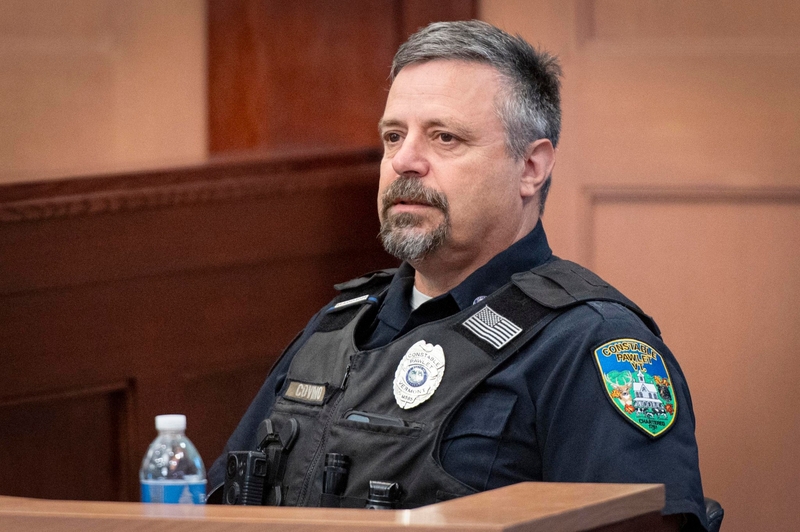
The case appeared to hinge on the testimony of Covino and on video of the altercation. The jury was shown video from Covino’s body camera as well as from a camera on a nearby property and the cellphone of the driver of the pickup, David Brodsky.
Sullivan, the prosecutor, said during his opening and closing arguments that Banyai was at fault for the altercation.
“This is not a whodunnit,” Sullivan told the jury.
Banyai at the time had an active arrest warrant after an Environmental Court judge found him in contempt of court for flouting orders to tear down unpermitted structures on his Slate Ridge property. Banyai was instructed to turn himself in to the Vermont Department of Corrections, but never did.
According to documents supporting the assault charge, Banyai was a passenger in the pickup that Covino pulled over on the afternoon of March 20, 2024, for driving 64 mph in a 50-mph zone.
Covino, who testified Thursday that he recognized Banyai and knew there was a warrant for his arrest, tried to take him into custody, but Banyai refused several orders to get out of the truck.
According to video of the traffic stop played in court Thursday, Banyai repeatedly told Covino he would not get out of the vehicle because he didn’t trust him. Instead, Banyai said he would wait until another “real cop” could get to the scene.
Banyai could be heard in the video telling Covino he didn’t feel safe around him.
“You’re a dirty cop, bro,” Banyai said to him.
At one point in the video, Covino said to Banyai, “Do you want to wrestle with me?”
During the videos, both men could be heard speaking with raised voices.
Under questioning from Sullivan, Covino testified that as he was outside the pickup’s passenger side and ordering Banyai out of the vehicle, he saw Banyai “postering up” in the passenger seat and forming a fist with one of his hands.
That’s when, Covino said, he decided to use pepper spray, which he described as an irritant, to gain control of Banyai and arrest him.
A physical altercation spilled outside the pickup and lasted several seconds between the two men. Covino was eventually able to gain control of Banyai and place him in handcuffs with his hands behind his back.
Covino testified that during the altercation Banyai struck him on the side of his head, leading to ringing in his ears and continuing headaches.
“I was fighting for my life,” Covino said.
Davis, Banyai’s attorney, pressed Covino on his actions leading up to the altercation, asking him why he decided to deploy the pepper spray when he did.
“He postured up,” Covino replied, referring to Banyai.
Davis told jurors that at the point the pepper spray was used, there was no emergency, and that its use only escalated the situation. Banyai wasn’t trying to evade any arrest, Davis added, but wanted to wait for other officers to arrive because of his mistrust of Covino.
Davis described his client’s conduct during the traffic stop as “passive resistance,” which he said didn’t warrant the escalation of force by Covino through the use of pepper spray.
Davis also raised a previous statement Covino made under oath during a deposition in the case, when he said Banyai had been throwing a punch at the time Covino used the pepper spray. Davis told jurors the video showed that wasn’t the case.
“It was excessive,” Davis said of Covino’s use of force. “That is not to say, by the way, that Mr. Banyai was behaving himself under this scenario. He wasn’t. But that’s not what he’s charged with here. He’s not charged with delaying his arrest.”
Read the story on VTDigger here: ‘I finally won something here in Vermont’: Jury acquits gun-range owner of assault.

Montpelier, VT