Federal appeals court allows Alabama to use 2021 state Senate map
May 29, 2026 | 10:43 am ET
Description
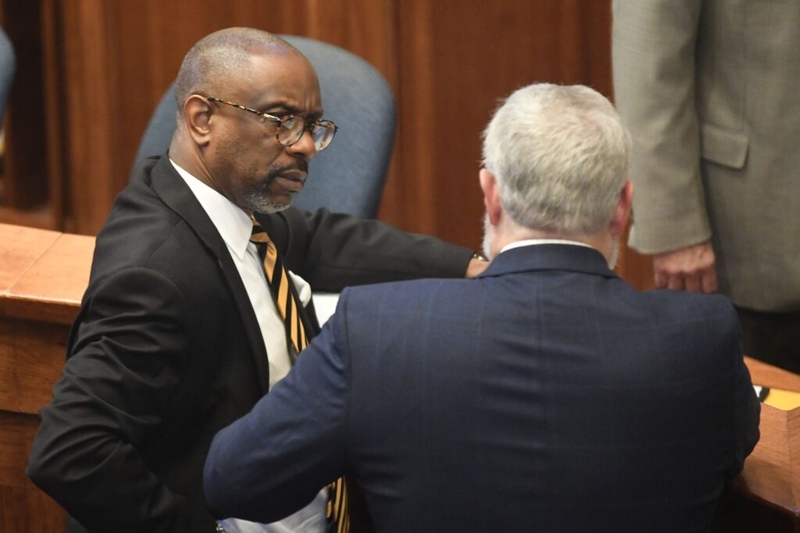
Sen. Kirk Hatcher, D-Montgomery (left) speaks with Sen. Will Barfoot, R-Pike Road on the floor of the Alabama Senate on April 1, 2025 at the Alabama Statehouse in Montgomery, Alabama. A three-judge panel of the U.S. 11th Circuit Court of Appeals Thursday evening lifted a stay against 2021 state Senate map that a lower court judge ruled discriminated against Black voters in Hatcher and Barfoot's districts. (Brian Lyman/Alabama Reflector)
A three-judge panel of the U.S. 11th Circuit Court of Appeals Thursday evening allowed Alabama to use a 2021 State Senate map that a lower court judge had ruled racially discriminatory against Black voters in two Montgomery-area districts.
U.S. Circuit Judges Elizabeth Branch and Robert Luck – appointed by President Donald Trump – said that the state is entitled to a stay in the state Senate case because the case aligns more closely with the U.S. Supreme Court’s decision in Louisiana v. Callais in April, which substantially weakened Section 2 of the Voting Rights Act, than the state’s ongoing congressional litigation.
“The district court’s injunctions irreparably harm the state because they prohibit it from conducting the senate elections under the 2021 map approved by the people through their elected representatives,” the majority opinion wrote. “As the Supreme Court has explained, ‘the inability to enforce its duly enacted plans clearly inflicts irreparable harm on the state.’”
The 11th Circuit did not rule on the merits of the case.
“Instead, for a stay, we look to whether the party seeking relief will likely succeed in his appeal,” Branch and Luck wrote.
U.S. Circuit Judge Nancy Abudu, appointed by President Joe Biden, dissented from the ruling, writing that the evidentiary record showed an intention to discriminate by the state — which would still render the map unconstitutional under the Callais standard — and that state officials had previously testified that they had to have a map in place by November 2025 to have elections “without disruption or confusion.”
“These facts, unique to this litigation, show that the state’s newfound urgency is inconsistent with its conduct over the past six months in a way that makes a stay inappropriate,” she wrote.
The ruling comes weeks after Gov. Kay Ivey called a special session and lawmakers passed a law creating a mechanism for a special primary election in case the state was granted permission to use the previous map.
A message seeking comment from Gov. Kay Ivey and Secretary of State Wes Allen were left Friday morning. In a statement Friday, Alabama Attorney General Steve Marshall called the ruling “a significant victory for the people of Alabama and the principle of self-governance.”
“The Eleventh Circuit rightfully recognized that the Supreme Court’s recent decision in Louisiana v. Callais fundamentally changes the legal landscape here,” the statement said. “The court also acknowledged what has been clear from the start: that a state enjoined from enforcing the laws passed by its own Legislature suffers a real and irreparable harm.”
Davin Rosborough, deputy director with the ACLU Voting Rights Project and attorney for the plaintiffs in the case, said in a phone interview Friday morning that he was a little surprised by the ruling because both the 11th Circuit and the Northern District Court of Alabama denied stays to use the 2021 map.
“Based on all of the evidence I’ve seen, they don’t really have time to do another primary. It doesn’t mean they’re not going to try to,” he said. “Gov. Ivey and Secretary Allen have not been very concerned about creating chaos and voter confusion in this cycle.”
U.S. District Judge Anna Manasco in August ruled that two Montgomery-area districts violated the now-weakened Section 2 of the Voting Rights Act. In November, a new map was put in place. Allen on May 12 filed an emergency motion to vacate Manasco’s previous ruling and the court-ordered map with the “benefit of the Supreme Court’s decision” in Louisiana v. Callais.
The court-ordered map changed Districts 25 and 26, which are currently represented by Sens. Will Barfoot, R-Pike Road, and Kirk Hatcher, D-Montgomery, respectively. Both senators have swapped districts for the 2026 election.
Hatcher, who faced two Democratic challengers in the May 19 primary, won the nomination with 55.4% of votes, according to unofficial returns, and will face Russell Taylor in November. Barfoot did not have a primary opponent, but will face Tabitha Isner, vice chair of the Alabama Democratic Party, in November.
Montgomery