Fire officials warn lawmakers of impending fire season
May 29, 2026 | 9:00 am ET
Description
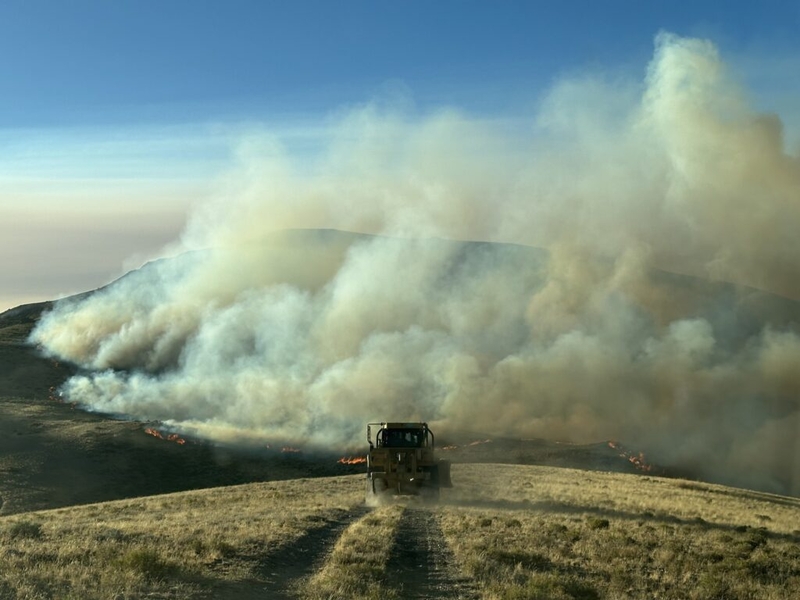
A dozer approaching the September 2024 Lake Mountain Fire south of Tuscarora in Elko County. (Photo by Jeremiah Braun, Bureau of Land Management/National Interagency Fire Center)
Nevada fire officials are warning that record low snowpack and abundant fuels could raise the potential for large-scale wildfires as the state heads into warmer months.
On Wednesday, state and federal fire agencies — including the Nevada Division of Forestry, the U.S. Forest Service and the Bureau of Land Management — briefed lawmakers on wildfire conditions and preparedness across the state during a Joint Interim Standing Committee on Natural Resources meeting.
Over the Memorial Day weekend, two large wildfires broke out in Pershing and Elko counties, burning through more than 3,100 acres of federally managed land. As of Thursday, both fires are more than 90% contained.
Those early fires align with data from the National Interagency Fire Center showing above-normal fire potential across almost all of northern Nevada in July and August.
As of mid-May, Nevada has already faced 76 wildfires which have progressively grown larger as the state’s record low snowpack has all but disappeared much earlier in the season than years past. Snowpack acts as a natural fire suppression, but as it melts and exposes cheatgrass and other fuels, the potential for large-scale wildfire grows.
Most snow measuring sites across basins in northern and eastern Nevada were snowfree one to two months ahead of normal, according to the Natural Resources Conservation Service. The only snow measuring sites in Nevada that still have significant snowpack are in all above 8,000 feet elevation in the Eastern Sierra.
“It’s a pretty unprecedented year,” said Ryan Shane, the state forester and fire warden for the Nevada Division of Forestry.
Snowmelt in lower elevations exposing abundant fuels contributed to the recent wildfires in Pershing and Elko counties. Early drought conditions have further increased the potential for wildfires by drying those fuels.
“We already see rapidly declining fuel moistures, and in some cases they’re already critical, which will sustain fire behavior much earlier in the season,” Shane said.
The U.S. Drought Monitor has declared all of Nevada under at least the most minor classification of drought. The northern portion of Elko County is experiencing the worst of the drought, reaching extreme and exceptional drought conditions.
“We’re probably going to see a worsening statewide drought, causing above normal fire potential and less water resources for fire suppression,” Shane said.
Temperatures in Nevada are also predicted to be warmer throughout the fire season, exacerbating the potential for wildfires.
This will be the first season under the direction of the nation’s new federal agency, the U.S. Wildland Fire Service, which consolidated firefighting efforts of the Bureau of Land Management, National Park Service, Fish and Wildlife Service, and Bureau of Indian Affairs.
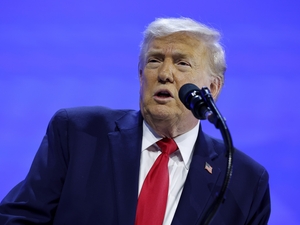
The new agency was created after President Donald Trump signed an executive order to consolidate federal wildfire resources in the U.S. Department of Agriculture and Department of the Interior.
However, the new U.S. Wildland Fire Service does not include the firefighting arm of the U.S. Forest Service, which includes about two-thirds of federal firefighters, as that would require congressional approval.
Gwen Sanchez, acting deputy director for fire and aviation at the Forest Service, said Trump intends to move forward with the consolidation of the Forest Service. She also reassured lawmakers that the new structure would not interfere with wildfire response.
“You should see no difference in terms of response this summer across Nevada or the rest of the country. We are working together in partnership, not only federally, but also states and local jurisdictions, no different than we have in the past, and we should see the same level of response that you have seen in the past,” Sanchez said.
Local and federal fire officials outlined actions being taken to mitigate heightened fire potential this summer, including the use of a camera network set up across the state. The camera network is a joint partnership between the University of Nevada Reno’s Nevada Seismological Lab, the BLM, and NV Energy. The network has 95 installed cameras, with plans to add 50 more.
Brock Uhlig, a chief with the U.S. Wildland Fire Service, outlined efforts the agency has taken to treat fire-prone areas in the state. Uhlig said federal agencies treated more than 360,000 acres of federal land in 2025 to reduce wildfire potential. That treatment includes hand-thinning, prescribed fire burns, mechanical trimming, chipping, targeted grazing, and fuelwood removal.
Last year wildfire mitigation in Nevada totaled $3.6 million, according to the state Division of Forestry.
“Every dollar invested in this kind of work results in nearly $4 of avoided suppression costs and damages. For preparedness, prevention, and mitigation, the best fire to fight is the one that never happened,” Uhlig said.
Wildfires are some of the costliest natural disasters in the state. Between 1980-2024, nearly half (43.2%) of Nevada’s 27 $1 billion natural events were wildfires, according to the National Oceanic and Atmospheric Administration.
Shane said Nevada is also pursuing federal funding to address the potentially challenging wildfire season.
Las Vegas, NV