Trump administration swiftly moves ahead on plans to restrict voting by mail in the states
Jun 08, 2026 | 4:49 pm ET
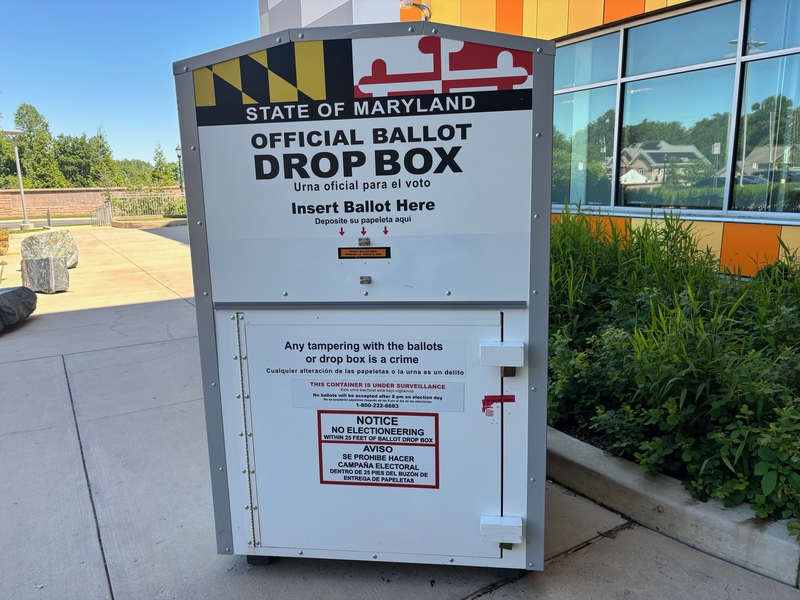
Description
An official ballot drop box for Maryland voters, in Wheaton, Maryland, on June 7, 2026. (Photo by Jane Norman/States Newsroom)
The U.S. Department of Homeland Security will allow states to access federal citizenship data by June 30 and plans to monitor the flow of mail ballots for signs of voter fraud, according to a court document.
Amid a series of lawsuits, President Donald Trump’s administration is now moving to carry out a March 31 executive order restricting voting by mail ahead of the November midterm elections.
Democrats and voting rights advocates oppose the directive as unconstitutional election meddling by Trump and have sued to stop him. The president, who has long attacked mail ballots but votes by mail himself, says the additional rules will fight noncitizen voting, a rare phenomenon.
“No president has the authority to unilaterally rewrite election rules or dictate how states administer their elections,” Marcia Johnson, chief of activation and justice at the League of Women Voters, said in a statement last week. The League of Women Voters filed one of at least five lawsuits challenging the order.
Potential disruptions
The order could carry major consequences for the midterm elections. Any new restrictions on mail ballots would risk disrupting how tens of millions of voters cast their ballots. About 30% of voters cast mail ballots in 2024, according to data gathered by the U.S. Election Assistance Commission.
But despite several legal challenges, the order remains in effect.
A federal judge in Washington, D.C., in late May ruled against a request by Democratic groups to pause the order, finding that it was too soon to weigh in because federal officials hadn’t taken enough action yet. A second judge in Massachusetts held a hearing last week, but didn’t immediately issue a decision.
“The Trump Administration will continue fighting for the safety and security of American elections,” White House spokesperson Abigail Jackson said in a statement shortly after the D.C. judge’s decision.
One portion of the order demands the postmaster general enact new restrictions on mailed ballots and not transmit ballots from states that refuse to provide the names of absentee voters. The U.S. Postal Service, despite its status as an independent corporation, has put forward a proposal in line with the order to require states to submit lists of voters before mailing ballots.
Now, Homeland Security is responding to another part of the order that requires the creation of lists of voting-age citizens in every state, which the Trump administration calls “state citizenship lists.” State election officials would receive the lists, which they could compare to their voter rolls in a search for noncitizen voters.
Homeland Security’s plans for the citizenship lists came into focus on June 5, when the U.S. Department of Justice filed a notice in federal court that briefly outlines the administration’s plans. The notice describes a two-part effort by Homeland Security and its subsidiary agency, U.S. Citizenship and Immigration Services, to comply with the order.
First, Homeland Security will implement a “State Voter Roll Verification” that allows state election officials to submit their voter rolls to the Systematic Alien Verification for Entitlements, or SAVE, system.
SAVE is a powerful computer program that checks names against citizenship information held in a variety of government databases. It can flag registered voters as possible noncitizens, but faces criticism for incorrect identifications.
For the past year, states have already had the option to upload their voter rolls into SAVE. Some Republican-led states, such as Indiana, Texas and Wyoming, have used the system, while Democratic states have declined. It’s unclear how the State Voter Roll Verification would be different, if at all, from states’ current SAVE access.
Homeland Security and U.S. Citizenship and Immigration Services didn’t respond to questions from States Newsroom.
Second, the Justice Department notice says Homeland Security will set up a registry for state election officials to securely access “citizenship-related data” from USCIS, the Social Security Administration and the State Department.
According to the notice, the “underlying data would remain in each agency’s respective system.” No other details were provided.
The notice also outlines Homeland Security’s intention to use the lists of voters that states provide to the Postal Service for investigations. It says DHS wants to “integrate” data on those voters “to monitor mail-in and absentee ballot flows, identify anomalies that may suggest voter fraud or misuse, and generate authorized investigative leads.”
California elections
The notice comes as Trump renews his attacks on mail-in voting. Last week he alleged, without evidence, voter fraud in California, which held primary elections last week. California relies heavily on mail ballots and often counts votes at a slow pace — meaning final results sometimes don’t match election night vote totals.
“Do you know why they’re doing that? Because they’re cheating on the election,” Trump said in an interview on NBC’s “Meet the Press.”
While the executive order already faces a slew of lawsuits, the NAACP on June 3 filed a motion in federal court seeking to specifically block the Postal Service’s proposed regulations of mail ballots. The NAACP alleges the regulations violate a 2021 settlement agreement that requires timely delivery of election mail to all voters.
The Postal Service has until Thursday to respond.
The American Postal Workers Union in a statement on June 5 denounced the executive order, saying the Postal Service serves all Americans. It is “not a tool for politicians” to pick which Americans receive which benefits, the union said.
“The Executive Order is an unconstitutional attack on the millions of Americans who vote by mail,” the union said, “and another front in an ongoing assault on voting rights in the United States of America.”
All States Newsroom content is free to republish. Read our republishing policy for more information.