How 1 SC college helped students using a now-cancelled grant for minority-serving schools
Oct 13, 2025 | 6:00 am ET
Description
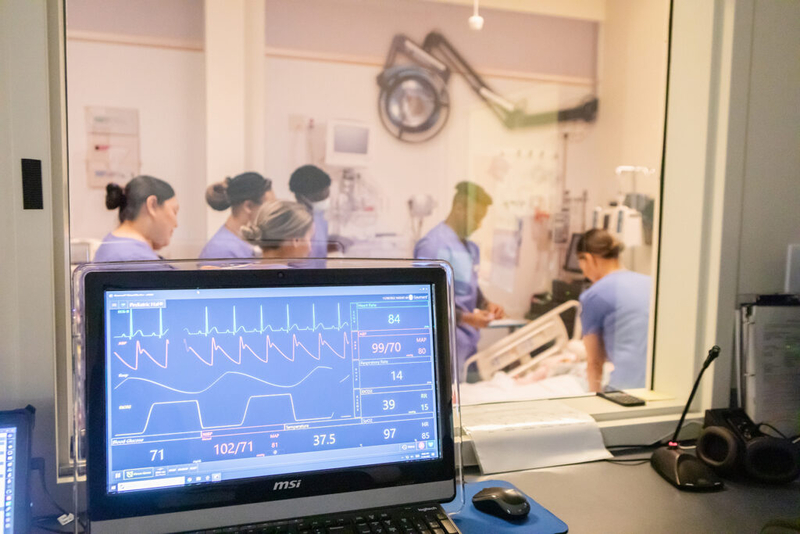
Central Carolina Technical College students learn in the school's high-tech health care simulation lab. An employee to operate this lab and help place students in internships won't be funded following federal grant cuts. (Photo provided by Central Carolina)
A tutoring hub, a center to help students land jobs after earning their diploma, and an academic advising office to keep students on track to graduate — these are all things Central Carolina Technical College has been able to add to its campus over the past 15 years with the help of federal funds awarded to colleges with a large percentage of minority students.
But now that grant program is ending, as the U.S. Department of Education claws back $350 million in funds specifically for schools with large populations of Hispanic, Black, Alaska Native, Native Hawaiians, Native Americans, and Asian Americans and Pacific Islander students. That money is being redistributed nationwide to historically Black colleges and universities.
Because of this, the technical college based in Sumter won’t receive the nearly $350,000 it had left on its five-year, $1.6 million grant, said Lisa Bracken, the college’s vice president of student affairs.
“That $1.6 million, for us, was an awful lot of money,” she said.
How the grant was used
The college was using this latest grant round for three things — a program to flag and help students at risk of dropping or failing out of school, an employee dedicated to placing healthcare students in internships and clinicals, and a team of degree advisers.
Central Carolina, which has satellite campuses in Manning, Camden and Bishopville, managed to get budget approvals from the General Assembly to make four of these grant-funded employees permanent hires, including two directors.
With the federal grant slated to run out next year, the college thought it was planning ahead with its request to legislators. Instead, the additional state aid was needed immediately.
“Had we not done that, every bit of this would have gone away,” Bracken said of those positions.
But the school had to let go two workers it could no longer pay, forcing other employees to take on the extra workload.
Nationwide, more than $250 million of the recalled federal funding was for the government’s Hispanic-Serving Institution program, which offers grants to colleges and universities where at least a quarter of undergraduates are Hispanic.
There was also $22 million for schools where at least 40% of the students are Black. The remaining $28 million went to schools with large populations of other minority groups.
In addition to Central Carolina, two other South Carolina colleges — Orangeburg-Calhoun Technical College and Florence-Darlington Technical College — lost funding under the program for what are known as Predominantly Black Institutions, according to Kelly Steinhilper, a spokeswoman for the state technical college system.
Neither of the other two schools responded to messages from the SC Daily Gazette.
Exempt from cuts
Tribal colleges and historically Black colleges and universities, which are open to all students regardless of race, are exempt from the cuts and will actually receive more funding as the Education Department redistributes a total of $495 million from the grants and other cancelled funds.
How much of that one-time funding will go to South Carolina HBCUs is unclear.
South Carolina State University, the state’s only public four-year HBCU, is waiting for additional details about how the Education Department will distribute the funding, spokesman Sam Watson said.
“SC State continues to work to ensure that our students have fair and adequate access to resources,” he said. “We will evaluate the specifics of this investment once they are available to determine its potential impact on SC State.”
The state’s six private HBCUs declined to comment or did not respond to the Gazette’s messages.
How cancelled National Institutes of Health grants are impacting SC college students
In eliminating the grants, the Education Department claimed they violated the Fifth Amendment’s due process clause and its implied guarantees to equal protection. The department argues that these programs create unconstitutional “racial quotas.”
“Discrimination based upon race or ethnicity has no place in the United States,” U.S. Secretary of Education Linda McMahon said in a statement. “Diversity is not merely the presence of a skin color. Stereotyping an individual based on immutable characteristics diminishes the full picture of that person’s life and contributions, including their character, resiliency, and merit.”
But Central Carolina is legislatively mandated to serve students across Sumter, Lee, Clarendon, and Kershaw counties. The school has about 800 full-time students and 2,200 part-time students (including 590 high school students) enrolled in classes, according to data from the state’s higher education agency.
The school’s student body — which is 45% Black and 12% other minorities — reflects the population of those counties and is not a product of efforts to recruit minority students, Bracken said.
The way the school used its grants also benefited all students — not just students of color.
“The assumption is that those funds are helping a small number of students and that is not the case,” Bracken said.
Getting programs off the ground
The money allowed the college to pilot several programs, helping get those initiatives off the ground.
“Without those funds, we would have had a very difficult time building a tutoring center from the ground up,” Bracken said. “We also used it to build out a career services center. Before we had that grant, we provided what career services we could through our admissions office, but we didn’t have the software tools or the center where students could get on computers.”
“It gets you out there to where you can launch some key things that really make a difference with your students,” she said of the grant program.
New tech school investments to address increased enrollment, AI skills in manufacturing
Over the last four years, the school started an early alert program to try to keep students in school.
“If you’ve got a student who doesn’t show up for class during that first week, that’s a risk indicator,” Bracken said.
In the first week of this fall semester, the school already had almost 500 early alerts for students.
From there, a designated employee, paid for by the grant, reached out to each of those students to find out why they hadn’t shown up and to let them know what services the school has available.
“Sometimes it’s ‘My work schedule has changed, and I can’t make it to class. I’ve had a death in the family. We have a serious illness. I don’t have child care. I don’t have transportation,'” Bracken said. “Life issues have gotten in the way.”
But the students may not realize or don’t always remember the school and its partner organizations in the community can help.
“For example, somebody can’t pay their light bill and so they’re choosing to take extra shifts at work rather than come to class,” Bracken said. “We have some emergency money that we’re able to then pay their light bill for that month. Cars break down. We’ve paid for student car repairs.”
The school will now continue this early alert program using state funds.
What is ending
Before the grant allowed the school to hire designated advisers, professors were advising students on what classes to take. With thousands of students enrolled, it was easy for some to slip through the cracks, accidentally taking classes that may not count toward their degree and not knowing what classes might transfer if they chose to change their major.
The college also will continue the new advising program using state funds, minus a part-time adviser that worked at the school’s Camden campus, which received $15 million through the last two state budgets for an expansion project.
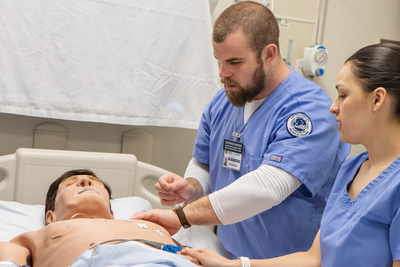
The third program, which the college says it does not have the money to continue, was for a designated employee trained to operate and maintain the school’s high-tech health care simulation lab. That staffer also made all of the clinical placements with the local hospitals for students to get on-the-job experience required for completing their degrees.
Those jobs will again fall back on the professors teaching those classes. The difference now is those degree programs have grown significantly.
Between an associate’s degree in nursing and a licensed practical nursing program, surgical technology and medical assisting, the school has added 45 new students in the past five years. It’s pre-nursing program, which feeds into those other degrees, has doubled, going from 250 students to 500, Bracken said.
“We’re full every semester,” she said.
For now, Central Carolina will still receive funds under a similar, annual grant program, which is considered mandatory under federal law.
Even so, the Trump administration’s Education Department in a statement said it “continues to consider the underlying legal issues associated with the mandatory funding mechanism in these programs.”
Columbia