Feds reject Arkansas’ request to renew Medicaid expansion program
Jul 31, 2026 | 6:21 pm ET

Description
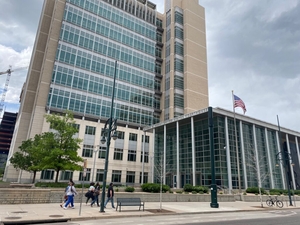
The Arkansas Department of Human Services building on Main Street in downtown Little Rock. (Photo by John Sykes/Arkansas Advocate)
The Trump administration has rejected Arkansas’ request to renew its hybrid Medicaid expansion, Gov. Sarah Huckabee Sanders’ office said Friday, creating uncertainty about the future of a program providing insurance to more than 200,000 low-income people.
Sam Dubke, a spokesperson for the Republican governor, said the federal Centers for Medicare and Medicaid Services verbally confirmed the decision to the state and that officials expect a formal, written notification soon.
“The administration is in discussions with CMS about a temporary extension to ARHOME to ensure impacted Arkansans maintain access to quality, affordable healthcare during this transition period,” Dubke said in an email.
The state’s current waiver for the ARHOME program, which was established in 2013, ends Dec. 31. The state had requested to continue the program through 2031. Barring a special session, lawmakers aren’t set to meet again until the regular session in January.
“Looking ahead to the next legislative session, CMS has provided the state with an opportunity for bold, conservative healthcare reform, and the governor will work with her partners in the legislature to build a sustainable model that maintains the same high quality of care and saves taxpayer dollars,” Dubke said.
Arkansas Explained: What’s happening to the state’s Medicaid expansion?
The Arkansas Democrat-Gazette first reported on the federal agency’s decision earlier Friday.
Arkansas was the first Southern state to expand Medicaid under the Affordable Care Act, but used a first-in-the-nation model that used expansion funds to purchase private insurance for those eligible.
The decision to not renew the program comes less than a month after Centene, one of two insurers providing coverage through ARHOME, announced it would not participate in the program next year.
Gavin Lesnick, the spokesperson for the Arkansas Department of Human Services, said “changes are in store” for the ARHOME program, but the changes would not be immediate. Those with insurance plans through ARHOME do not need to do anything right now, he said, and the department will provide “frequent updates.”
“We look forward to robust discussions with a wide range of partners as we develop the next evolution of this program in a way that is functional, practical, and sustainable,” Lesnick said in a statement. “While it’s too early to know specifics of how this new approach will look, our commitment to connecting eligible Arkansans to effective health care will remain our guiding principle at the core of this work.”
The move also comes as the state has been preparing to impose work requirements for people on the expansion program, required under the federal One Big Beautiful Bill Act.
“It sounds like our Medicaid expansion is seriously at risk going forward,” House Minority Leader Andrew Collins, a Democrat from Little Rock, said. “And it’s gravely concerning because this program was one of the things that helped Arkansans get access to health care, helped keep our provider network healthy and helped keep our state budget afloat for many years.”
Health experts have credited Arkansas’ expansion for a drop in the state’s uninsured rate and for a reduction in hospitals’ costs for treating patients without insurance.
Camille Richoux, health policy director for Arkansas Advocates for Children and Families, said losing Medicaid expansion would be “devastating” for Arkansas.
“It would be devastating for individuals who would lose access to health care, for an already struggling health system, for rural hospitals, for our health workforce who rely on that revenue. We would see a huge increase in uncompensated care and a loss of all the gains in health that we’ve had due to more Arkansans having access to health care for the past 12 years.”
In 2026, the average monthly insurance premium in Arkansas for a medium-level silver plan purchased through Affordable Care Act marketplaces was $774, according to KFF — a $301-a-month jump from 2025.
Senate President Pro Tempore Bart Hester, a Cave Springs Republican, said he wants clarity from the federal government about whether the state needs to be ready to transition ARHOME enrollees to non-expansion Medicaid by Jan. 1.
Hester said he doesn’t believe the Legislature will support continuing Medicaid expansion in the 2027 session that starts in January. He expects the state to put Medicaid recipients in fee-for-service or managed care coverage instead.
“The feds can’t afford it. We can’t afford it,” Hester said. “It’s just not the government’s role to provide healthcare to people, outside of those that are the absolute [neediest].”
House Speaker Brian Evans, a Cabot Republican, said no one should lose coverage while state officials decide what’s next for Medicaid, whether it’s fee-for-service, managed care or “some type of hybrid combination.”
He also said the federal government’s verbal rejection of the ARHOME waiver is not official.
“From the conversations verbally, one would guess that that is the direction that they’re going, [so] they are giving us ample time to work through any changes that we may need to make,” Evans said.
Arkansas adopted the hybrid model as a conservative alternative to Medicaid expansion when state government was divided between a Democratic governor and a Republican Legislature.
The program has survived multiple attempts to kill it, winning reauthorization each year despite the three-fourths vote needed in the House and Senate. The program easily won reauthorization in the Legislature earlier this year.
Republican Sen. Jonathan Dismang of Searcy, who was an architect of the state’s hybrid expansion model, said he did not believe scrapping the program was on the table, but agreed that the form it takes going forward will likely change. The Joint Budget Committee co-chair said he didn’t know what a workable plan for the program could look like yet, and that a “lot of energy” needs to be spent in “a very short period of time” to figure out a solution .
“It’s going to be a massive thing for the next session, and something we shouldn’t take lightly. I can’t think of a more significant decision that we’ve got to make,” Dismang said. “I don’t think we can understate the significance of the decision that’s ahead for the administration, the legislative body, in how we move forward.”
Little Rock