Former SC chief justice elected to SC State’s board over Freedom Caucus-led opposition
Apr 15, 2026 | 6:44 pm ET
Description
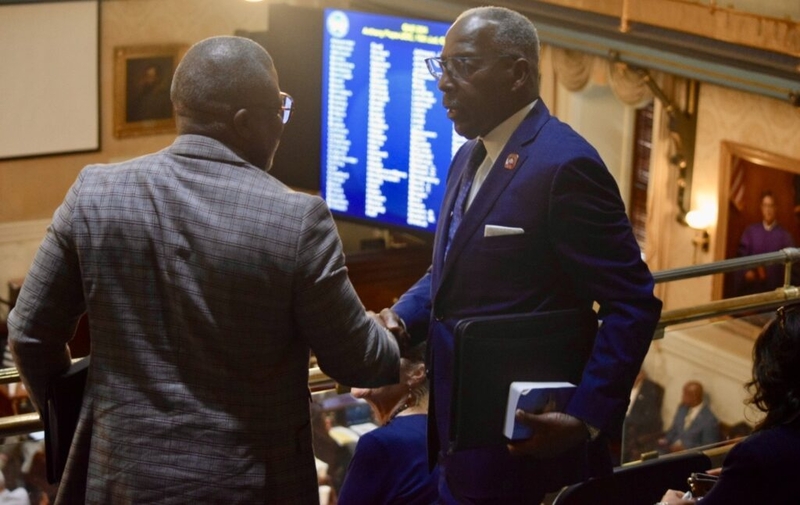
Left to right, Douglas Twitty and former South Carolina Chief Justice Don Beatty shake hands in the state House balcony Wednesday, April 15, 2026, after Beatty beat out Twitty for a seat on the governing board of South Carolina State University. (Photo by Jessica Holdman/SC Daily Gazette)
COLUMBIA — Former South Carolina Chief Justice Don Beatty overcame criticism that he’s a Democrat to win a seat on the governing board of his alma mater.
The General Assembly elected the state’s retired top judge to the South Carolina State University Board of Trustees in a closer-than-usual vote Wednesday. With 150 legislators attending the joint assembly, the winner needed at least 76 votes (a simple majority). Beatty cleared that threshold by 10 votes.
The 86-64 vote followed an unsuccessful attempt by the ultra-conservative House Freedom Caucus to toss out the slate of candidates and start over.
Beatty ultimately beat out retired Army Lt. Col. Douglas Twitty, a Fort Mill businessman.
Both Beatty and Twitty are alumni of South Carolina’s only public, historically Black university — two decades apart. Beatty was in the Class of 1974, and Twitty was Class of 1995.
Beatty went on to attend the University of South Carolina in 1979 for law school after spending two years as an officer in the Army.
Retiring SC Chief Justice Don Beatty grew up in the civil rights era, urges judicial diversity
But it was Beatty’s time as a Democrat in the state House and decisions he made while on the state’s high court that were the source of opposition, said Rep. Jordan Pace, who chairs the Freedom Caucus.
The hardline caucus didn’t know much about Twitty, beyond his 26 years of military service, which included deployments to Iraq and Afghanistan, where he earned a Bronze Star, the Goose Creek Republican told the SC Daily Gazette.
“But mostly he wasn’t Don Beatty,” Pace said.
During candidates’ screening last month before a legislative panel, no one asked Beatty or Twitty about their party affiliation, according to the transcript.
Beatty was elected to the House as a Democrat for two terms starting in 1991. Legislators elected him directly from the Statehouse to a seat on the Circuit Cout in 1995 (before state law required legislators to leave and sit out a year before seeking election to a judicial seat).
In 2007, the Legislature elected him the second Black justice on the state Supreme Court since Reconstruction. He eventually rose to the pinnacle of the state’s legal system as chief justice in 2016.
Then, in 2022, the U.S. Supreme Court overthrew Roe v. Wade, which left the legality of abortions to legislators and state courts.
The General Assembly twice passed a law banning abortions after six weeks of pregnancy. The state Supreme Court threw out the first law in January 2023 on a 3-2 split vote, with Beatty in the majority.
Eight months later, justices upheld the second law 4-1, with Beatty the lone vote to strike it down again. He was also the lone justice voting days later to reconsider the ruling. That dissenting opinion outright encouraged a new lawsuit challenging the ban’s timing.
Last May, after Beatty retired, the justices ruled unanimously that the ban is effective at six weeks.
New research status for SC State highlights its enrollment, fiscal turnaround
“Neither candidate was a strong conservative option,” said Pace, who pointed to the abortion rulings in his opposition to Beatty. “We have a Republican supermajority in both chambers. The candidates should reflect the population of the state, values wise.”
Asked about the outcome of the race, Twitty declined to comment to the SC Daily Gazette.
As for Beatty, he summed up his hopes for his alma mater in one word: “progress.”
“My roots run deep at SC State,” Beatty told the screening panel in March, adding that three of his siblings also graduated from the college in Orangeburg.
“I have a deep and passionate love for that institution. And I have to give it credit for making me, excuse me, the person that I am today,” he told the panel, noting the governing board lacks a lawyer who could’ve guided decisions on “completely avoidable” lawsuits.
In the last decade, SC State has recovered from a mounting debt and threatened closure to achieve a new level of research status.
“I am happy to say, at this point in time, we’re on the upswing,” Beatty told legislators. “I want to lend whatever talents that I might have for the future and continued growth of that institution.”
Columbia