Federal court hears arguments in Alabama appeal of absentee ballot ruling
Sep 17, 2025 | 7:59 am ET
Description
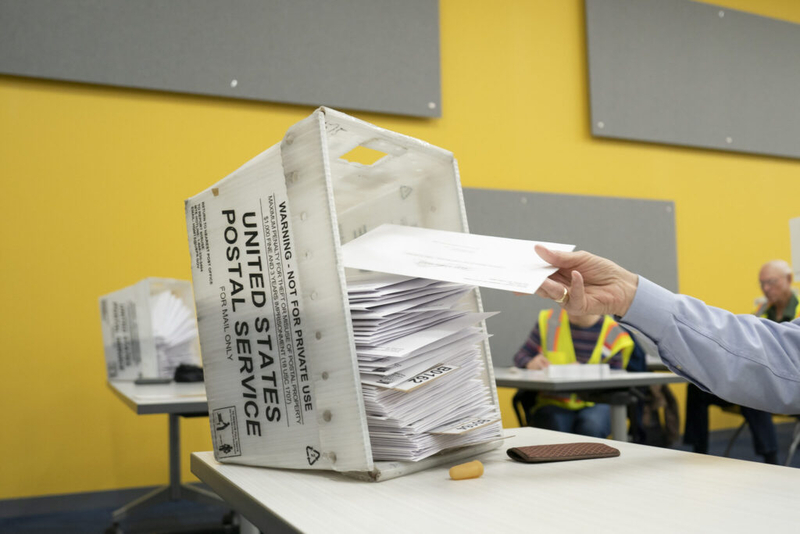
Absentee ballots are prepared to be mailed at the Wake County Board of Elections on Sept. 17, 2024 in Raleigh, North Carolina. A federal court Tuesday heard arguments in Alabama's appeal of a lower court ruing that struck down a portion of a law criminalizing some forms of absentee ballot assistance. (Allison Joyce/Getty Images))
A federal court heard arguments Tuesday in Alabama’s appeal of a 2024 ruling that blocked a portion of a state law criminalizing some forms of absentee ballot assistance.
SB 1, sponsored by Sen. Garlan Gudger, R-Cullman, made it a Class C felony, punishable by up to 10 years in prison, for a person to knowingly receive payment for “distributing, ordering, requesting, collecting, completing, prefilling, obtaining or delivering” an application. A person convicted of knowingly paying or providing a gift to a “third party to distribute, order, request, collect, prefill, complete, obtain or deliver” would be subject to a Class B felony, punishable by up to 20 years in prison.
U.S. District Judge R. David Proctor ruled last year that a portion of the law violated the federal Voting Rights Act, which allows blind, disabled and illiterate voters to choose a person to assist them with filling out a form.
Alexander Barrett Bowdre, representing the Alabama Attorney General’s office, said Tuesday the purpose of the law is to prevent voter fraud, not to prevent disabled voters from casting a ballot.
“Alabama’s SB 1 incorporates Section 208 of the Voting Rights Act, because both laws have the same overarching purpose, which is to protect vulnerable voters from experiencing manipulation, coercion or fraud during the voting process,” Bowdre told the three-judge panel.
The main question in the case is whether or not Alabama’s law preemptively contradicts the Voting Rights Act.
“We would argue that there is no preemption, because our law is not contradictory. It actually incorporates Section 208 and gives full effect to Section 208,” Bowdre said.
U.S. Circuit Judge Britt C. Grant questioned his argument and the difference between “knowingly” and “intentionally.”
“I guess I don’t understand your argument,” she said. “If the person is a paid health care worker or paid aid, whatever, and the only reason that they’re there, receiving the instruction from the person they’re helping, is to help that person in whatever capacity, including filling out their application for an absentee ballot. Why are they not, as a matter of fact, receiving payment for doing exactly what the statute prohibits?”
U.S. Circuit Judge Robin S. Rosenbaum said the law puts caretakers, who are paid to aid potentially disabled voters, from aiding them in voting.
“It says it from the point of view of the person with the disability, who is blind or who is illiterate, but be the helper, it exposes all of them to criminal liability, up to 20 years in prison if they knowingly accept money in exchange for helping the person,” Rosenbaum said.
Bowdre said Alabama law “does distinguish between knowingly and intentionally.”
I don’t think that that makes a big difference here, because in the statute, the person would accept payment for distributing, ordering or requesting the ballot applications,” he said.
Anuja Thatte, representing the plaintiffs who initially challenged the law, said that since the law does not define “third party” and later prohibits “a person” from aiding a disabled person in filling out an absentee ballot or application, it creates uncertainty.
“I think part of it derives from going back to the statute of SB 1 itself, which doesn’t obviously define third party. And I think third party can be construed: Are you someone who’s sort of outside the voter-election official transaction?” Thatte said. “I think it’s all sort of vague, and I’m not sure that any of this turns on the usage of the word third party versus not.”
Section 208 of the Voting Rights Act protects the rights of disabled people to vote, with assistance if necessary, except for the voter’s employer or union representative. The 2024 Alabama law includes the text of Section 208, but does not provide explicit exemptions for disabled voters or their assistors.
U.S. Circuit Judge Andrew L. Brasher questioned the way the law was written, saying it seemed like Sections E and F were put on the end of the law when lawmakers realized there are federally protected voters. Section E protects disabled voters and Section F protects voters that may vote via absentee ballot from overseas deployments.
“Why isn’t that at least a reading of this statute that is good enough that we should ask the Alabama Supreme Court if that’s the right way to read the statute?” Brasher asked.
Thatte advocated for a change in the statute that was not vague.
“To the extent there is a way to protect voters and assisters under (Section) E for any part of this statute, we certainly wouldn’t object to that, Your Honor,” Thatte said. “If there’s a way to read this statute to say voters who pay their assister, liable under Section 208, we certainly would also appreciate that.”
The judges did not immediately rule on the state’s appeal Tuesday.
Montgomery