Lawsuit challenges South Dakota’s new ban on abortion-pill advertising
May 29, 2026 | 7:20 pm ET
Description
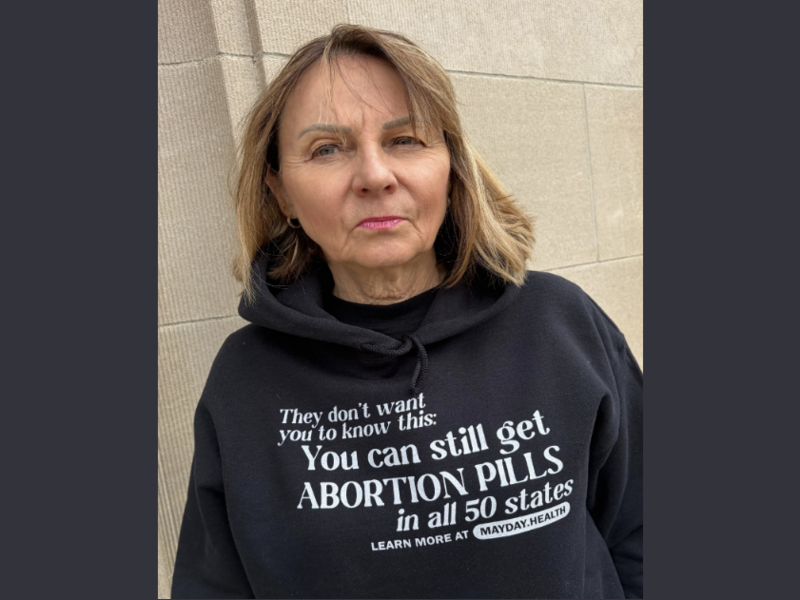
A new South Dakota law unconstitutionally bars Nancy Turbak Berry from wearing this sweatshirt advertising abortion-pill information, she alleges in a lawsuit. (Image from court documents)
South Dakota’s new law criminalizing the providing and advertising of abortion pills and other abortion-related items faces a lawsuit alleging the advertising prohibition is unconstitutional.
A New York-based nonprofit, Mayday Health, and a Democratic former South Dakota lawmaker, Nancy Turbak Berry, filed the lawsuit Friday in federal court against South Dakota’s Republican governor and attorney general.
The state’s Republican-dominated Legislature passed the bill in March, and Gov. Larry Rhoden signed it into law that same month. It’s scheduled to take effect July 1.
South Dakota already had a law that bans abortions except when necessary “to preserve the life of the pregnant female.” The new law says no person may knowingly dispense, distribute, sell or advertise an article or thing designed, adapted or intended to produce an abortion. The ban also covers any article, instrument, substance, drug, medicine or thing that is “advertised or described in a manner calculated to lead another to use or apply it for producing an abortion.”
New anti-abortion laws clarify definition, criminalize pills, require prenatal videos in schools
Violations are felonies punishable by up to two years in prison and a $4,000 fine. The law also gives the state attorney general authority to recover civil penalties of $10,000 per violation.
The lawsuit alleges it’s unconstitutional to prohibit advertising that’s protected by the free speech guarantees in the First Amendment.
Turbak Berry previously led a group supporting a failed 2024 ballot question that would have restored abortion rights in the state. The lawsuit alleges her free speech is deterred by the new law. As an example, the lawsuit says the prohibition on advertising would prevent her from wearing a sweatshirt that features Mayday’s mission and web address.
“Unless this court grants relief, Turbak will be deterred from wearing the sweatshirt, and thereby deterred from engaging in lawsuit First Amendment-protected speech,” the lawsuit says.
Turbak Berry responded to South Dakota Searchlight with a written statement.
“Apparently, our state government isn’t satisfied with controlling women’s reproductive organs — they even want to control our eyes and ears,” Turbak Berry said. “They even want control over what women in South Dakota can see and hear. It’s outrageous.”
Gov. Rhoden responded to the lawsuit in a post on X, formerly Twitter.
“If Mayday Health and the abortion lobby want to sue us for defending unborn life, bring it on.”
State Attorney General Marty Jackley issued a written statement.
“The U.S. Supreme Court has made it clear that states have the right to protect life,” Jackley said. “As with Mayday’s previous unsuccessful lawsuit, I will defend innocent life.”
Mayday previously engaged in a legal battle with Jackley over advertisements Mayday placed at gas stations around the state saying “Pregnant? Don’t want to be?” and directing people to Mayday’s website, which includes information on obtaining abortion pills.
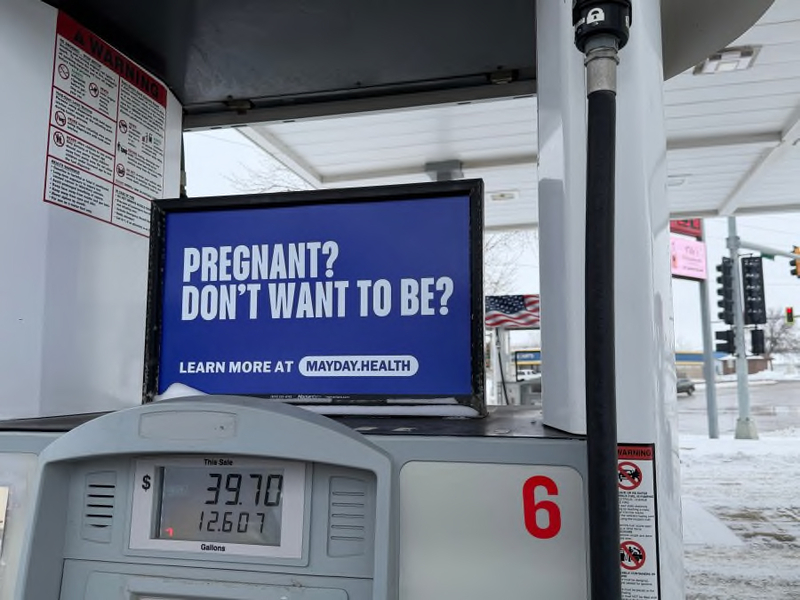
In dueling state and federal lawsuits, Jackley accused the nonprofit of violating South Dakota’s abortion ban. Mayday claimed its advertisements were protected under the First Amendment. The lawsuits ended with a settlement that included Mayday removing the ads.
In 2023, medication abortions accounted for 63% of abortions in the country, according to data from the Guttmacher Institute. The drugs mifepristone and misoprostol, commonly used in medication abortions, are also listed on the World Health Organizations’ list of essential medicines.
The U.S. Supreme Court decided earlier this month to preserve telehealth access to mifepristone until after the U.S. 5th Circuit Court of Appeals has ruled on the merits of the lawsuit Louisiana v. Food and Drug Administration. Louisiana, where state officials sued the FDA in October, is arguing that a rule allowing telehealth access to mifepristone undermines the state’s abortion ban.
EDITOR’S NOTE: South Dakota Searchlight has engaged attorney Jim Leach, who represents the plaintiffs in the lawsuit, in a past legal matter.
For broadcasters

Pierre, SD