House lawmakers see governor’s proposed FY27 budget and raise it to $15.2B
May 29, 2026 | 8:06 pm ET

Description
The Rhode Island State House is shown on a January night in 2026. (Photo by Michael Salerno/Rhode Island Current)
Two long-debated topics on Smith Hill, a millionaire’s tax and a state inspector general, were cemented in the revised fiscal 2027 budget given first passage by a panel of House lawmakers Friday night.
The record $15.2 billion budget — even higher than the $14.9 billion tax-and-spend plan Gov. Dan McKee unveiled in January thanks to an extra $228 million surplus revealed from updated revenue estimates in May — sailed through committee in record time, with the Friday night deliberations complete by 7:30 p.m.
The revised version preserves McKee’s proposed millionaire’s tax, but spreads out the 3% tax hike on an income over $1 million across three years rather than making the change in a single year.
“We thought this strikes the right balance here for our state given the situation we’re in with the federal government,” House Speaker Christopher Blazejewski said in a briefing with reporters Friday night. “We wanted to be sure we have revenue coming online at the same time we see a decrease in federal support.”
Raising taxes on top earners took center state on Smith Hill this year, with business groups decrying the economic consequences for top employers, and progressives urging lawmakers to enact a more comprehensive version of a “tax the rich” proposal to offset forecasted federal funding cuts.
Another long-simmering debate, to create an independent inspector general, gained traction weeks ago thanks to the backing of Blazejewski days after his ascension to the leadership role. Blazejewski, who was elected by his peers to succeed K. Joseph Shekarchi 22 days ago, cemented his advocacy for the government watchdog by including the $2 million, 12-person office in the revised fiscal 2027 budget.

The even-keeled Providence Democrat raised his voice in defense of the proposal, and specifically the exclusion of the legislature from the inspector general’s purview, when questioned by a reporter Friday.
“Once we pass this budget, 99.5% of government spending will fall within the Office of Inspector General,” Blazejewski said. “To me, that’s incredibly important.”
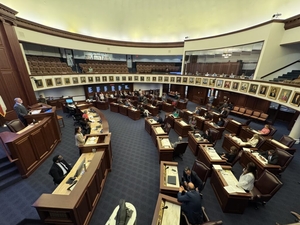
The House Committee on Finance’s 11-2 vote Friday sends the updated spending proposal to the full House of Representatives for consideration on June 5. The two Republicans, George Nardone of Coventry and Sherry Roberts of West Greenwich, voted against the revised spending plan.
Lawmakers must approve a final spending plan before the new fiscal year begins July 1.
Prioritizing healthcare
Federal funding cuts under the One Big Beautiful Bill Act remain a top concern for legislators, who are leveraging the state’s surplus to help blunt the consequences for hospitals and healthcare providers, working families with children, and transit riders.
To that end, the revised fiscal 2027 budget includes the full $116 million Medicaid reimbursement rate increase for home and behavioral health providers as recommended by the Office of the Health Insurance Commissioner. McKee’s initial proposal spread out the inflationary payment adjustment over two years.
Lawmaker also added another $26 million in state funds to hospitals to offset rising costs associated with more under and uninsured people — short of the $70 million hospitals wanted, but enough to assuage some of the worst cuts to service and staff. There is also $1.6 million dedicated to the Newport Hospital birthing center, and $5 million in initial funding for a new medical school at the University of Rhode Island.
“I am particularly proud of the strong investments we are making to improve our health care system and to support Rhode Islanders in need,” Senate President Valarie Lawson said in a statement Friday night.
Childcare and education
Noting the personal importance of childcare — the newly minted speaker has a 12-year-old daughter and a 9-year-old son — Blazejewski also emphasized efforts to help working families afford and access childcare. Lawmakers restructured McKee’s proposal to establish a permanent child tax credit for income-eligible families with the intent of making a bigger impact for middle-income families. The $330 per child credit, on average, will cost $23 million in fiscal 2027, with a $46 million price tag for a full year offering in fiscal 2028.
Formula-driven state aid to school districts is also increasing above current levels and beyond McKee’s plan, with the extra spending concentrated on transportation costs and low-income students. And the long-awaited return of the Central Falls school system to city control has arrived after more than three decades under state purview, with a $1.5 million allotment of state education aid for the city district in the fiscal 2027 spending proposal.
Lawmakers are also filling the estimated $4.6 million deficit in the Department of Children, Youth and Families, preventing the staffing cuts that have prompted protests by employees who say the short-staffed agency is inequipped to adequately protect and help children under state care.

Energy affordability
Advocacy to protect the state’s ambitious climate change mandates was also acknowledged by lawmakers, who opted not to proceed with the most controversial elements of McKee’s energy affordability plan. The revised fiscal 2027 budget offers short-term savings to ratepayers by incorporating nuclear and hydropower into the acceptable renewable energy sources needed to meet state benchmarks. But the 2033 deadline to generate 100% of electricity needs from renewables, or purchase credits to offset fossil fuel use, remains intact.
“That was really important to our caucus,” said Majority Leader Katherine Kazarian, an East Providence Democrat.
Social Security taxes
Not as important: easing Social Security benefit taxes to retirees. McKee pitched a three-year phaseout of the state income taxes on retirement benefits. But lawmakers agreed only to the first step of the phaseout, which eliminates the age requirement that allows retirees over 67 to bypass the tax. But the $40 million cost to eventually cut income taxes on Social Security benefits for higher-income retirees remains in flux.
“Hopefully we have a better budget next year, and are in a better position to take another look,” Blazejewski said.
RIPTA and RIDOT
But, the cash-strapped Rhode Island Public Transit Authority will no longer have to fight for survival, with a $7 million boost above what McKee proposed for fiscal 2027. Rather than cut the gas tax by 2 cents, as McKee pitched, lawmakers are preserving the gas tax increase from last July. Instead they are drawing on a separate highway maintenance account through the Rhode Island Department of Transportation to boost RIPTA. There will be no increases in cruise ship fees in Newport, which were originally proposed as a means to help fund RIPTA.
The revised budget also requires a state-led audit of RIDOT, in acknowledgement of the high-profile failures of the Washington Bridge and, more recently, the Route 10 onramp.
And, the state transportation director will no longer lead RIPTA’s appointed board of directors, though they will continue to have a seat on the panel.
“We think it’s a conflict of interest,” Blazejewski said of letting McKee’s cabinet director on roads and bridges call the shots for the quasi-public transit agency.

Bonds
The $600 million borrowing plan across a series of six bond questions on the November ballot remains intact, although the allocations have shifted, with more money for a new health sciences building at URI and preserving farm and forestland. A $50 million bond for a new career and technical education program via the state education department was cut, following testimony that the startup bond was not enough to fully fund the program, Blazejewski said.
The state archives and history center pitched by Secretary of State Gregg Amore remains.
Other highlights
- A $19 million earmark ($9.5 million more than McKee’s proposal) to help offset rising premiums for HealthSource RI participants remains in the revised fiscal 2027 budget.
- Additional funding and a new state magistrate to oversee a designated domestic violence court, as suggested by Judge Joseph Montalbano, presiding justice of the Rhode Island Superior Court.
- No additional money for Bally’s Corp, which had asked for another $11 million for marketing efforts as a workaround to offset potential revenue losses from a ban on indoor smoking in its Rhode Island casinos
- No increases in cigarette and cigar taxes, asMcKee’s proposal sought.
- A line-item veto for the governor, which McKee enshrined in his spending plan, did not make it past lawmakers’ review.
McKee said he was “encouraged” by the inclusion of his priorities, including Social Security tax relief, child tax credits, money for state heath exchange participants and an extension of the Hope Scholarship at Rhode Island College.
‘Our team is reviewing the full budget now, and we’ll have more to say in the coming days,” McKee said in a statement Friday night.
Democratic representatives Karen Alzate of Pawtucket and Nathan Biah of Providence were absent from the meeting.
- 8:52 pmUpdated to include comments from Gov. Dan McKee.

Providence, RI