FY 26-27 budget done, vetoes are coming, and property tax debate lies ahead
May 29, 2026 | 7:47 pm ET
Description
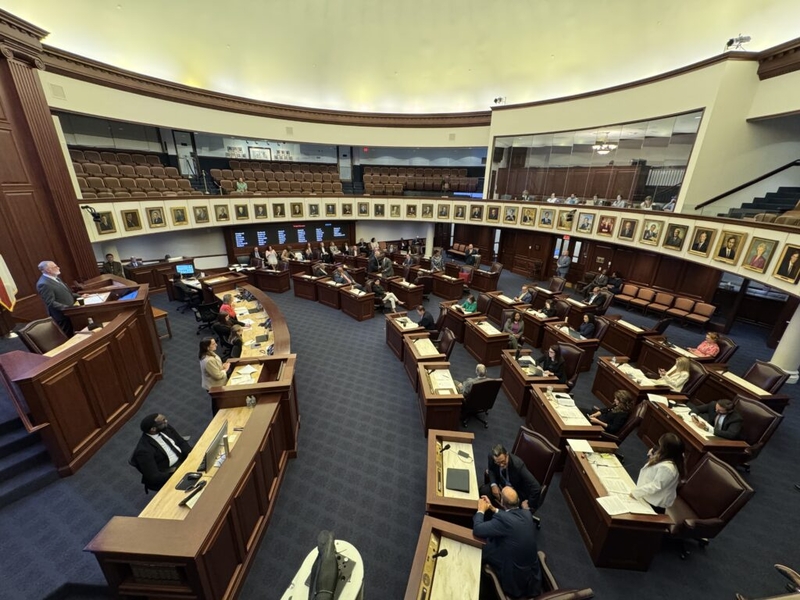
The Florida Senate chamber on May 29, 2026. (Photo by Jay Waagmeester/Florida Phoenix)
The Florida Legislature signed off on a $114.5 billion budget Friday afternoon, even as some legislators worried it falls short of doing enough for schools, healthcare, and the environment.
A handful of Democrats also sharply criticized a nearly $300 million tax cut package that they said does more to help special interests than everyday Floridians.
Republican legislative leaders countered that the budget pays for critical needs while at the same time reducing overall spending from the previous year.
Democrats also complained that a push to suspend the state’s gas taxes, which Gov. Ron DeSantis embraced in October 2022 but not this year, ultimately was not included in the tax reduction package, while savings for gun accessories, including silencers, was embraced.
The Senate voted unanimously to pass the state fiscal year 2026-27 budget, while the House voted 99-6 to pass the budget to guide state spending between July 1 and June 30, 2027.
The budget sets spending guidelines for public schools, higher education, healthcare, criminal justice, the environment, and more.
“Floridians expect their government to spend responsibly and prioritize the issues that matter most to families across our state,” House Speaker Daniel Pérez said in a written statement following the vote.
Additionally included in the budget is a $4 million appropriation for the so-called Groveland Four. It includes $50 million to help the Tampa Bay Rays build a new stadium near Hillsborough College. It also earmarks $250 million for an emergency fund overseen by DeSantis that he has used for immigration enforcement.
Eleventh hour budget deal includes $4M compensation for ‘Groveland Four’
Some members quickly rushed out of the Capitol to catch Friday afternoon flights home but they must return to Tallahassee Monday for a special session on property taxes.
After more than a year discussing property tax reductions, the governor’s office sent the Senate its formal proposal, which Sen. Bryan Avila filed this week as SJR 2F. DeSantis wants to increase the state’s homestead property tax exemption to $150,000 of a home’s value beginning Jan. 1, 2027, and to $250,000 beginning Jan. 1, 2028.
Opposition
That proposal faces opposition from both Republicans and Democrats and even some special interest groups.
The Florida Association of Counties sent an email to the 160 members of the Legislature Friday calling DeSantis’ proposal a “tax shift” and asking them to vote against it.
“Decisions about how to fund local services work best when they are made close to the people who live with them. Property taxes are local by design. They are debated publicly, set locally and tied directly to the services residents see every day,” the counties wrote.
The Florida Education Association also came out against the plan, arguing it would starve public schools. And the Florida Chamber of Commerce, which frequently aligns itself with the governor, said in a written statement that it would evaluate the proposal and its potential fiscal impacts with its members.
The Chamber noted that property taxes accounted for nearly $60 billion in local government and school funding in 2025 — more than the $55.18 billion paid by local governments the year before.
Meanwhile, Democrats in both the House and Senate, without dropping any specific names, said they have heard tell of the governor’s lobbying efforts to get his proposal passed. To put his proposal on the ballot, a supermajority — 60% — of each legislative chamber must vote for the legislation.
“I also have heard that he’s been calling around some members on both sides of the aisle, trying to lobby them to vote for his property tax proposal, but what’s interesting to me is, when I have conversations with colleagues on both sides of the aisle, they understand that this is wildly unpopular, and that it would toggle our local government, that it would harm our public schools. So, it’s going to be interesting,” Tampa Democrat Fentrice Driskell, the House Democratic leader, said.
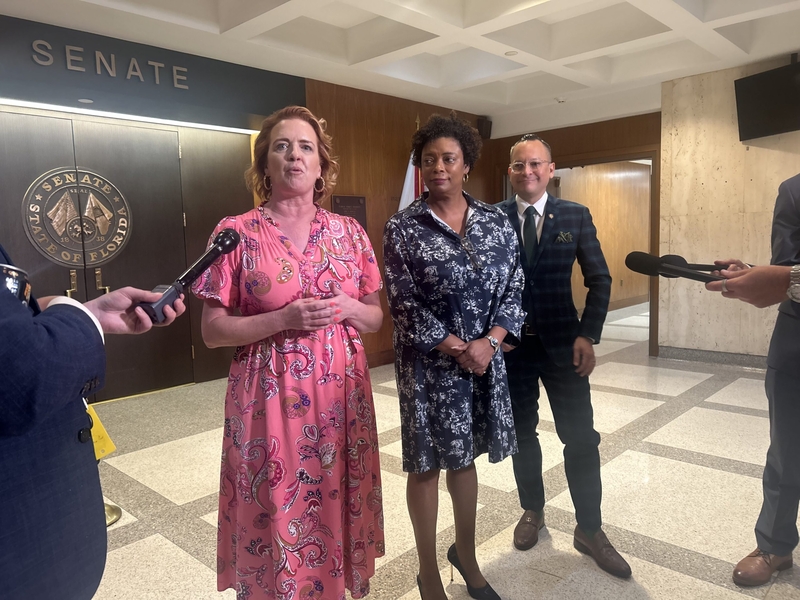
There’s “no consensus” in the Senate to vote for the plan, Jacksonville Democratic Sen. Tracie Davis said.
“We know that we’re talking among ourselves, we’re talking to our colleagues, we know that we’re split all over the place, so it’ll be interesting to see where we land with this,” said Davis, the Senate Democratic leader-elect.
“We do know it’s a split, and there is no consensus over here as to where we will land, whether we have a number of people that’s going to support this measure or not. We know we’re going to have members on both sides,” Davis said.
If DeSantis gets his plan on the November ballot, it would take 60% of the voters in November to vote “yes” for it to take effect.
Vetoes
DeSantis twice in the past two weeks mentioned his power to veto line items from the budget. Delivering the keynote address during a Federalist Society meeting May 22, the governor acknowledged he vetoes money for projects championed by legislators who oppose his agenda and priorities.
“That helps you to be able to advance a legislative agenda,” DeSantis said of veto threats.
And DeSantis this week mentioned budget vetoes while calling for the three-day special session on property tax reduction.
His comments haven’t fallen on deaf ears.
“I mean, this is the elephant in the room as we’re here voting on a budget. Many of us would like to feel good about member projects for our municipalities — water projects, road projects, nonprofits that provide meals to our seniors. But we don’t know what’s going to happen to all those programs and municipalities come this property tax reform next week,” Sen. Kirsten Arrington, a Democrat from Kissimmee, said.
“So, while we’re here, we’d love to pat ourselves on the back and feel good about projects and stuff that we’re bringing home. We don’t know what’s on the horizon.”
Driskell felt similarly.
“I do think that he has now released his property tax proposal during budget season because he wants that to be a threat,” she said.
Education
There was perhaps no more controversial issue when it came to education than the state’s universal school voucher program. An audit showed financial mismanagement by the Department of Education. While the Senate pushed to separate voucher funding from traditional public school funding, the House held firm against bifurcating the dollars.
Specific to higher education, there is no money in this budget for “preeminent universities” even though the Senate pushed for $100 million. That money in the past has rewarded schools that demonstrate excellence in various categories.
Budget on the table, but House and Senate can’t agree on solution to school voucher struggles
Health
Healthcare is the largest portion of the budget, accounting for $49.2 billion, and, not surprisingly, was one of the last to be finalized before the General Appropriations Act was agreed upon over the Memorial Day Weekend.
Ultimately, the Legislature agreed to increase Medicaid reimbursement rates for nursing homes and pump additional funds into two programs that help people with intellectual and developmental disabilities obtain the care they need to keep them living outside of institutions and in the community.
An additional $10 million was appropriated to the Agency for Persons with Disabilities to help chip away at a lengthy waiting list for the iBudget waiver program. Another $15 million was directed to Medicaid to pay for a managed care program for people with intellectual and developmental disabilities.
The Legislature agreed to reduce reimbursements by 1.3% to contracted Medicaid managed care plans that provide services to the poor, elderly, and disabled. Only contracted plans can provide services in the state’s Medicaid program. The Legislature agreed to extend the length of those contracts from six years to 10 years.
Hospitals, which had faced potential budget cuts, went unscathed.
Criminal justice
Regarding criminal justice, the budget provides $4.05 billion for the Department of Corrections. That includes $50 million for a new prison hospital and $52 million for additional dorms. It does not include funding for a new prison.
Nor does it include additional funding to provide air-conditioning for any prison facilities.
Orlando Democratic Sen. Carlos Guillermo Smith noted that a 2023 report conducted by KPMG showed it would cost $582 million to install air conditioning in all of the state’s prisons.
The budget includes $78.7 million to increase correctional officer pay, raising the minimum hourly wage to $24. It provides the corrections agency with an additional $12.9 million for recruiting and retaining prison guards.
The budget includes $4.4 million for 40 positions in state attorney offices. Of that, $1.8 million is earmarked for eight new positions in public defender offices.
Environment
The budget includes $638.6 million for Everglades Restoration, including money to complete the state’s portion of the Everglades Agricultural Area (EAA) Reservoir, a critical 17,000-acre infrastructure project south of Lake Okeechobee.
Everglades Foundation Vice President for Government Affairs Bradley Watson issued a statement thanking DeSantis and noted that he “fulfilled the promises” he made regarding Everglades restoration in two separate executive orders, one issued after initially taking office in 2018 and another after his re-election.
Democrats lamented that there is no direct funding for Florida Forever, the state’s main program for buying land for conservation, but $425 million for the Rural and Family Lands Protection Program, which allows agricultural landowners to permanently preserve their land from development but doesn’t require the landowners to allow public access.
The failure to again fund Florida Forever was denounced by St. Petersburg Democratic Rep. Lindsay Cross.
“As a Legislature, it would be wise to recognize the value of our parks as places for people to improve their physical and mental health, especially as our children spend more time behind screens than they do green spaces,” Cross said. “These parks are also economic engines, providing a three-to-one return on investment for towns and communities.
“Going forward, the state needs to reimagine and reinvest in conservation programs, in ways that feed our families, protect our water, preserve our vibrant wildlife and increase safe and equitable access to natural areas for people.”
Mitch Perry and Jay Waagmeester contributed to this story.
Tallahassee, FL