Ethics Commission dismisses complaint at center of GOP probe into DOJ legal fellows
Jul 13, 2026 | 5:27 pm ET
Description
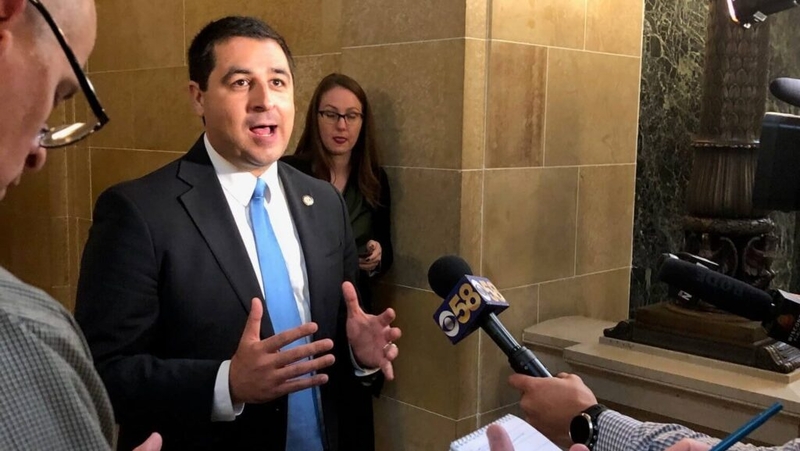
Attorney General Josh Kaul speaks with reporters outside the Wisconsin Supreme Court in February 2023. (Wisconsin Examiner photo)
The Wisconsin Ethics Commission has dismissed a complaint alleging Attorney General Josh Kaul violated state rules when the Department of Justice hired out of state lawyers on contract to enforce the state’s environmental regulations.
The complaint was dismissed by the commission late last month in a closed session and released to the public last week. The issue has been highlighted by Republican legislators eager to land blows on Kaul, who is running for re-election against Fond du Lac County District Attorney Eric Toney, a Republican.
Faced with a limited budget from the GOP-controlled Legislature and increased scrutiny on the DOJ since the enactment of the Republican lame duck laws in 2018, Kaul hired the out-of-state lawyers to assist with the enforcement of the state’s environmental regulations.
The lawyers were given fellowships to work as special assistant attorneys general through a New York University program tied to former New York Mayor Michael Bloomberg. The attorneys were paid by the NYU program and officially classified as volunteers under the state employment system yet given the powers of an assistant attorney general.
In a statement to the Wisconsin Examiner, Kaul said the dismissal of the complaint confirms that Republicans were only trying to score partisan points against him.
“This unambiguous dismissal from the bipartisan Ethics Commission makes it even clearer that the Senate Oversight Committee is a partisan stunt,” Kaul said. “The Wisconsin Department of Justice will not be deterred from effectively enforcing our laws.”
The complaint over the fellows was made to the ethics commission in February 2025, alleging Kaul engaged in a quid pro quo by hiring the fellows to work on specifically environmental litigation.
This February, the newly established Committee on the Oversight of the Department of Justice held a multi-day hearing in which Kaul and other DOJ officials were grilled about the program. In March, the committee released a report detailing the Republican belief that hiring the fellows amounted to Kaul putting the department up for sale and letting state litigation strategy be determined by an outside interest group.
Leading the testimony against the DOJ during the February hearing were a representative from Wisconsin Manufacturers and Commerce, the state’s largest business lobby and a powerful GOP ally, and a dairy farmer who was subject to an enforcement action by the state after he operated his factory farm without a permit for six years. The committee was chaired by Sen. Mary Felzkowski (R-Tomahawk), who has a legislative history of opposing environmental initiatives.
In the report, Republicans allege that the arrangement was “not authorized” by Wisconsin statutes, that the DOJ violated state law by not immediately administering the attorneys oaths of office, exposes concerns about the state’s system for adjudicating ethics complaints, opens the state up to influence from outside interests and that the DOJ did not fully cooperate with records requests filed by the committee.
The report recommends that the DOJ immediately terminate the agreements that facilitated the hiring of the attorneys. It also recommends that the Legislature pass a resolution declaring the hirings unlawful, more strictly manage the processes through which the DOJ is funded and pass legislation that only state employees can conduct prosecutions. Additionally the report states that government attorneys should take their oaths of office before conducting any work for the state and that the state Ethics Commission should be subject to faster timelines for adjudicating complaints.
In the dismissal of the ethics complaint, the commission found that Kaul doesn’t gain any personal benefit by hiring low-level attorneys to handle litigation.
“As an elected official, [Kaul] is vested with significant discretion in what his agency focuses its efforts on,” the dismissal states. “It is, in fact, possible that, as a result of the acceptance of the legal services of the fellow, the DOJ will be able to participate in more environmental litigation or other official actions related to the environment. It is also possible that the DOJ might be able to shift a paid staff member to other work. However, the statutory influence clause is not concerned with whether accepting the service of the legal fellow could reasonably be expected to influence the
DOJ’s actions. It is concerned with whether it could reasonably be expected to influence the state public official’s actions. By naming only the Attorney General, the question is whether acceptance of the free services could reasonably be expected to influence the Respondent’s official actions, not others in the Department of Justice.”
The dismissal also noted that the state has an interest in hiring interns and fellows to complete the necessary work of state government.
“Accepting unpaid interns and unpaid fellows is a benefit to the agency in which they work and to the State more generally,” the dismissal states. “Absent additional facts, unpaid interns and unpaid fellows are not a benefit to a specific state public official. This is true in every case where an unpaid intern or unpaid fellow works. Moreover, the services of an unpaid intern or fellow, are generally of the nature and type that it is not reasonable for a person to expect it to influence the elected head of a large agency, in the absence of other facts.”
Additionally, the dismissal states that the commission “is aware that the Legislature is concerned” about the issue and noted that the ethics statutes aren’t the proper venue for handling the question.
“The ethics laws were not intended to cover discretionary decisions where there is no personal benefit to officials or more than a theoretical potential impact or influence on an official’s decision,” it states. “As noted above, the ethics laws are not intended to apply to agencies; they are intended to apply to individual officials. Whether an agency should accept the services of someone that is provided by or paid by an outside organization, is a question of policy that can be addressed by the Legislature. Indeed, it is the body politic that is best suited for that purpose.”
Madison, WI