Eliminating property taxes would weaken local control and open the door to income tax discussions
Jun 28, 2026 | 8:00 am ET
Description
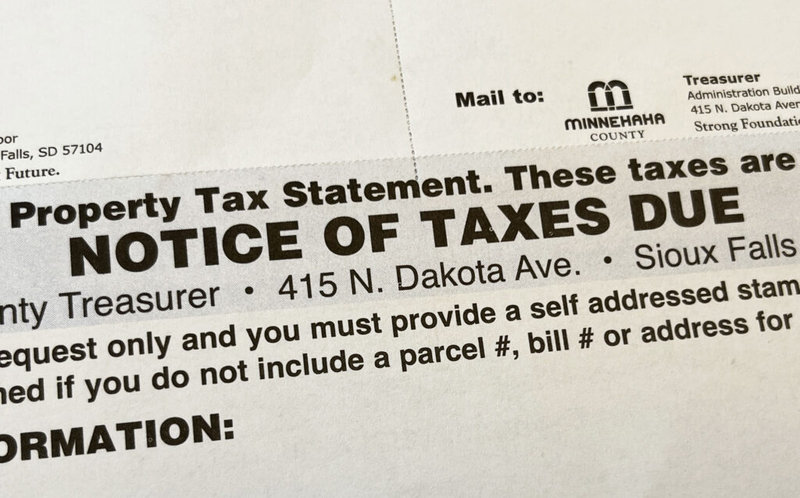
A Minnehaha County property tax bill delivered in early 2026. (Photo by Makenzie Huber/South Dakota Searchlight)
Toby Doeden, a candidate for the Republican nomination for governor, says he wants to eliminate property taxes.
Most people hear that and immediately think about their own bill. They wonder whether they would finally get relief from rising valuations and steadily increasing taxes.
That is understandable.
But the bigger question is not how much you pay. It’s who decides.
Because eliminating property taxes would not just change how South Dakota raises revenue. It would change who controls local government.
Today, counties, cities and school districts raise much of their own revenue through property taxes. Local voters elect local officials, and those officials decide how local dollars are spent.
It’s imperfect, but it’s local. Take away property taxes and that relationship changes fundamentally.
How governor candidate Toby Doeden says he’ll phase out property taxes
Schools, counties and cities would become dependent on money distributed by Pierre. Legislators — not local boards — would determine whether communities have the resources to maintain basic services.
The irony is hard to miss. Politicians advocating property tax elimination are often the ones who campaign loudly on local control.
Property taxes are unpopular. Local control is not. Eliminate one, and you weaken the other. And that’s before we even get to the money.
Property taxes generate roughly $1.9 billion every year, funding schools, counties, cities, townships, law enforcement, roads, bridges, emergency services and more.
A governor cannot make that revenue disappear. Only the Legislature can eliminate property taxes. And if lawmakers choose to do so, they must replace every dollar. Not once. Every year. Forever.
Replace it how? And just as importantly: Who gets the replacement money?
Would Pennington County get back what it generates today? Would Minnehaha County?
Would tourism-heavy communities subsidize counties with smaller tax bases?
Would growing communities compete against shrinking ones for the same pool of state dollars?
Every answer creates winners and losers. And every community would have a reason to lobby Pierre for a larger share, because decisions would be made by the state rather than locally.
Doeden’s answer for revenue replacement is what he calls “external revenue” — tourism, economic growth, trust wealth and other sources that shift the burden away from South Dakotans.
In a June 2025 interview, Doeden claimed South Dakota is leaving $2 billion to $3 billion in visitor revenue “on the table” and insisted a state income tax is not a possibility.
If South Dakota truly had access to that much in untapped visitor revenue, then every Legislature for the last 30 years — Republican supermajorities included — has inexplicably refused to collect it.
There’s a reason for that.
Tourism is enormously important to South Dakota’s economy. But it is not stable. It is affected by weather, fuel and recessions. Pandemics can wipe it out.
No serious county commissioner would build a sheriff’s department budget around whether Americans decide to take vacations next summer.
Tourism supports economies. It does not anchor local government finance.
South Dakota already relies heavily on sales taxes. Raise them substantially and the burden falls hardest on working families.
Trust revenue presents a different challenge. South Dakota became a global trust center by creating laws designed to attract mobile wealth. And mobile wealth has one defining characteristic: It moves.
Could South Dakota impose targeted fees? Probably. Could those fees replace $1.9 billion? Almost certainly not. Aggressive taxation also risks damaging an industry the state spent decades cultivating.
Which brings us back to the central question: If property taxes disappear, what replaces them?
Roads will still require maintenance. Deputies will still answer 911 calls. The constitution will still require a public education system.
Government obligations do not disappear because a tax disappears. That’s why a state income tax inevitably enters the conversation.
South Dakota is nowhere near adopting one today. The state has built part of its identity around not having an income tax. Business recruiters promote it. Retirees value it. Politicians celebrate it.
But if lawmakers eliminate one of the state’s largest and most stable sources of local revenue, the list of realistic alternatives becomes remarkably short.
That does not mean South Dakota would adopt an income tax. It does mean eliminating property taxes makes future discussions about an income tax more likely than they are today.
And it does not mean property taxes should remain untouched. Lawmakers and Doeden’s opponent, Gov. Larry Rhoden, have passed several bills during the past two legislative sessions to bring property taxes down for homeowners. Two of those new laws use a higher state sales tax rate and an optional county sales tax to fund the property tax reductions.
But reform and elimination are not the same thing.
Before South Dakotans embrace the largest restructuring of local government finance in state history, they deserve more than promises about “external revenue.”
They deserve to know what replaces $1.9 billion in local funding. They deserve to know who decides where that money goes.
Because eliminating property taxes is not simply a tax proposal. It’s a proposal to transfer power from local communities to Pierre.
And once that power moves to Pierre, it will not come back.

Pierre, SD