Corn growers urge DOJ investigation into ‘collusive’ fertilizer industry practices
Jul 16, 2026 | 2:47 pm ET
Description
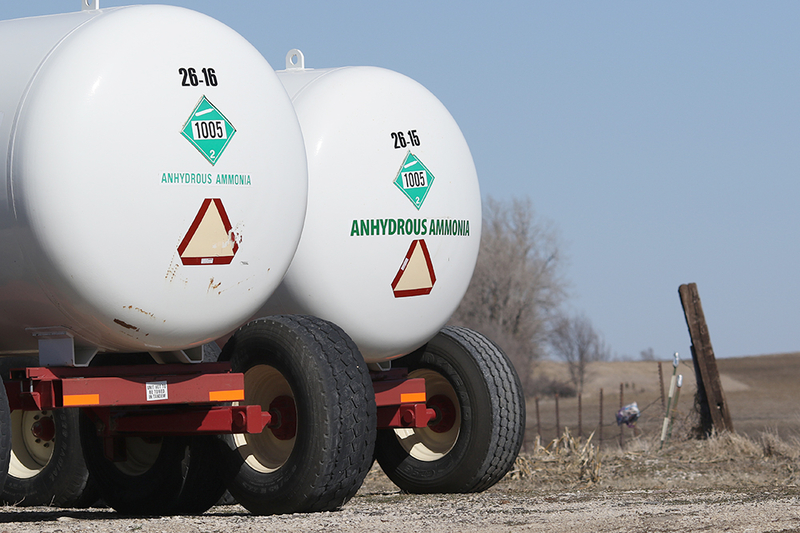
Anhydrous ammonia is a common farm fertilizer. (Photo by Jared Strong/Iowa Capital Dispatch)
Farmers from across the country are urging the federal government to expedite an investigation of the fertilizer industry as they struggle with “impossibly high input costs.”
A letter from grower associations follows a slew of recent federal actions taken to address the expense of fertilizers.
In the letter sent to leaders of the Senate Committee on the Judiciary, corn growers said recent events, like the closure of the Strait of Hormuz amid conflicts in the Middle East, have “exacerbated” the “fragility of our agricultural economy.”
But, the letter said, the issue of high fertilizer prices has been “years in the making” due to a “failure” of the U.S. Justice Department and the Federal Trade Commission to enforce antitrust laws.
“American farmers, and our nation’s food supply chain, stand on the precipice of an irreversible collapse due to impossibly high input costs that are untethered from the reality of crop prices,” the letter said.
FTC Chair Andrew Ferguson confirmed in May that the commission was investigating potential anticompetitive practices in the fairly consolidated fertilizer industry. In March, Bloomberg reported the DOJ was investigating potential collusion between fertilizer companies Nutrien and The Mosaic Company, who supply much of the potash and phosphate fertilizers to the country, as well as nitrogen fertilizer giants CF Industries, Koch Inc. and Yara International ASA.
“Announcements and reports of investigations are welcome news, but it will take decisive action to restore free and fair markets so that the same competitive environment farmers face when selling their crops is present when they purchase inputs like fertilizer,” the growers said in the letter.
The Iowa Corn Growers was one of 17 associations that signed the letter, which was addressed to Iowa Republican, Sen. Chuck Grassley as chair of the Committee on the Judiciary. The letter, sent July 13, asked Grassley and Ranking Member Dick Durbin, D-IL, to question Acting Attorney General Todd Blanche in his confirmation hearing about plans to enforce antitrust laws.
US senators grill Blanche over ‘slush fund’ deal as he seeks attorney general confirmation
Grassley, during the confirmation hearing Wednesday, said he has “long been concerned” about anti-competitive conduct across industries, but “particularly in agriculture.”
“Family farmers deserve fair prices,” Grassley said.
Grassley noted a hearing he led in October 2025 on anti-competitive actions and consolidation in the fertilizer and seed industries and the subsequent investigation launched by the DOJ.
Responding to Grassley’s question, Blanche said was committed to the issue and noted he has “worked closely” with Secretary of Agriculture Brooke Rollins to investigate anti-competitive actions and consolidation in agriculture. Most recently, the two announced plans to look at the cattle industry, where beef prices have mounted in recent years.
In their letter corn growers also asked the judiciary committee leaders to urge the DOJ to investigate the “collusive practices in the fertilizer industry as fully and expeditiously as possible.”
Iowa farmers welcome suspension of fertilizer duties
Corn growers in the letter said they “fully support” recent actions from President Donald Trump authorizing a temporary suspension on the countervailing duties on phosphate fertilizer imports from Morocco.
The suspension lasts for eight months, or until the end of the emergency declared by the president for threats to the “availability of sufficient supplies of fertilizers to meet expected agricultural demand.”
Countervailing duties are a type of tariff applied to goods that receive assistance – like a tax break – from a foreign nation for exporting the product to the U.S. These tax breaks or assistance from the product’s country of origin allow manufacturers to sell the goods cheaper than domestic manufacturers.
The countervailing duties on Moroccan phosphate were finalized in 2021, following a petition for the duties from The Mosaic Company.
According to The Fertilizer Institute, the U.S. imports about 41% of its phosphate supply, and globally, Morocco is the top exporter of the mineral which is a key element in phosphorous-based fertilizers. Data from the institute also show Iowa consumes the most phosphorus of any U.S. state.
A news release from the U.S. Department of Agriculture estimated the suspension of countervailing duties on Moroccan phosphate could save U.S. farmers approximately $1.82 billion annually as additional supplies enter the market and foreseeably lower fertilizer costs. USDA estimates the suspension of duties will lower phosphate fertilizer prices by 22%.
The recent letter from corn growers said the effects of the suspension have not been immediate and members “still experience elevated phosphate fertilizer prices at a time when plans are being made for purchases for the upcoming 2027 planting year.”
Stu Swanson, chair of Iowa Corn Growers Association and a farmer in Wright County, said high input costs have been a “big factor” in the profitability of Iowa farmers for several years. He said he was appreciative of the president’s move to suspend the phosphate duties, but was frustrated by countervailing duties put on agricultural chemicals.
“Fertilizer, chemical, seed, everything has increased during the last few years,” Swanson said. “But those unnecessary taxes like countervailing duties on fertilizer are just kind of insulting to us as farmers when we’re facing these financial issues that we have.”
Similar to the case with Mosaic, Corteva Agriscience petitioned for countervailing duties on the herbicide 2,4-dichlorophenoxyacetic acid. The U.S. Department of Commerce sided with the company in 2024 and initiated the countervailing duties on imports of the chemical from China and India.
The Monsanto Company and Ruveon LLC, parented by Bayer, filed a petition at the end of June which would impose countervailing duties on glyphosate imported from China, if the U.S. International Trade Commission agrees that China is selling the chemical below a fair value.
National Corn Growers Association said the action was “at the expense of the American farmer.”
“We need our products that we use, we need to be able to utilize those at an affordable price,” Swanson said. “We’re not asking for any favors. We just want to be able to operate in an environment that is fair and balanced.”
In addition to the temporary suspension of phosphate duties, the administration launched a $500 million program to boost domestic fertilizer production. The Fertilizer Investment & Expansion for Long-term Domestic Supply, or FIELDS program, will fund projects that expand or upgrade existing facilities, construct new domestic fertilizer production facilities and improve supply chain efficiency.
Awards will be given between $15 million and $150 million to eligible projects that are domestically owned and operated and are outside of the “dominant” fertilizer suppliers.
The program is funded through USDA’s Commodity Credit Corporation and implemented through USDA Rural Development. Applications are open through Aug. 17.
Des Moines, IA