Coralville Lake visitor center reopens after 4 years, but no money for exhibits
May 23, 2026 | 9:00 am ET
Description
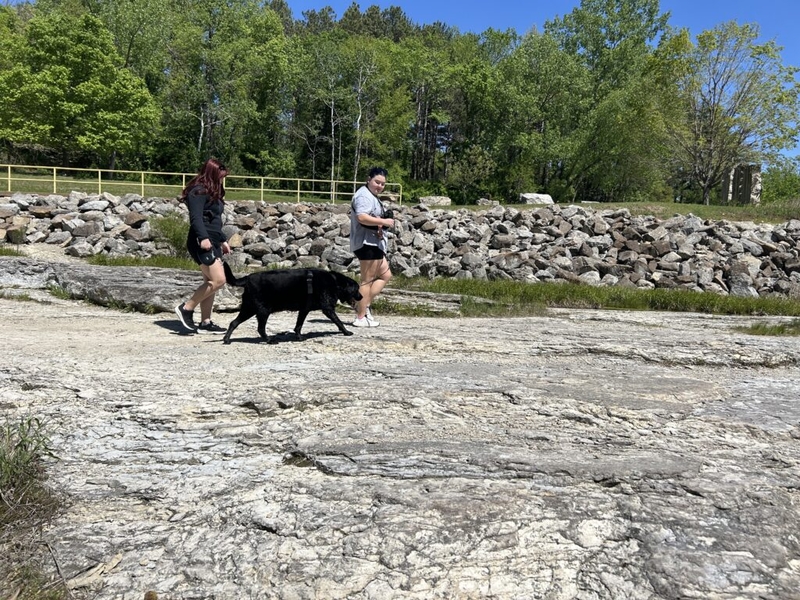
Meilina Xiong (left) and Olivia Xiong, both of North Liberty, and 7-year-old lab Diesel, walk at the Devonian Fossil Gorge near the Coralville Lake on May 11, 2026. (Photo by Erin Jordan for Iowa Capital Dispatch)
CORALVILLE – Just in time for the busy summer season, the Coralville Lake Visitor Center reopened May 1 after being closed for nearly four years for repairs and renovation.
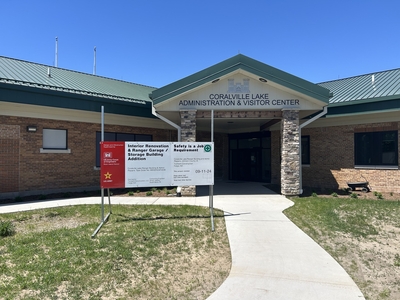
There are new restrooms, a volunteer kiosk and a few temporary displays, but the $6 million renovation did not include money for permanent or interactive exhibits to highlight the area’s marquee attraction – the Devonian Fossil Gorge.
“Right now, our goal was to get back into the building,” said Doug Vogel, Coralville Lake manager for the U.S. Army Corps of Engineers. “We’ll be switching gears to that long-term planning.”
Coralville Lake sees more than 1 million visitors a year, for camping, fishing, mountain biking, disc golf and fossil viewing.
Slabs of limestone near the lake show exposed fossils of animals and plants that lived in a shallow sea that covered much of the Midwest during the Devonian period more than 380 million years ago. Most of the fossils are tiny – coral, shellfish and stemmed echinoderms – but scientists also found a bony plate from an armored fish the size of a school bus.
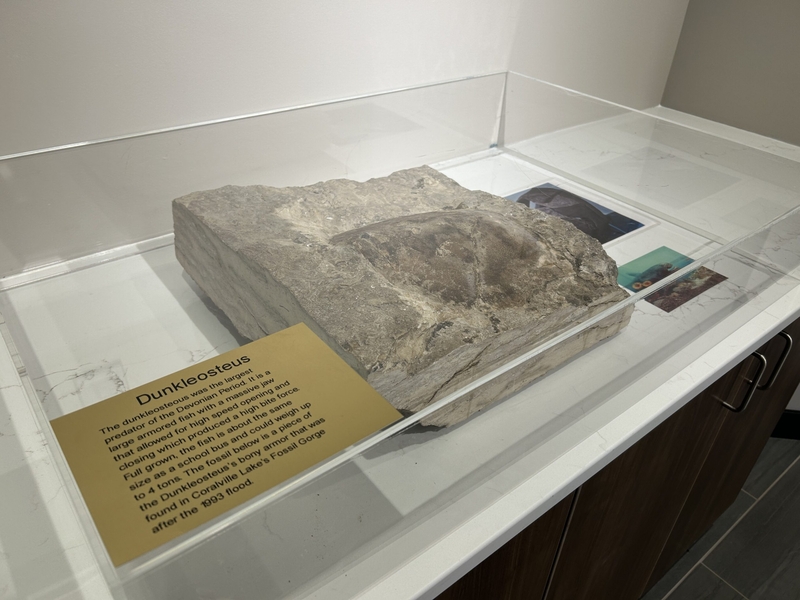
The Dunkleosteus fossil is back at the visitor center following the renovation. There also is a stuffed golden eagle, wings outstretched, some geodes in a display case and a few recycled signs from before the renovation.
“Interpretive development was not part of the contract,” Vogel said of the renovation project, which started in 2024. “We are going to have to develop and produce them.”
Exhibit development is costly – one display can cost thousands of dollars – especially for exhibits with interactive components. The visitor center was renovated with generic display space rather than designed with or around interactive exhibits, Vogel said.
“We’ll have to fit the displays around the space,” he said.
Coralville Lake park rangers hope to tap into local resources, such as the University of Iowa or other agencies, for help creating exhibits and educational materials, he said. Vogel would like to have some interactive exhibits available by next summer.
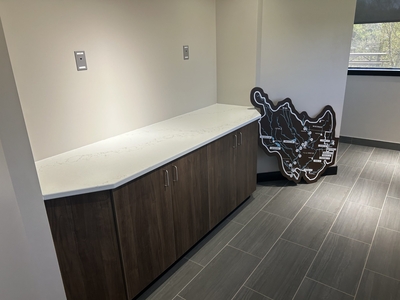
Lake Red Rock, a Corps-owned site near Pella, is getting a new $11 million visitor center. That project’s scope of work includes exhibit development, which means professional exhibit creators will design the interactive elements and the building will be constructed around the displays.
Dee Goldman, who served as park manager at Coralville Lake 13 years before retiring last June, said the Visitor Center was a hub for school field trips before it closed for renovation.
“In April and May, we would have 100 school kids almost every day or two days out there,” he said.
In June 2022, a heavy rain leaked into the building as the roof was being replaced. The Corps did mold and asbestos remediation before beginning renovations in 2024. The Visitor Center has been closed ot the public since 2022.
Hiring freeze
The Corps initially was among federal agencies targeted with lease terminations and budget cuts after President Donald Trump took office in January 2025. Some of the cuts were reversed, but the agency still is under a hiring freeze, confirmed Allen Marshall, spokesman for the Corps’ Rock Island District, which oversees Coralville Lake, Saylorville Lake and Red Rock Lake in Iowa.
“The hiring freeze is still in effect,” Marshall said in a May 6 email.
This means two vacant ranger positions at Coralville Lake, which has nine ranger positions, can’t be filled unless they can hire from within the Corps, Vogel said.
“It won’t be ideal for the lake we’re taking them from,” he said.
Like the Iowa Department of Natural Resources, which manages Iowa’s state parks, the Corps has contracts with law enforcement agencies near their parks to help with patrols and emergency response calls from the beaches, campgrounds and other spaces.
Park rangers, who are not sworn law enforcement officers and do not carry firearms, have the option to call the Johnson County Sheriff’s Office for specific issues in addition to the deputies’ contracted patrols.
“Our coverage will be the same as in the past,” Vogel said.
Coralville Lake water quality plan
The Coralville Dam was completed in 1958 so the Corps could control the flow of water through the Iowa River during times of flooding.
The lake’s purpose is flood control, but lake users generate an estimated $70 million to $80 million a year for things like boat rentals, camping fees and restaurant tabs at the popular Bobbers Grill.
But the lake is filling in with sand and silt from farms upstream.
That sediment is causing the lake, in places, to be too shallow for motorboats. Warm, shallow water is more susceptible to harmful algae and bacteria that can harm human health.
“I believe there are ways of managing upstream lands that could significantly improve water quality at the lake,” said Ken Leo, who lives near the lake and serves on the Friends of Coralville Lake board of directors.
The Middle Iowa Watershed Management Authority released a water quality plan this spring for the watershed that starts north of Marshalltown and ends at the lake. Among recommendations, the plan calls for reducing sediment loading by 10%, or about 5,701 tons per year, by implementing conservation practices upstream.
The Iowa Department of Natural Resources helped pay for the $221,000 plan, but the local watershed management board now has to raise money to implement it.
“With the Coralville Res, the whole sediment issue is a beast to take on,” said Kasey Hutchinson, environmental regulations coordinator for Johnson County, an authority member county. “Of course, you could dredge the lake, but that’s not a long-term solution. You’re trying to get at the sources of the issues and address those as opposed to a Band-aid approach.”
Hutchinson anticipates using future grant money to help farmers install prairie strips, bioreactors or other edge-of-field practices that reduce fertilizer runoff and keep soil in place.
Des Moines, IA