Climate groups, caught by surprise last year, fight to protect Maryland energy fund in 2026
Feb 01, 2026 | 10:48 pm ET
Description
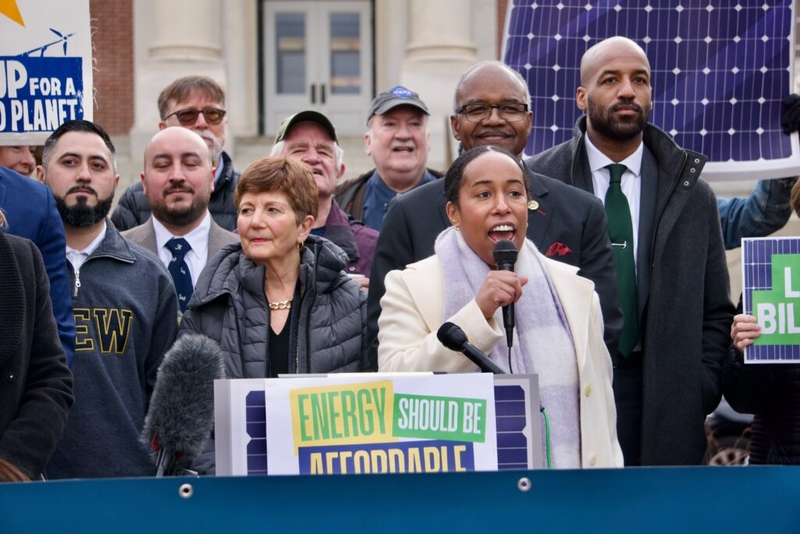
Brittany Baker, Maryland director of the Chesapeake Climate Action Network, speaks during a rally for the Affordable Solar Act, on Jan. 14, the first day of the Maryland General Assembly session. (Photo by Christine Condon/Maryland Matters)
For the second straight year, the General Assembly is looking to tap a large state energy fund as legislators grapple with another significant budget deficit.
This time, climate advocates hope they’re better prepared to defend it.
The Strategic Energy Investment Fund, which is managed by the Maryland Energy Administration, is meant to be used for programs that help reduce energy bills, minimize energy waste and bring new renewable energy online.
But the fund has reached unprecedented levels in recent years, due to changing economic conditions, capturing the attention of appropriators eager to find fixes for the state’s estimated $1.5 billion shortfall in the fiscal 2027 budget.
Gov. Wes Moore’s (D) proposal would pull $292 million from the fund to balance the state budget. Another $100 million would be divided among all of Maryland’s residential ratepayers, each of whom would receive a roughly $40 refund on their electric bill.
The governor’s proposal also designates another several hundred million dollars for specific programs related to energy infrastructure and combating climate change. The governor’s plan would leave about $164 million in the fund.
But it’s the millions headed for the state’s general fund that has attracted the most ire from groups like the Maryland Sierra Club, the Maryland League of Conservation Voters and the Chesapeake Climate Action Network, which are banding together to campaign for protecting the fund best known by the shorthand SEIF.
Moore proposes another $40 electric bill credit for Marylanders
Amid federal rollbacks, including the loss of tax incentives and grant programs for clean-energy projects, state-level funding like the dollars in SEIF are “more important than ever,” said Matt Sehrsweeney, climate campaign representative for the Maryland chapter of the Sierra Club.
“To pull it back from its intended purposes and to use it to cover budget gaps is just unacceptable,” Sehrsweeney said. “We just think that that’s a really huge mistake.”
Advocates are also frustrated by Moore’s proposal to give all Maryland households a small refund on their bills. The proposal is a repeat from last year, when legislators pulled twice as much money from SEIF for the same purpose, and also used the fund to balance the state budget.
“When the rebate is spread across the whole state, it’s not a meaningful amount of money, and also it’s a one-time, Band-Aid solution,” Sehrsweeney said of the residential refund.
Kim Coble, executive director of the Maryland League of Conservation Voters, said her group is pushing for the funds to go specifically to low-income households, rather than all ratepayers.
The Sierra Club is aiming for $88 million from SEIF to go toward installations of electric heat pumps in low-income households, which reduce emissions compared to fossil fuel-burning heating equipment. The club’s proposal also requests smaller disbursements go toward induction stoves, electric school buses and residential solar projects.
“If you’re getting a heat pump in someone’s home, that can lower their energy bills for 15 or 20 years, instead of just one year,” Sehrsweeney said.
In a statement, a spokesperson for Moore touted his climate proposals. Moore would pull from SEIF to help finance solar projects impacted by federal cuts, university climate change research, installing clean energy on state properties and exploring transmission upgrades.
To pull it back from its intended purposes and to use it to cover budget gaps is just unacceptable. We just think that that's a really huge mistake.
“While the federal government has spent the past year rolling back climate protections and funding, Governor Moore has focused on moving Maryland forward through record investments in clean energy and climate action,” wrote Rhyan Lake, a spokesperson for the governor. “Building on that progress, the historic investments in this year’s budget reflect the Governor’s ongoing commitment to climate action and a clean-energy economy.”
The advocates may have a somewhat unlikely ally in Republicans, some of whom have railed against the use of SEIF to balance the state budget.
“At the end of the day, this is a hidden energy tax: Marylanders are overpaying because of Democratic mandates, and instead of giving that money back or fixing the policies that caused the problem, the Governor is using it to fund government operations,” wrote Senate Minority Leader Steve Hershey (R-Upper Shore) in a recent statement. “That is not energy relief
— it’s a shell game.”
Other proposals from climate groups would make structural changes to SEIF.
The fund is fueled by utilities, who can choose between purchasing “renewable energy credits” from suppliers of renewable energy or making alternative compliance payments. They can use ratepayer dollars to do so. Fluctuations in the price of the credits have led utilities to increasingly make the alternative payments.
In fiscal 2022, utilities made $77 million worth of alternative payments. But only two years later the payments jumped to $318 million, and the figure increased further in fiscal 2025, growing to $365 million.
Revenue from Regional Greenhouse Gas Initiative auctions also go into the SEIF. Those funds made up 40% of SEIF’s proceeds in fiscal 2025, and alternative compliance payments made up 54%.
Coble said it’s possible that the alternative compliance payments may be set too low.
“It’s really cheap for the utilities to just pay it. So, I think in the longer run, we have to look at raising that rate so that it is actually a deterrent to the utilities.”
The alternative compliance payments were meant to be a price ceiling, to protect ratepayers if the cost of renewable energy credits rose too high, said Brittany Baker, Maryland director of the Chesapeake Climate Action Network. But now, the alternative payments are routinely cheaper than the credits, known as RECs.
The network is supporting the Affordable Solar Act, which would modify solar credits, in an effort to address this problem.
“One of the intentions of this bill is to make it more flexible, so cheaper solar projects would have lower SRECs,” Baker said.
To Baker’s group, part of the solution might also be pulling money away from SEIF to protect it. The Affordable Solar Act would redirect certain alternative compliance payments into an escrow account to fund solar projects.
“We can’t keep doing the regressive thing, which is taking that money that’s designed to lower bills, and using it to balance the budget,” Baker said.
Annapolis, MD