Historic Omaha stockyards tower turns 100 as tenants look to future
May 27, 2026 | 10:36 am ET
Description
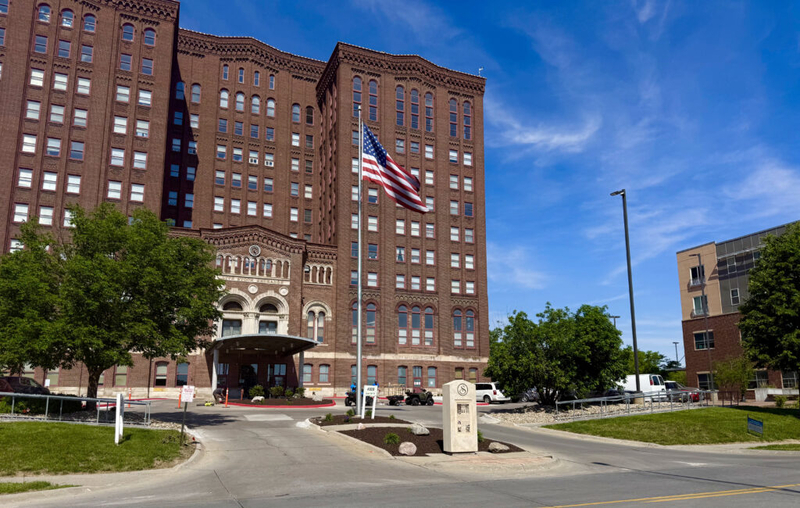
Livestock Exchange Building at 100 years old in 2026. To the right, is one of the newer health center buildings on the South Omaha campus. (Cindy Gonzalez/Nebraska Examiner)
OMAHA — A historic 11-story structure in South Omaha — a landmark that was once the epicenter of the world’s largest livestock and meatpacking market — turns a century old this month.
On Thursday, the Livestock Exchange Building’s current anchor tenant, OneWorld Community Health Centers, celebrates the milestone with an open house and display of historical materials.
Public tours will be offered of the structure at 4920 S. 30th St., which also houses affordable apartments and a top floor ballroom that harkens to a heyday of hosting lavish corporate and industry festivities for farmers, executives and community members.
The event from 4:30 p.m. to 6:30 p.m. also marks the culmination of OneWorld’s clothing drive for its baby boutique, which serves new and expectant parents. “Look Back, Give Back” is the anniversary theme.
“The Livestock Exchange Building has been our organizational home since 2005, and we are proud to be stewards of this historic building in its centennial year,” said OneWorld CEO Andrea Skolkin. “As we celebrate the occasion, we also look to the future — not just for our building but for our newest patients as our community welcomes them as part of Onesies for OneWorld.”
OneWorld is a federally qualified health center that provides care and support services to more than 50,000 patients each year at 20 clinical locations in Omaha, Bellevue and Plattsmouth, without regard to insurance status or ability to pay.
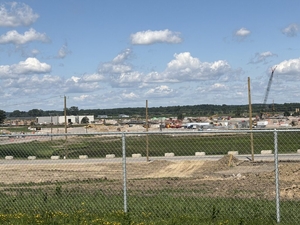
The health center operates on three floors of the Livestock Exchange Building, and also serves the community in a pair of newer, neighboring buildings. A fourth OneWorld structure, funded largely by a state grant from the North and South Omaha Recovery Grant Program, currently is rising on the campus. Scheduled to open next year, it will serve as a training ground for health care workers, a center point for future pandemics and epidemics and will provide more behavioral health and child care services.
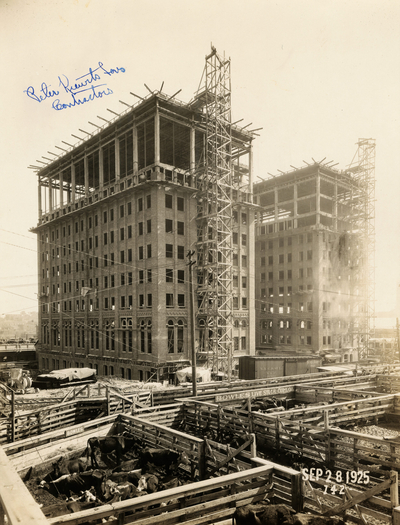
Still today, the H-shaped Livestock Exchange Building — which replaced an 1886 facility when it opened in May 1926 — dominates the South Omaha landscape.
The high-rise combines the Romanesque and northern Italian Renaissance revival styles and, according to a historical marker that stands out front, an especially notable element was the arched entry portico and plaza that led to the main lobby ornamented with marble and tile imported from Italy.
The Stockyards National Bank had occupied the north wing of that second-level lobby, while telephone and telegraph offices, a soda fountain and cigar store dotted the south wing. On the ground level was a bakery, cafeteria and railroad offices. Apartments and sleeping rooms were available for ranchers bringing in cattle on trains to trade.
The actual business of running the market unfolded on the upper levels active with commission agents, traders and government agencies. On the top level was the ballroom with a stage and a full kitchen. At one point, the exchange building was surrounded by 100 acres of land used for pens, sheds and scale houses necessary to care for livestock.
“As such, the Livestock Exchange Building was both the nerve center for the Omaha market and an event and activity center for the entire community,” the historical marker reads.
The Omaha stockyards date back to 1883, when a Wyoming cattleman and six prominent Omaha businessmen created the Union Stockyards Co. of Omaha and acquired land to establish a livestock market. Historians noted proximity to the Missouri River and railroads as keys to success.
During the 1940s and 1950s, the Union Stockyards were the economic engine of Omaha. More than 1,000 people reportedly visited the Livestock Exchange Building daily, many of whom came to shop in its clothing store, get a haircut or visit the physician or veterinarian.
According to an account in the National Register of Historic Places, the South Omaha stockyards in 1955 reached the goal of its founders: Omaha had grown into the largest stockyard and meat processing center in the country. By 1957, the livestock industry employed half of the city’s workforce.
Following the decentralization of the meatpacking industry, the stockyards closed in 1999, the same year the exchange building was listed on the National Register of Historic Places. A public-private renovation of the structure was completed in 2005.
More contemporary uses and industries are in play today, but the historical marker says the Livestock Exchange Building “remains the one lasting monument of Omaha’s great livestock market era. Its 240,000 square feet will continue to serve the South Omaha community into the future.”


Lincoln, NE