Chesapeake Bay sees increase in juvenile blue crabs, drop in adult females
May 21, 2026 | 5:27 am ET
Description
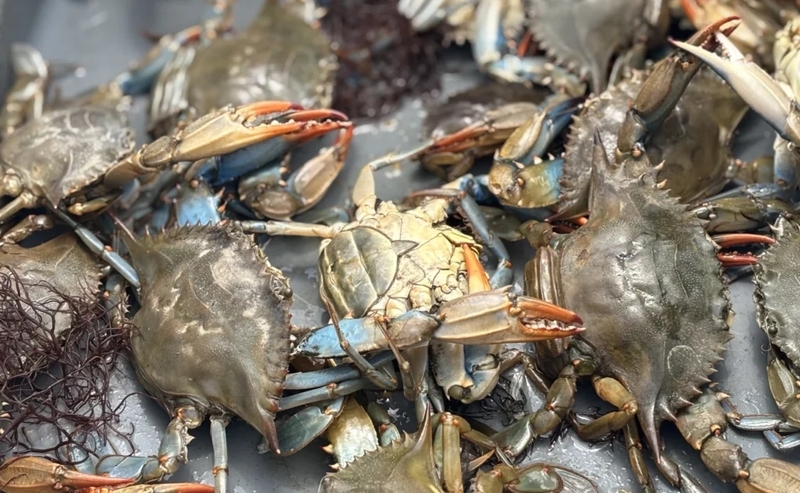
Blue crabs from the Lynnhaven River in Virginia Beach in May 2025. (Photo by Katherine Hafner/WHRO)
For the last five years, populations of juvenile blue crabs in the Chesapeake Bay had struggled to thrive. From 2010 to 2023, the population dropped about 50% as researchers tried to pinpoint the reason behind the decline. But new data from the winter dredge survey shows a significant rise in the young crustaceans that brings hope, but also caution.
“There has been an uptick in recruitment. So, this year juvenile abundance for 2026 is going to be substantially higher than what we saw ‘21-25,” Romuald Lipcius, with the Virginia Institute of Marine Science (VIMS) at William & Mary, said.
The winter survey is a Bay-wide look at how the blue crab population fares during their cold weather period and how many are removed by fishing. The survey, conducted by VIMS and the Maryland Department of Natural Resources, includes samples from 1,500 sites throughout the Bay.
The results of the survey show that the total blue crab abundance increased to 349 million in 2026. Juvenile crabs, which were added to the population in the last year and will be old enough to be caught in the fall, showed a significant increase to 228 million.
But female crab populations didn’t do as well, dropping to 81 million this year. And another troubling factor: While the juvenile class is promising, there is no guarantee that it will translate into a robust population later in the year.
“In the past, we’ve had evidence of much stronger year classes of blue crabs that didn’t materialize,” said Michael Wilberg with the Chesapeake Biological Laboratory at the University of Maryland Center for Environmental Science.
Time will tell if the winter survey numbers will mean more crabs available for harvest in the late summer and fall. In the meantime, researchers are seeking answers as to why the abundance of crabs has suffered over the last several years.
“I think the idea that there’s a single cause is one that’s probably not true,” Wilberg said. “There’s probably always multiple factors affecting crabs, as well as all the other species in the Bay. And so it’s really difficult to disentangle them.”
In the latest draft blue crab stock assessment that was presented to the Chesapeake Bay Commission earlier this month, scientists from multiple research universities and state natural resource agencies looked at data to try and narrow down what’s causing the female crab decrease. They considered environmental conditions, other species that eat the crabs, and if there is potentially over fishing going on.
“The first cause that we looked at was whether too much fishing on females was causing the low number of young and that didn’t seem to be the case, ” Wilberg said. “The other main thing we looked at was whether blue catfish are causing it and they also didn’t seem to be responsible, at least not for as big a decline as we saw.”
A number of species eat the crabs when they are young. But striped bass have also seen their populations drop at the same time as the crabs, while the invasive blue catfish species is estimated to consume only about 8% of the blue crabs, Wilberg said.
The crabs also cannibalize their young when there are lopsided amounts of adults vs. juveniles, or if there is a lack of food for them.
While scientists continue studies into the impacts of factors such as sea grass availability, climate conditions, and other potential reasons, missing data could help paint a better picture of what is happening to the crabs.
“A good example is the red drum. We have very little information on red drum. We know they eat crabs, but we don’t have any good ideas about how many of them there are in the Bay or even how really they’ve changed over time,” Wilberg said.
This is not the first time the blue crab population has seen population shifts. The management agencies are well versed in keeping close tabs to see what actually materializes from the new juvenile classes to determine appropriate management measures for the harvest season.
“From the ‘80s when the population was doing really well, and then in the early ‘90s, it declined, and there was a major decline that remained that way until 2008 when the Maryland Department Natural Resources, Virginia Marine Resources Commission, and Potomac River Fisheries Commission all got together and decided to implement some major management actions, ” Lipcius said.
Several studies are currently underway, including one by the National Oceanic and Atmospheric Administration that is investigating climate and current changes to the Bay that could impact the crabs. For now, regulations are staying in place – and researchers urge caution before changing them.
“To support a strong blue crab population, the focus needs to remain on three fronts: preventing pollution, restoring important blue crab habitats such as underwater grasses and oyster reefs, and tackling the growing threat of blue catfish,” said Chris Moore, the Virginia executive director of the Chesapeake Bay Foundation.
Richmond, VA