Can a candidate for governor list a UPS Store as his home address? Arizona’s high court will decide.
Apr 30, 2026 | 3:56 pm ET

Description
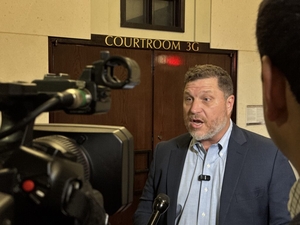
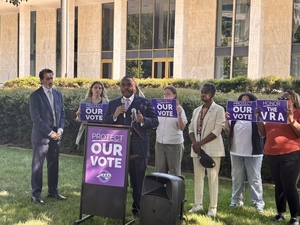
Hugh Lytle, an independent candidate for governor, held a press conference on Feb. 16, 2026, outside of the state house to criticize a bill that would make his party name, the Arizona Independent Party, illegal and he said would derail his campaign. (Photo by Dermont Stevenson/Cronkite News)
If the Arizona Supreme Court doesn’t kick a third-party candidate for governor off the ballot for listing a P.O. box as his address on key paperwork, then a state law requiring candidates to declare their actual residential address will be unenforceable, attorneys challenging Hugh Lytle’s candidacy argued in a legal filing this week.
“According to Mr. Lytle, a candidate for statewide office could list any commercial address in Arizona — a law firm, a hotel, a FedEx store, or anywhere else. That’s not what the statutes say,” wrote Austin Yost, an attorney for Democratic activist Craig Beckman.
Lytle, a wealthy entrepreneur, hopes to be on the ballot as a candidate for the No Labels Party. But Beckman claims that, because Lytle listed a P.O. box on his nomination paperwork and nominating petitions instead of the “actual residential address” that is required by state law, his candidacy is illegal.
“Allowing him to list a UPS store instead of his actual residence address would undermine legislative intent and turn this statutory scheme into a dead letter,” Yost argued in an opening brief to the Supreme Court.
Earlier this month, a trial court judge rejected Beckman’s challenge, ruling that Lytle “substantially complied” with the law and concluding that the purpose of the address requirement is so voters can know that candidates live in the jurisdiction they hope to represent. Because Lytle is running for a statewide position, the UPS Store and Lytle’s home are in Scottsdale, and Lytle is the only person with that name registered to vote in Arizona, the use of the mailbox address did not mislead voters, Maricopa County Superior Court Judge Michael Mandell ruled.
Lytle’s attorney, Andrew Pappas, argued in his opening brief that that trial court applied the law correctly because “no voter could be confused or misled about whether Mr. Lytle resides in the jurisdiction he seeks to represent as Governor: the State of Arizona.”
And the Arizona Supreme Court has never kicked a candidate off the ballot for using a P.O. box or a different address that is in the correct jurisdiction, Pappas noted.
“Different facts could yield a different result. But the Court has always found substantial compliance where nomination documents list an address in the same jurisdiction the candidate seeks to represent, because voters are unlikely to be confused or misled about the candidate’s eligibility for office,” he argued.
But Yost said Lytle’s situation is different than the four Supreme Court cases in which addresses were the basis of a candidate challenge and the candidates were allowed to appear on the ballot.
In one, a school board candidate launched a campaign with one residential address and then moved — within the same school district — and failed to adopt the new address on nominating paperwork. In another, a legislative candidate used an incomplete address, but there was never any contention that the candidate lived outside the legislative district. And in a third, a candidate for sheriff used a P.O. box in the same ZIP code as his house.
Much of Yost’s argument centers on the fourth, and most recent, address-based candidate challenge — a case that prompted the legislature to change the state law requiring residential addresses.
In that 2020 case, Shawnna Bolick used a P.O. box as the address on her nomination paperwork instead of her home address. The Supreme Court ultimately ruled that she did so in good faith, because her address and voting records are shielded from public view because her husband is a justice on the Arizona Supreme Court.
In Bolick’s case, the mailbox address was in the same legislative district and ZIP code as her house, meaning voters would not have been confused about whether she lived in the district.
When the legislature convened in 2021, it amended the law requiring candidates list their “actual residential address” on nominating forms to codify that court ruling. In doing so, it said the only reason a candidate can legally use a private mailbox is if their residential address is protected under the state law that shielded Bolick’s.
And that, Yost argued, is key in Lytle’s case.
“A candidate who has an actual residence address that is not protected under (state law) must provide the candidate’s ‘actual residence address,’” he wrote. “Mr. Lytle violated (the law’s) simple command by falsely declaring under penalty of perjury that his ‘[r]esidential [a]ddress’ was the (P.O. box).”
Lytle’s campaign said the strict letter of that law is not what should determine whether he stays on the ballot. Rather, Pappas wrote, the fact that no voters were — or could have been — confused by the P.O. box address renders the whole exercise moot.
“(V)oters couldn’t have been confused or misled about Mr. Lytle’s eligibility for the statewide office he seeks because both the mailbox and his home are in Scottsdale, and no one disputes that he meets the residency requirements to be Governor,” he argued.
Like the trial court ruled, the Supreme Court should find that Lytle substantially complied with the law, Pappas concluded.
Yost warned the justices that adopting that view would have serious consequences in future elections.
“That cannot be the law because it would create perverse incentives and produce absurd results,” he wrote. “Arizona law requires candidates to publicly disclose their actual residential addresses — a substantial personal burden that the Legislature imposes as a condition of seeking public office.
“A ruling in Mr. Lytle’s favor would tell future candidates that the easier path is to consistently ignore the statutory requirements and invoke substantial compliance when challenged.”
Phoenix, AZ