Business Group Fighting Tax Hikes Shields Information About Funders
Apr 01, 2026 | 6:00 am ET
Description
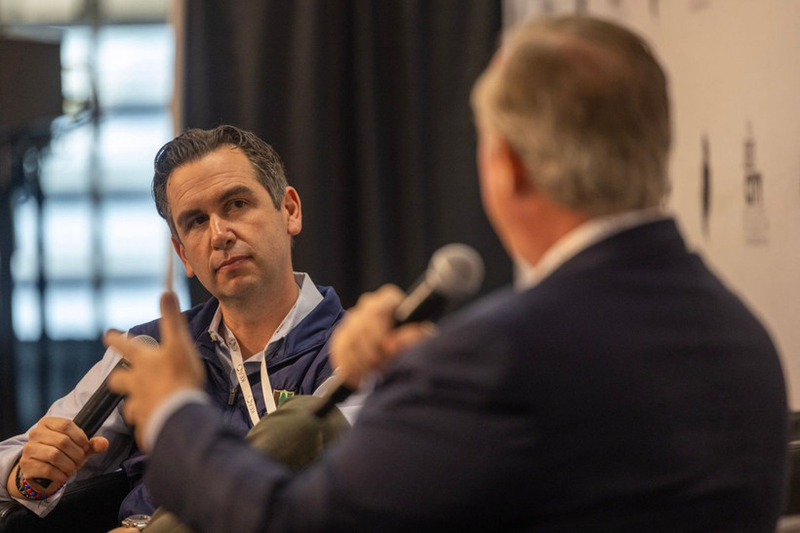
Photo courtesy of New York Focus
A prominent business group is stepping up its efforts to stop tax hikes on corporations and the wealthy in this year’s state budget — while keeping key information about its funding secret.
The Partnership for New York City raised $10 million in “seed” money last year for its political arm, its new president and CEO, Steven Fulop, said on X earlier this year. Fulop told the Wall Street Journal last week that the political arm plans to run ads opposing tax increases. “If you believe that something is detrimental to the economic well-being of New York City, you need to be vocal about it,” Fulop said.
The state budget was due at midnight on Tuesday, but Albany leaders have so far been unable to strike an agreement, and taxes are among the biggest sticking points. The legislature and New York City Mayor Zohran Mamdani have pushed for billions of dollars in tax hikes. Governor Kathy Hochul has ruled out an income tax hike on high-earners, though she has left the door more open to raising corporate taxes.
The Partnership is planning to jump into the fray through its political arm, while shielding the amounts donors provided.
Three months before it began collecting the $10 million, the group’s political arm amended its certificate of incorporation to become a membership organization. That allowed it to classify the donations it then received as “dues” paid by members, and get around a requirement to disclose the amount of each contribution.
A Partnership spokesperson declined to answer a question about whether this was the motivation for the well-timed amendment.
After Governor Andrew Cuomo took office in 2011, Fulop’s predecessor, Kathryn Wylde, helped lead a business-backed political organization that spent $16 million pushing Cuomo’s vision of a lower-tax, lower-spending state government.
Under state law at the time, the donors behind the lobbying effort, called the Committee to Save New York, were allowed to stay anonymous. Even so, information trickled out when Cuomo proposed government action favorable to a major gaming company that had contributed $400,000 to the group.
That year, Cuomo signed a law requiring such high-spending political nonprofits — known under the tax code as a 501(c)4s — to reveal their major funders. The state’s ethics regulator declined to apply the law retroactively, and the Committee was never forced to reveal its benefactors. Under current law, a 501(c)4 that spends more than $15,000 on state lobbying has to disclose donors who contribute more than $2,500.
In 2016, a little-noticed exemption was tucked into an end-of-session bill. Under the exemption, if donations are classified as “membership dues, fees or assessments,” the specific amount each donor gives can remain secret.
“If you were a client and came to me and said, ‘We never want to report how much these people are paying, we want to avoid the source of funding,’ well, one way to avoid the source of funding is to be a dues-paying member,” David Grandeau, a lobbying compliance attorney who formerly served as the state’s top lobbying regulator, told New York Focus. Grandeau does not represent the Partnership.
The Partnership first established its political arm, called the Coalition for New York’s Future, in 2010, but it has typically spent little on lobbying.
That began shifting last year, when it lobbied lawmakers to change laws on criminal justice and involuntary hospitalizations in the state budget, and ran ads backing pro-housing ballot measures in New York City. Over the past year, the political arm has reported spending $3.6 million on ads and social media.
As required by the 2011 law, the group disclosed the 20 donors who contributed last year. The list is a who’s who of major New York City executives and bigwigs from the financial and real estate sectors, among other places, including the media organization Hearst, the online marketplace Etsy, and the pharmaceutical giant Pfizer.
But it didn’t include the amounts each one donated. Since the Coalition has characterized the donations as “membership dues, fees or assessments,” all the donors are listed in lobbying filings as having given $0 — making it impossible to know from public records who is providing the bulk of the funding. (In August, Wylde told Crain’s New York that, at that time, the biggest donors to the Coalition included the financial firms BlackRock and JPMorgan Chase.) It’s also unclear from current public records how much the Coalition raised in total, since each donor is listed as giving $0.
Rachael Fauss, senior policy advisor at the government reform group Reinvent Albany, called the membership exemption a “loophole.” While the Partnership appeared to be following the letter of the lobbying law, she said, the spirit of the law was clearly “for the public to have much more information about how much donors are giving to lobbying operations.”
A number of major lobbying interests — such as New York’s powerful hospital organization — report lobbying donations in a similar manner. Such organizations are typically trade groups that have broad, longstanding memberships.
The Partnership’s political arm does not. The Partnership itself lists 326 businesses as members, but only about 6 percent of these members donated last year to the Partnership’s political arm.
As of 2024, the political arm did not have its own staff or office, according to that year’s tax filing, and relied entirely on Partnership staff. The political arm did recently hire an executive director, Fulop told the New York Editorial Board. “There is a willingness to spend real money to make sure that New York City stays competitive,” he said.
In corporate documents filed over more than a decade, the Coalition repeatedly described itself as having “no members,” and stated that instead, it was controlled by a board of directors.
The certificate of incorporation was changed in December 2024 — three months before the $10 million spate of donations began — to now state: “The corporation shall have members.”
In response to questions from New York Focus, a spokesperson for the Partnership said the political arm was an “affiliated, but legally distinct, separately incorporated entity from the Partnership for New York City.”
“The Coalition is formed as a membership organization and collects dues from all members,” said the spokesperson, Nick Bader. “Consistent with the Coalition’s Bylaws, all members have the right to participate in governance of the organization, as well as any of the organization’s social welfare activities.”
Besides spending on the tax battle, Fulop wrote on X in February, the Partnership’s board was looking to ramp up its political spending, including against any elected official who “enables” antisemitism in New York.
“Our first foray into a place more overtly political,” Fulop wrote. “I’m proud these CEOs see the moment and are willing to engage.”
Nick Garber contributed reporting.
Albany