Some retired NC state workers will pay more for health insurance. Working enrollees could save.
Jun 05, 2026 | 4:42 pm ET
Description
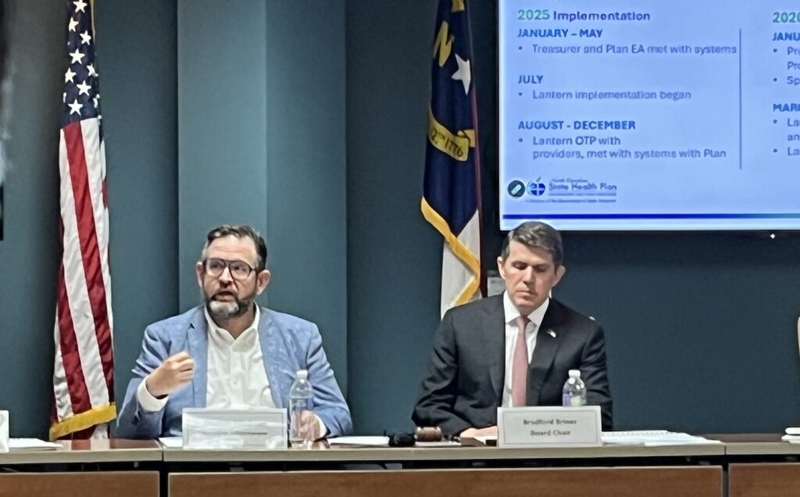
State Health Plan Executive Administrator Tom Friedman speaks at a State Health Plan Board of Trustees meeting on June 5, 2026. State Treasurer Brad Briner is on the right. (Photo: Lynn Bonner/NC Newsline)
Retirees using Medicare Advantage health insurance under the State Health Plan will see significant increases next year. The Plan’s Board of Trustees voted Friday to approve the increases.
Copays will increase for a range of medical services. For example, the daily copay for an inpatient hospital stay of 1 to 10 days will go up from $160 to $200 under the base plan. The radiology copay under the base plan will increase from $40 to $75.
Out-of-pocket maximums will go up, too, rising $500 to $4,500 for retirees on the base plan, and increasing by $400 to $3,700 for those on the enhanced plan. About 177,000 retirees are enrolled in the health plan’s Medicare Advantage insurance.
Jackson Cozort, associate director of the Retired Government Employees Association, said retirees will struggle to pay more. They have no way to offset the higher costs through job promotions or raises, he said.
“For many retirees, healthcare costs are not simply another line item in their household budget,” he said. “They’re among the most significant expenses they face.”
Suzanne Beasley, lobbyist for the State Employees Association of North Carolina, said the increase for retirees is probably going to be “pretty unbearable.”
Retirees have gone a long time without a cost-of-living increase, she said.
The Medicaid Advantage increases “are going to turn our folks on their head,” Beasley said.
State employees and teachers who are still working and enrolled in the State Health Plan would pay less out of pocket when they seek care from “preferred providers” under a strategy for reducing costs health plan administrators discussed Friday. The plan covers about 750,000 people, including about 575,000 state employees, teachers, and their dependents.
Health systems and specialists designated as “preferred providers” will offer care at lower costs to the insurance plan.
To help convince insurance plan members to use those providers, members would also pay less. For example, the deductible for an individual would drop to $1,500 from $3,000 under the “standard” plan, and from $1,500 to $1,000 for the “plus” plan. Copays at medical specialists and walk-in clinics would also drop.
“Everyone of our active members should have the opportunity to save material amounts of money under this new strategy,” state Treasurer Brad Briner said Friday. Out-of-pocket savings for plan members will amount to one-third or more, he said.
Big changes ahead for State Health Plan as trustees work to lower costs
This is the latest effort by plan administrators to help control medical costs and reverse the drain on health plan reserves.
Health insurance premiums increased this year for the first time in seven years. Trustees are expected to vote on another premium increase next month.
Workers are paying premiums on a sliding scale pegged to their salaries this year for the first time.
The latest change separates medical systems into four tiers: preferred, access, non-preferred, and out-of-network. It would be considerably more expensive for members to use non-preferred or out-of-network doctors and hospitals. The health plan will announce which health systems will be on the preferred list next month after contracts are signed.
Briner acknowledged that the new tiered system could be confusing for members, and anticipated that health systems that end up in the “non-preferred” category will complain.
However, every major provider was invited to compete for a contract, Briner said. Providers who end up on the non-preferred list didn’t bid at all or decided to keep their prices high.
Over time, health plan administrators hope to have 90% of members using “preferred” or “access” providers, said Tom Friedman, the health plan’s executive administrator. Health plan administrators want to make it worthwhile for members to use preferred providers while steering them away from non-preferred providers.
“We cannot afford to continue to pay the highest prices for things,” Friedman said.
Raleigh, NC