Auditors: Maryland Medicaid agency may have paid for care for inmates, dead people
May 28, 2026 | 4:30 am ET
Description
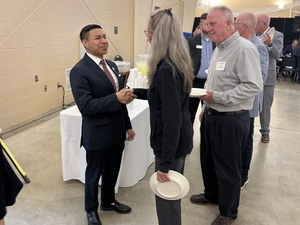
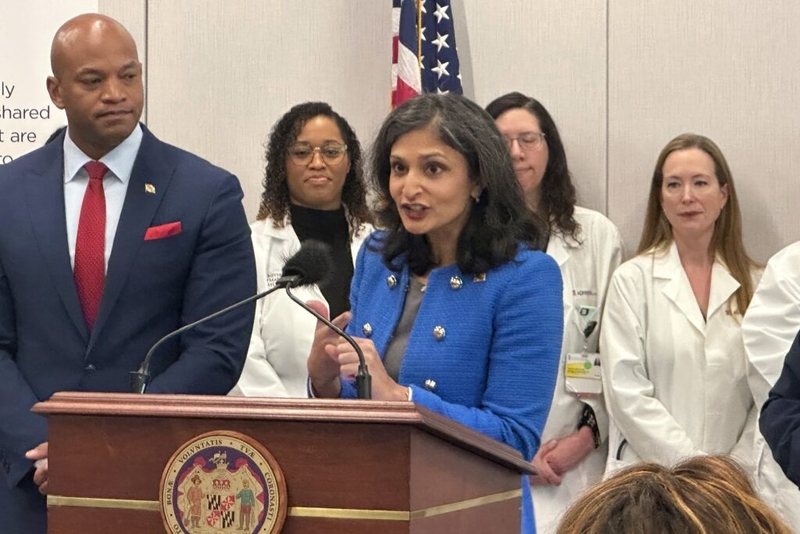
Health Secretary Meena Seshamani, with Gov. Wes Moore and backed by healthcare providers from the University of Maryland Capital Region Health in Largo, at a January event to talk about flu preparedness. (Photo by Danielle J. Brown/Maryland Matters)
The state agency responsible for overseeing Medicaid payments and services lacked “effective processes” to identify millions in questionable payments made to dead or incarcerated people, according to an audit released this week.
The Office of Legislative Audits also found that the Medical Care Programs Administration did not process changes to care plans in a timely manner, possibly delaying care for vulnerable patients. Those were among other findings in the report that was issued May 20 and released to the public Tuesday.
The report, which covered MCPA operations from April 1 2022, to March 31, 2025, included a number of the troublesome “repeat audit findings” that lawmakers and the Moore administration have identified as a top issue in recent months, after a string of damaging audits last year.
It found eight instances of questionable fiscal documentation or program oversight that could indicate improper management of funds for Medicaid, the joint federal-state health care plan largely targeted for low-income households and other challenging situations.
Auditors noted that six of those findings were similar to the previous audit for MCPA released in November 2023, covering the agency’s operations from August 2018 through March 2022.
Health Secretary Meena Seshamani said the latest audit findings do not accurately reflect efforts to fix those “repeat” findings, claiming that actions taken after the auditing period have made great strides in solving some of those accountability problems.
While the department “generally agrees” with the recommendations outlined in the report, Seshamani said in her May 13 response letter to the audit that it “does not sufficiently distinguish between unresolved compliance failures and issues already actively remediated or substantially corrected prior to issuance.”
“In several instances, the report also does not adequately reflect the operational complexities associated with administering one of the State’s largest and most federally regulated programs during a period of significant system modernization and transition,” she said.
Repeat audit findings have become so common that Gov. Wes Moore (D) and the General Assembly took steps earlier this year to address the issue.
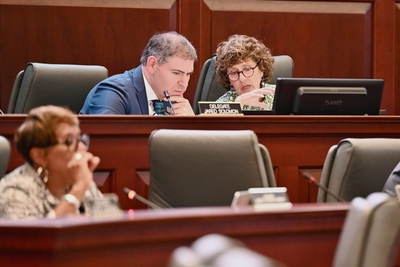
Del. Jared Solomon (D-Montgomery), House co-chair of the Joint Audit and Evaluation Committee, said reducing repeat audit findings is important, especially in a “in a world where … budgets are obviously tighter and tighter.”
“We can’t waste taxpayer money. And we have to make sure we have our own house in order,” he said.
That said, Solomon added that he does not think “that anybody was necessarily surprised that there’s still issues here that are being addressed” in the latest audit.
“Obviously there’s been some long-standing issues,” he said. “It’s well-documented that MDH was not left in the best of shape by the previous administration.”
He was referring to the administration of former Gov. Larry Hogan (R). Audits in previous years cited significant staffing shortages at state agencies left behind when Hogan left office, which resulted in “pervasive lack of documentation” at agencies like the Maryland Department of Health.
But the period studied in the latest audit primarily fell under Moore’s watch, which started in 2023.
One example of a repeat finding is auditors’ concern that the agency did not have an effective process to identify and recover questionable Medicaid payments.
Auditors found that between May 2022 and January 2025 there were claims for $6,4 million in payments on behalf of 2,397 recipients who were incarcerated. They also determined that MPCA paid out about $2.8 million in claims for services that occurred after the death of around 4,510 Medicaid recipients — another issue raised in the 2023 report.
For the incarcerated claims payments, health officials say that incarcerated individuals can receive Medicaid payments until the first of the month after the department verifies the date they were incarcerated.
“MCPA cannot recover funds paid for any date prior to the Department receiving and verifying the data, even if payments were made after the enrollee’s incarceration date,” the department says, noting that the agency was investigating $2.8 million in potentially improper payments for incarcerated individuals. That investigation should be complete by December.
Another repeat finding determined that MCPA did not quickly update the Home and Community Based Service plans for certain Medicaid recipients, meaning the state may have been paying for services that were no longer medically necessary for some and delaying care for others.
A review of 20 plans that were awaiting approval at the time of the audit found that five identified the need for additional services that were not provided because the new services had not yet been approved. Meanwhile, MCPA paid for $430,00 in services for 12 recipients, even though their plans no longer included those services.
“For example, one plan submitted in July 2022 reduced the recipient’s personal assistance services; however, the plan was not approved until October 2025, resulting in MCPA paying $54,000 for unnecessary services,” the audit said.
The department did not challenge that finding, but said it was already in the process of reducing a backlog of plan updates that stemmed, in part, from a disruption in annual Medicaid plan redeterminations during the COVID-19 public health emergency.
Auditors also said that health officials did not have “adequate oversight” over required nurse visits for people who receive health care in their home.
The Community First Choice program allows certain elderly or disabled Medicaid recipients, who would otherwise live in a nursing facility, to receive care in their homes. People in the program are supposed to be visited every six months by a nurse monitor to ensure their care is going well.
The audit found that 229 people had never had a nurse monitor visit “despite receiving services for 6 months to 10.6 years,” andf that 902 recipients were more than 60 days overdue for a visit.
The department said that “significant progress on this issue that is not reflected in the analysis.”
Despite the health department’s responses, state auditors stood by their findings.
“As indicated in MDH’s response, the corrective action proposed by MDH for all recommendations is anticipated to be completed in the future or was completed subsequent to our fieldwork,” auditors replied. “The impact of this corrective action was not included in our scope and will be evaluated during our next audit.
“As a result, we continue to believe that our report provides an accurate characterization of the procedures and controls in place during the period covered by our audit, and that the unsatisfactory rating is warranted and the related results are supported and presented in a fair and transparent manner.”
Solomon said that the report shows a natural “push and pull” between state auditors and the agencies under evaluation.
“The audit looks at a spot in time,” he said. “By the time the actual document comes out, they’re (MDH) like, ‘We’ve already started working on this.’
“MDH’s response is that they’re not waiting until the audit comes out. They know that they need to be working on this,” he said.
Recent actions
In November, state audit officials told lawmakers that than one-third of compliance issues identified by the Office of Legislative Audits in 2025 were repeated from previous audits. About 10% of those findings had been included in two or more previous audits.
Legislative auditor concerned about increase in repeated findings in state agencies
In February, Moore directed agency leaders to review audit findings and identify those that could be resolved without significant additional resources. Secretaries were also tasked with identifying repeat audit findings where additional resources would be needed to solve issues, among other directives from the governor.
During this year’s legislative session, the administration also worked with Senate and House leaders, along with the Joint Audit and Evaluation Committee, to push several pieces of legislation to further cut down on repeat audit findings. The fiscal 2027 state budget includes $10 million to help agencies reduce repeat audit findings.
“These new laws and investments will substantially reinforce the work we began earlier this year to sharpen audit compliance and responsiveness through lasting change,” Moore’s Chief of Staff Lester Davis said in an April letter sent to the Joint Audit and Evaluation Committee.
“While we have made progress, we recognize that there is more work to do — and are eager to continue working closely with the General Assembly and our colleagues at the Office of Legislative Audits to improve state operations and honor our obligation to Marylanders,” his letter said.
Annapolis, MD