After Shreveport killings, Louisiana domestic violence support groups denied more funding
May 28, 2026 | 5:00 am ET
Description
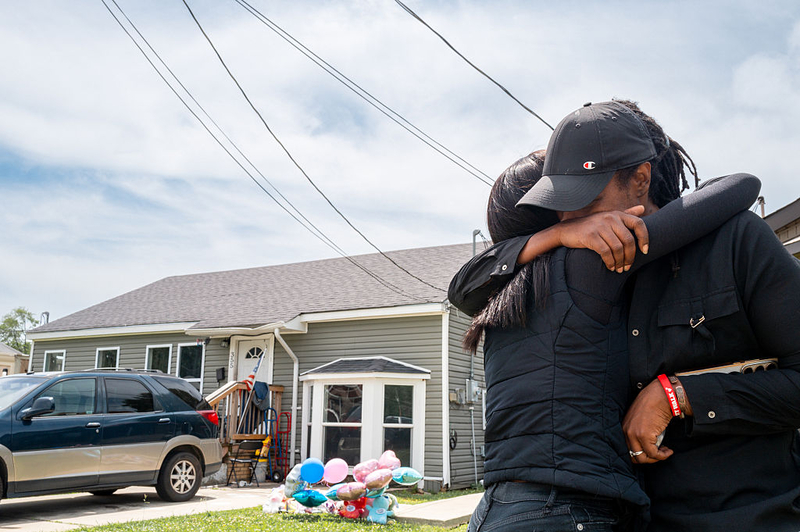
People grieve in front of the home where a shooting spree occurred on April 19, 2026 in Shreveport's Cedar Grove neighborhood. Following the mass killing, advocates for domestic violence victims had requested more money for services in Louisiana. (Photo by Brandon Bell/Getty Images)
In the wake of one of the deadliest domestic violence incidents in Louisiana history, advocates pushed the state Legislature to provide more money for victim services.
But no additional money has been set aside for domestic abuse prevention and state lawmakers are only a few days away from finalizing the annual state budget plan that takes effect July 1.
The Louisiana Coalition Against Domestic Violence said its victim assistance programs will have to be scaled back if the state doesn’t provide funds to cover a shortfall left by federal funding cuts.
“This is not the time to allow any domestic violence protections to end, and that, unfortunately, is what will occur if we don’t receive additional funds,” said Mariah Stidham Wineski, executive director of the coalition.
Wineski asked the legislature to provide $3.2 million more in the next fiscal year.
She requested the money at a public hearing held just three weeks after Shamar Elkins shot and killed his seven children and one of their cousins on April 19 in Shreveport. He also injured his estranged wife and another woman during the same attack and later died in a standoff with police.
The Associated Press called the tragedy one of the deadliest mass shootings in the country in recent years. The children killed were ages 3 to 11.
The domestic violence shelter for the Shreveport area, Project Celebration Inc., saw a surge in requests for help following the event. The organization’s crisis calls went from 15 to 97 per week, executive director Mitzi Harris told lawmakers at a hearing earlier this month.
“Some survivors are reporting that their abusers are making threats referencing violent acts similar to those committed by Mr. Elkins on April 19,” Harris said.
Louisiana has had a pervasive domestic violence problem for years. It consistently leads the nation in domestic homicides and has ranked among the top five almost every year since 1997, according to Louisiana’s Domestic Abuse Fatality Review report from 2024.
Nearly one-fourth of women and 6% of men in the state have experienced potentially lethal forms of intimate partner violence — defined as being choked, beaten, burned or wounded with a gun or knife — during their lifetimes, according to the Louisiana Violence Experiences Survey in 2025. Four percent of women and 3% of men said they were subjected to potentially lethal intimate partner violence in the last year.
To combat domestic abuse, Louisiana legislators started allocating an additional $7 million to expand domestic violence victim services three years ago. The funding allowed the state to double its number of emergency shelter beds for domestic violence survivors, from 335 to 661 beds, over four years.
But those gains have been offset by a loss of federal support. Since the state started devoting $7 million annually more to combat domestic violence in 2023, federal funding has dropped $4 million, with every shelter affected by the cut, according to Wineski.
There are also 1,300 requests for emergency shelter from domestic violence victims that go unmet every year, she said.
“Our organization alone has lost over a million dollars over the past five years in funding from the federal government,” Billi Lacombe, executive director of Faith House, a crisis center for domestic violence victims in Acadiana, said during the legislative hearing.
In addition to restricting shelters, Wineski said the loss of federal funding is going to make it harder for her organization to provide free legal support to domestic violence survivors seeking divorces, child custody and protective orders. The federal grant that pays for those services expires Sept. 30, and it’s not clear whether it will be continued.
Another federal grant given to the Louisiana Department of Health that trains health care workers to screen for domestic violence and provides health care services at shelters is also ending, Wineski said.
Advocates also worry the state’s domestic violence fatality review panel will be scaled back or possibly shuttered when its $200,000 in annual federal funding disappears later this year. The panel investigates deaths attributed to domestic violence to look for patterns and trends that might inform state laws and public policy.
Louisiana just established its review panel in 2021, when it received federal funding to support the operation. Only four other states don’t have a similar system, Wineski said.
Louisiana lawmakers are facing budget constraints this year after economists downgraded the state’s revenue projections by $104 million for the next fiscal year. Gov. Jeff Landry and lawmakers also haven’t come up with the $150 million to $200 million needed to avoid a public school teacher and support worker pay cut yet.
Yet lawmakers have managed to find tens of millions of dollars to grant raises to several groups of state employees, including judges, firefighters and prison guards. Landry and lawmakers are also increasing spending on the state prison system by approximately $100 million next year in an effort to shore up public safety.
Sen. Sam Jenkins, D-Shreveport, said state lawmakers should consider increasing spending on domestic violence survivor services if they want to be serious about fighting crime. Jenkins represents Cedar Grove, the community where Elkins killed eight children last month.
“If an incident like what happened in Shreveport doesn’t get our attention, what will?” Jenkins said in a recent interview. “I think it would be a fitting tribute to those children who lost their lives.”
Baton Rouge, LA