Al Gore talks renewable energy, data centers and climate crisis at Tennessee conference
May 06, 2026 | 6:01 am ET

Description
Former Vice President Al Gore spoke to reporters during a Climate Reality training in Nashville, Tenn. on May 1, 2026. (Photo: Cassandra Stephenson/Tennessee Lookout)
Former Vice President Al Gore said he is encouraged by the growing international adoption of renewable energy sources, even as the effects of a changing climate are hitting closer to home.
Gore delivered an updated version of his Climate Crisis presentation — popularized 20 years ago in the documentary, “An Inconvenient Truth” — during a training hosted by his nonprofit the Climate Reality Project in Nashville on Friday.
Man-made global warming pollution spurred by burning fossil fuels, agriculture and deforestation is now trapping energy “equivalent to exploding 750,000 Hiroshima-class atomic bombs per day, 365 days per year,” Gore said.
That estimate is an update from calculations introduced by James Hansen, former director of the NASA Goddard Institute for Space Studies, in a 2012 TED Talk. At that time, the trapped energy equated to about 400,000 atomic bombs per day, Hansen said.
That extra energy raises the heat, Gore said. The 10 hottest years on record occurred from 2015 to 2024, according to the National Oceanic and Atmospheric Administration’s 2024 annual report.
Impact on Tennessee
Gore moved to Nashville in 1971 after an army stint in Vietnam.
“Since that time, to this day, the average annual temperature here in this city has increased almost three and a half degrees Fahrenheit,” Gore said. “It may sound like a small number, but that is a huge amount.”
Much of that extra heat is absorbed by the oceans, and hotter oceans evaporate more water into the atmosphere, destabilizing the water cycle.
“For every one degree increase in temperature, there’s a 7% increase in the amount of water vapor held in the sky, so the downpours get bigger,” Gore said, leading to “rain bombs” and “snow bombs” — massive amounts of precipitation in short periods of time.
As he spoke, images from Nashville’s January ice storm appeared on screen behind him.
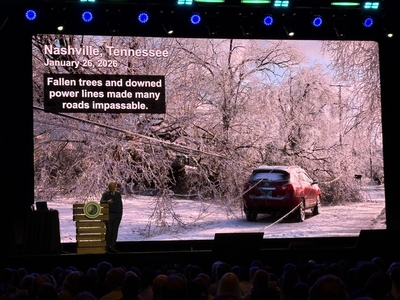
Nashville set a daily precipitation record of 1.92 inches on January 24, and freezing temperatures coated vital infrastructure in a thick blanket of ice, causing deadly widespread power outages and travel disruption.
In August, Chattanooga saw nearly seven inches of rain fall in three hours, spurring severe flooding.
Conversely, rising heat is also contributing to drought.
“The same heat that pulls the evaporation off the oceans pulls the moisture out of the soil,” Gore said.
As of April 28, 60% of the Southeastern United States was in extreme or exceptional drought, according to the U.S. Drought Monitor. In Tennessee, extreme drought stretches from the state’s northwest corner to middle Tennessee, dipping down to the southern end of the Tennessee River. Tennessee’s southeast corner shows another extreme drought hotspot, and Tennessee’s remaining counties are experiencing severe or moderate drought.
Higher temperatures and dryer conditions also increase fire risk. Gore’s own 400-acre farm in Carthage, Tennessee was affected by smoke from Canadian wildfires last year.
He said summer temperatures have climbed so high that work on his farm often starts before the sun comes up in summer months, allowing workers to avoid dangerous conditions during the hottest hours.
Droughts and sudden deluges of rain are affecting crop yields nationwide, Gore said.
Renewable energy is on the rise, but so is demand from data centers
Gore has found cause for optimism.
“In the last 20 years since this Climate Reality Project started, solar capacity has grown 400 times over,” Gore said.
Solar panels and batteries have become cheaper to make, and demand has risen.
“If you look at all of the new electricity generation established worldwide last year, 86% was renewable, most of that solar and wind,” he said. “And 20 years ago, more than three quarters of all the electricity in the world came from burning fossil fuels, with less than one quarter from renewables.”
While President Donald Trump’s administration has adjusted policy to favor fossil fuels, market forces are continuing to push toward renewable energy sources.
The war in Iran has driven up fuel prices, Gore said, making less-volatile renewable energy sources more appealing.
“It remains to be seen whether this (market shift) will continue, but I’m very optimistic that it will continue and even accelerate,” he said.
This comes at a time of ballooning energy demand driven in part by the proliferation of data centers, the largest of which can use the same amount of energy it would take to power entire cities.

Gore said the underlying problem is the global spike in energy use, but it’s not practical to try to stem the tide of the “AI revolution.” Instead, he suggests requiring data centers to be paired with renewable energy sources instead of sources powered by fossil fuels.
“We should encourage them to choose renewables as a source of energy, but asking people to not … use the energy … whatever your beliefs about it, the practicality of that — it’s just probably not going to happen,” he said in an interview following his presentation.
Tennessee lawmakers this year passed a bill stipulating that the owners of data centers (requiring at least 50 megawatts of power) must pay for any electric infrastructure upgrades needed to power the center.
The bill, which has not yet been signed by Gov. Bill Lee, also allows data centers the option of producing power themselves, free from state or local oversight. This can include using equipment like gas-powered turbines, or purchasing power from independent producers that operate outside of public utilities.
The NAACP recently filed a lawsuit against xAI over alleged illegal air pollution from more than 24 gas turbines located in Southaven, Mississippi that the company is using to power its Colossus and Colossus 2 supercomputer facilities in Memphis.
Speaking about that bill, Gore said “giving companies the right to evade any kind of regulation over their air pollution” is “horrible, and it’s horribly unjust for the people who have to breathe in the pollution.”
He noted that Southwest Memphis already suffered from elevated air pollution before the supercomputing facilities were built, and the area has cancer rates more than four times higher than the national average.
Gore said he’s hopeful that market forces will push data centers toward renewable energy sources regardless of government policy.
“I think the market is already pushing very powerfully toward more renewable sources of energy, most of all, because it’s cheaper, and the addition of even cheaper batteries to extend the number of hours a day solar and wind can be used, makes it even more attractive,” Gore said, despite federal and state government connections with the fossil fuel industry.
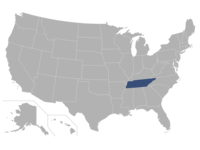
Nashville, TN