After federal funding cuts, Sussex County clinics look to fill HIV care gaps
Jul 16, 2026 | 6:00 am ET
Description
Photo courtesy of Spotlight Delaware
Why Should Delaware Care?
After major federal cuts, funding for HIV prevention and care in Delaware is spread thin. With infection rates on the rise, many organizations have had to reduce or eliminate services. In a state where HIV funding comes almost entirely from federal dollars, a few local clinics are looking to pave a way forward.
After acute cuts to federal HIV prevention funding, state agencies and community organizations working in Delaware’s southernmost — and most medically underserved — county have been left to pick up the pieces.
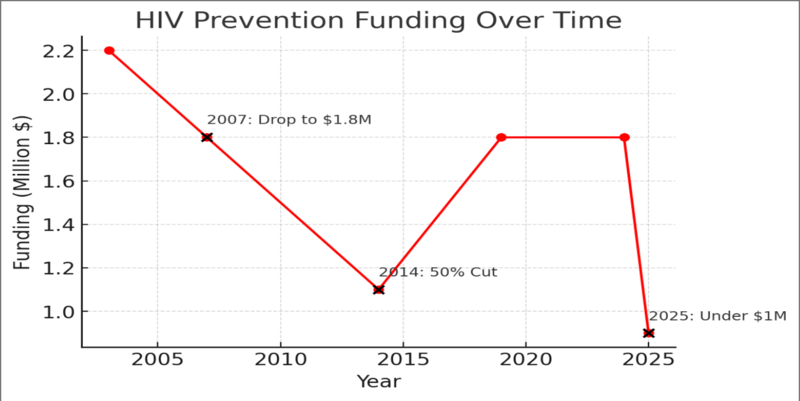
The cuts, totaling nearly half the state’s total $2.4 million budget for HIV services since 2023, come at a time when cases are on the rise across the state.
That combination has weighed on patients, healthcare workers and service providers working at the front lines of navigating and combatting rising HIV rates in Delaware.
“There’s just true strain across all of these programs in the state,” said Tyler Berl, executive director of the Delaware HIV Consortium.
Delaware, like most states, relies almost entirely on federal funding to provide HIV services. In 2024, the state’s annual federal allocation dropped from $2.4 million in 2023 to roughly $1.1 million. That amount stayed stagnant in 2025.
The roughly million-dollar loss has meant less community-based healthcare providers and organizations are receiving funding to provide HIV prevention services.
Those services help the 4,232 Delawareans currently living with HIV, according to the latest Delaware Division of Public Health data.
In 2025, 119 new cases were diagnosed — a 40% increase since 2021.
Based on those numbers, HIV cases are increasing at a rate higher than the state’s population growth, Berl said.
As organizations put their heads together to navigate a dwindling funding landscape, and HIV patients are left with fewer services, two upcoming clinics are utilizing new funds and legislation to provide care.
Statewide services ‘operating at a loss’
The Delaware HIV Consortium receives contracts from the state to implement HIV prevention and care programs across the state. But the consortium has lost all of its contracts over the past year due to funding cuts, Berl said.
That means the consortium has had to “substantively reduce” its services, including community outreach initiatives, mail-in HIV testing kits and safe sex supplies, Berl said.
HIV disproportionately affects the LGBTQ+ community, particularly gay men, Berl said. Black Americans also are disproportionately impacted. According to the latest DPH data, Black Delawareans make up 54.4% of cases in the state.
Therefore, Berl said, marginalized communities have been directly impacted by HIV funding cuts.
Suzan Abdallah, the consortium’s director of prevention and outreach services, said she began hearing from clients about the funding cuts “not even a week after” they began.
“On paper, prevention is very silent,” she said. “When it’s working well, nobody hears about it. But when funding cuts start to happen, the community feels it before the system feels it.”
Along with the cuts, the consortium lost their contract as the state’s PrEP (pre-exposure prophylaxis) navigator, a highly effective medication that can be taken to prevent HIV. Navigators help guide patients through the medication process, which Berl said can be “complex.”
Abdallah said the majority of her PrEP clients were from Kent and Sussex counties. The biggest barriers they faced to treatment were a lack of primary care providers and transportation, she said.
Sussex County clinics respond
While HIV care has become increasingly difficult to navigate across Delaware, its ripple effects have particularly shaken Sussex County, which has less primary care and medical services than the rest of the state.
The longstanding LGBTQ+ resource center for Delaware’s beach communities, CAMP Rehoboth, stopped offering its in-house HIV and sexually transmitted infections testing due to the funding loss, a CAMP spokesperson said.
The program was one of Sussex County’s oldest HIV testing and prevention services, operating for nearly 30 years.
But a new partnership with Beebe Healthcare looks to breathe life back into the clinic.
Dr. Bill Chasanov, a senior vice president at Beebe, said it was a “natural conversation” to partner with CAMP to continue providing services despite the federal funding cuts.
With Beebe, CAMP will run a pharmacy-led PrEP program, “which would be the first of its kind in Delaware,” according to an April announcement.

In 2023, Delaware became the last state to allow pharmacists to enter into agreements with doctors to prescribe drugs like PrEP and PEP (post-exposure prophylaxis), an emergency medication taken after exposure.
CAMP’s services will return at their Health Suite later this summer.
Further north from Rehoboth Beach, a new sexual health clinic opening this week in Milton is using federal rural health grants to provide accessible care. Novus, a clinic geared toward LGBTQ+ patients with roots in eastern Pennsylvania, looks to bring “modern sexual health” to southern Delaware.
Shaun Barcavage, Novus’s clinical director, said there is often an “unspoken barrier” between patients talking about sexual health with their primary care doctors.
One of Barcavage’s patients told him it sometimes is easier to turn toward urgent care facilities to get HIV services.
The backbone of the clinic is a federal program that allows clinics to recoup money from the drugs they prescribe via steep discounts. Barcavage described the program as a “lifeline” for nonprofit medical services like Novus that operate in rural areas.
He said the beauty of the program is that when more revenue comes in, clinics can expand their services to provide free or low-cost testing.
Sussex County’s Planned Parenthood clinic is also reopening in Seaford, which will bring sexual health services back to western parts of the county. The location temporarily closed almost two years ago due to a staffing shortage, according to reporting by Spotlight Delaware.
Efforts continue to make HIV funding ‘state issue’
While the funding cuts have dwindled prevention and care services, the HIV Consortium and AIDS Delaware, a nonprofit that provides HIV preventative care and support, are working with smaller community organizations to fill the gap.
Domenic Merendino, the executive director of AIDS Delaware, said the federal funding cuts have brought many organizations across the state together.
“At the surface, people think that we compete for resources, but in reality, what we’re just trying to do is make sure that everyone is being served that needs help,” Merendino said.
While state laws have helped make partnerships like CAMP Rehoboth and Beebe’s possible, advocates are still working with legislators in Dover to shift away from solely relying on federal dollars.
Last summer, in light of the funding cuts, the consortium wrote a policy brief urging the General Assembly to consider allocating state dollars to sustain HIV prevention efforts.
“Without state support, this critical and life-saving infrastructure is in jeopardy,” the brief said.
Berl highlighted that since the biggest funder of HIV care is public health insurance, prioritizing prevention services will save tax dollars in the long run. The U.S. Centers for Disease Control reports that lifetime treatment costs for someone living with HIV in Delaware total $554,000.
Two years after losing federal funds, Berl said the consortium is still advocating.
On June 25, House Bill 200, which requires health insurance providers to cover PrEP and PEP, passed the legislature. It currently awaits consideration by Gov. Matt Meyer.
Dover