Advocates ramp up pressure on Lamont to reject pipelines, citing economic data
Jun 10, 2026 | 5:00 am ET
Description
Photo courtesy of CT Mirror
Hoping to put pressure on Gov. Ned Lamont’s administration to reconsider the state’s longtime reliance on natural gas, environmental advocates are zeroing in on one aspect that’s particularly salient in an election year: affordability.
A report released this week by two economists with the Connecticut Center for Economic Analysis at the University of Connecticut — conducted on behalf of the Connecticut League of Conservation Voters — argues that past efforts to increase the use of natural gas in the state resulted in costly infrastructure upgrades that were passed on to customers, without any decrease in the price of fuel.
In addition, the report blames the state’s existing gas-fired power plants for worsening local air quality while exporting large amounts of electricity to other New England states.
A copy of the report was shared with the Connecticut Mirror last week, ahead of its publication on Tuesday. The report was also shared with the governor and lawmakers.
The report largely focuses on the impact from policies put in place under Lamont’s predecessor, Gov. Dannel Malloy, to expand access to natural gas pipelines to hundreds of thousands of homes and businesses.
“Frankly, we didn’t get a good deal,” said Fred Carstensen, the director of CCEA and one of the report’s authors. “The expansion of natural gas led to the kind of development in which we bear the cost, but we got no benefit, essentially. So that raises the question of why, in the last year or two years, has there been a discussion of expanding natural gas further in Connecticut? It didn’t help us the first time around.”
Carstensen wrote the report along with Peter Gunther, a senior research fellow at the CCEA.
The report comes at a time when several New England governors, including Lamont, have embraced the possibility of expanding gas pipelines in order to address the region’s soaring energy prices. Much of their interest has to do with gas that is burned to fuel power plants, supplying more than half the region’s power.
Connecticut, like the rest of New England, gets all of its gas shipped in from other states through pipelines or, to a lesser extent, by ship. The region’s existing pipeline network operates at or near capacity, so expansion would be necessary to meet growing demand and help lower prices, supporters say.
In a statement on Tuesday, Lamont called the report a “timely and important study,” but did not renounce his past support for an “all-of-the-above” energy strategy that includes natural gas.
“Lasting affordability cannot be achieved through volatile fossil fuels alone, and the green energy technologies outlined in this report will drive down electricity costs while positioning Connecticut as a leader in the clean energy economy,” Lamont said.
He continued, “My administration remains committed to growing Connecticut’s green economy, especially by strengthening offshore wind, to build a cleaner, more resilient grid, reduce our dependence on gas, and deliver long-term rate relief for Connecticut families and businesses. The only sustainable path to lower rates and greater energy independence is a diverse, locally sourced energy portfolio.”
Natural gas consumption in CT
Rising demand for natural gas has exacerbated Connecticut’s energy issues and led to higher prices, the CCEA report argues.
Between 2012 and 2024, total consumption of natural gas in Connecticut increased by 33%, according to the U.S. Energy Information Administration.
Power plants were responsible for much of that increased demand. The amount of natural gas burned to create electricity climbed by more than half. And three new gas-fired power plants have been built or expanded in Connecticut over the last decade, the report noted.
The report argues that because Connecticut is a net exporter of electricity, it has to bear more of the environmental and health-related costs associated with pollution from gas-fired plants, while much of the electricity produced is sent to power homes in states like Massachusetts and Rhode Island.
In addition, it argues that a reliance on natural gas makes Connecticut vulnerable to occasional price spikes caused by global events such as the wars in Ukraine and Iran.
Lori Brown, executive director of the Connecticut League of Conservation Voters, said her organization commissioned the report after hearing politicians touting more natural gas as a solution to the state’s high cost of electricity.
“They don’t know how to respond when someone says, ‘My bill is too high, and oh, it must be the renewable energy,'” Brown said. “Part of what this report really is about is to put something out there that shows the data that says no, renewable energy actually is part of the solution and there are different options — and gas, we should not be locked into.”
The report acknowledges some benefits from the shift toward natural gas in the last decade, most notably the closure of the state’s last coal-fired power plant, Bridgeport Harbor Station, in 2021.
But other benefits that were once touted as part of the push for more natural gas — such as ending the reliance on fuel oil to heat homes and businesses — have not come to fruition.
The share of Connecticut homes that rely on oil as their primary source of heat has fallen by around 18% in the last decade, according to U.S. Census data. But the data indicates that much of the shift over that time period has been toward electric heating, while the number of homes relying on gas has increased only slightly.
Carstensen said that is likely because the cost is prohibitively expensive for most homeowners to connect to the nearest gas distribution line. An incentive program that began under the Malloy administration to help people pay for gas connections ended in 2022, after falling far short of its original goals.
Instead of delivering more gas to homes and businesses, most of the increase in gas usage over the last decade went to fuel investments in power plants, the report argues. Those plants, in turn, necessitated the construction of new power lines to carry electricity over long distances, with the costs passed along to customers through their monthly electric bill.
The current state of natural gas expansion
The report did not address any specific proposals to expand or build new gas pipelines in Connecticut. Proponents of expansion argue that the supply of gas flowing through pipelines into Connecticut has not kept up with rising demand, causing prices to increase.
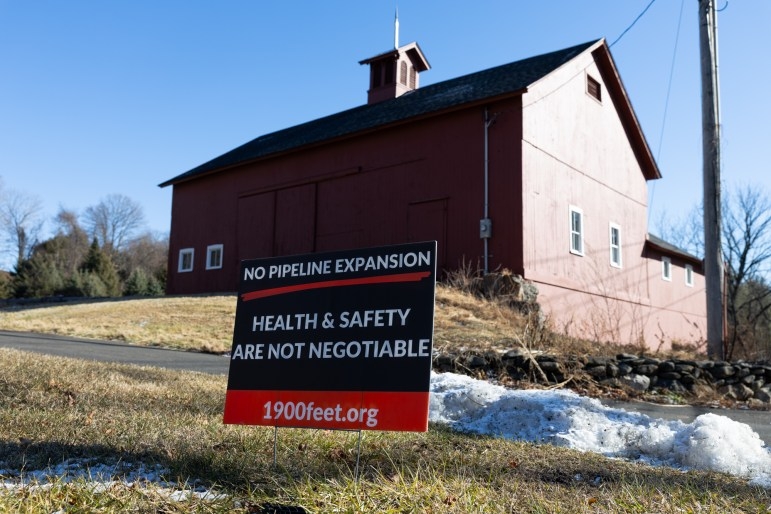
The Lamont administration is currently reviewing permits for a proposed compression-only expansion of the Iroquois Pipeline that crosses the state and underneath Long Island Sound before delivering gas to New York. The project, which requires the development of a new compressor station in the town of Brookfield, has attracted intense local opposition.
The Connecticut Department of Energy and Environmental Protection is scheduled to issue its final decision on the permits for the project later this month.
A second, even bigger expansion project was put forward last month by the owners of the Algonquin Pipeline, which cuts diagonally across Connecticut on its way from New York to the rest of New England.
The proposal, known as Project Beacon, could end up increasing the system’s overall capacity by about 10% according to the Algonquin Pipeline’s owner, Enbridge. The company is currently in the process of gauging demand for the expansion from gas utilities and power plants, before submitting the project for regulatory approval.
Melissa Sherburne, a spokeswoman for Enbridge, said that if it is approved, the project could save the region up to $2 billion a year in energy costs by 2030.
“For many years, the Northeast has faced energy costs that are significantly higher than the rest of the country, particularly during very cold winters and hot summers when demand is at its highest,” Sherburne said. “These price swings place real pressure on families, small businesses, and local economies. Project Beacon seeks to provide relief by improving access to natural gas supplies located only a few hundred miles away.”
But Connor Yakaitis, the deputy director at CTLVC, said the region’s struggles with high energy costs weren’t simply the result of stagnant supply and rising demand.
“I think there’s more at play with rising costs, especially in the last year or two,” Yakaitis said, pointing specifically to the ongoing impact on fossil fuel prices from the war in Iran. “Is it worth investing in the infrastructure — and the time that it is going to take to build that infrastructure — for something that is historically very volatile?”
The report on the impacts from natural gas expansion is the first of two studies that CTLCV plans to release over the next few weeks regarding Connecticut’s energy future.
The second report — also conducted by economists with CCEA — will focus on the potential for greener technologies such as solar, wind, battery storage and geothermal to meet the region’s rising electric demand by 2050 and beyond, according to the authors.
“The question is going forward, what do we expand?” Carstensen said. “The historical record says natural gas does not look like a good strategy for expansion. We’re not saying, ‘Get rid of it.’ We’re just saying, ‘Let’s see.’ As we get new generation capacity, what is the one that is the most efficient? What is the one that is going to have the most resilience, the highest reliability?”

Hartford, CT