ACLU files lawsuit over Huntington Flock agreement
Jul 16, 2026 | 4:38 pm ET
Description
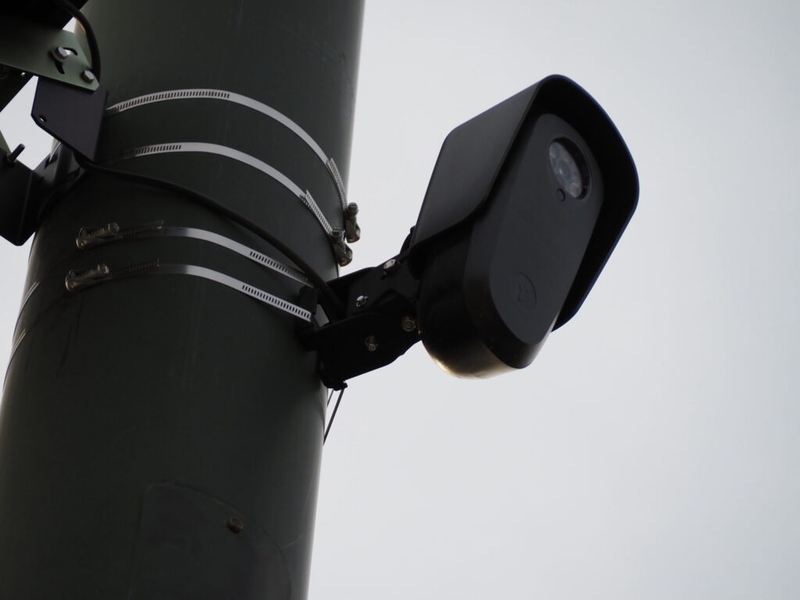
A Flock Safety license plate-reading camera is seen at Colfax Avenue and Franklin Street in Denver, Colorado, on Aug. 5, 2025. (Photo by Quentin Young/Colorado Newsline)
The American Civil Liberties Union of West Virginia has filed a lawsuit against the city of Huntington and Mayor Patrick Farrell over the city’s $2.1 million deal with Flock Safety for artificial intelligence-assisted surveillance equipment.
The ACLU-WV filed the petition for writ of mandamus Thursday in Cabell County Circuit Court. ACLU-WV is representing Huntington resident Gregory Jimison in the legal challenge, which names the city and Farrell in his official capacity. Jimison is also represented by Haslam Law Firm, and Glazer, Saad, Anderson.
The lawsuit argues the city neglected key procedural matters in awarding the contract.
“The legal issues with this contract are numerous, but we are starting with how it was awarded in the first place,” ACLU-WV legal director Aubrey Sparks said in a news release. “Simply put, the city acted hastily and did not follow its own laws when approving this contract, so it should be considered null and void from the start.”
ACLU asserts in the lawsuit that the city went against its own laws by allowing Flock, a private company, to profit from the use of public property.
“City code is clear that a private company cannot use property for commercial purposes,” Sparks said. “If the city wanted to grant Flock the right to use property belonging to the City of Huntington, there’s a proper process by which to do that. That process includes public notice, a public hearing, and other procedural safeguards to make sure that city property is used appropriately.”
Sparks said more legal action relating to the contract itself is likely to follow.
Huntington City Council voted 6-4 early Tuesday morning to approve a five-year contract with Flock or audio detection, live video cameras, drone services, license plate recognition and support services. More than 50 residents spoke against Flock, and many rallied against the devices prior to Monday evening’s meeting, which lasted more than eight hours until around 4 a.m. Tuesday.
Farrell asked council members to approve the contracts with Flock, saying the devices would lead to convictions of people harming the community. He said license plate readers had been used in another city to arrest a man suspected in the shooting death of Huntington resident Jackie Harper on July 7.
The contracts will cost Huntington $394,785 the first year and $438,220 per year thereafter, according to a resolution. The city will pay another $77,560 for two years for professional services with Flock.
A Freedom of Information Act request by the ACLU-WV Investigative Reporter Kyle Vass turned up emails between the company and the police department indicating they’d been working “several months on a large deployment” of the devices, but the proposal had only been presented to council about a month ago.
Flock Safety devices have raised privacy concerns in other jurisdictions they’ve been used in. In Houston, at least six Flock cameras were cut down last week after residents complained about the devices to county commissioners. The Los Angeles Police Department announced Saturday it would not renew its contact with Flock, citing concerns over privacy.
In Minnesota, Flock cameras reportedly wrongly flagged a car’s plates as stolen, leading police to pull a man over.
In the wake of Huntington’s approval, people from varying political backgrounds have expressed concerns over the surveillance systems. On Tuesday, the Freedom Caucus, a group of conservative lawmakers, called for the removal of Flock cameras.
“The Constitution does not disappear because technology advances,” Del. Chris Anders, R-Berkeley, and the chairman of the caucus, said in a post on the social media platform X.
“No state or local government should be mass tracking the daily movements of law-abiding citizens without a warrant. Mass surveillance has no place in a free society,” Anders said.
The Putnam County Commission announced Thursday it would reconsider its use of the devices. The commission said it had approved the cameras last June but had not yet installed them.
Barboursville Police Chief Greg Lucas said in a statement on Facebook the village had been inundated with questions about whether it planned to install Flock cameras. The short answer is no, he said.
“Across the country, there’s been a lot of debate about these systems,” Lucas said. “People are asking important questions about privacy, government overreach, and the protections guaranteed by the Fourth Amendment. Those are legitimate concerns, and I don’t think they should be dismissed.
“I also think it’s important to be honest about where technology is headed,” he said. “Artificial intelligence isn’t going away. It’s becoming part of almost every profession, including law enforcement.”
In a statement Thursday, ACLU-WV director Eli Baumwell said that as other towns are waking up to “abuses” of the technology, Huntington worked behind closed doors to “thwart the will of their constituents and push this invasive surveillance on the city.”
“We will not stand by while the city runs roughshod over the will of the people and the privacy rights of every person in Huntington,” Baumwell said.

Charleston, WV