Pennsylvania poised to strike down its last law criminalizing HIV
Jul 16, 2026 | 5:02 pm ET
Description
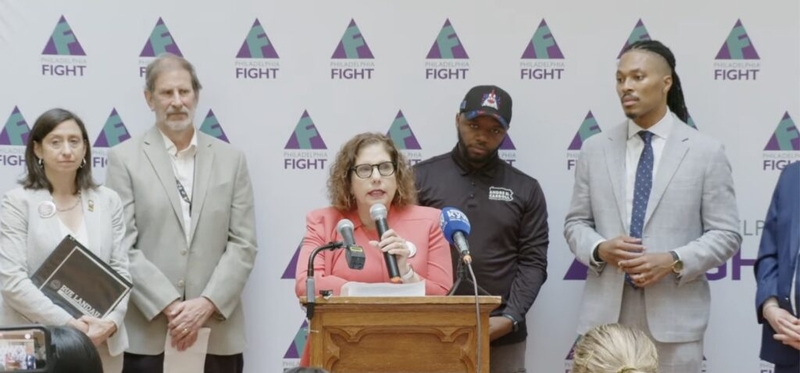
With Gov. Josh Shapiro's signature, Pennsylvania will eliminate the last criminal charges singling out people living with HIV. (Screenshot from livestream)
This story was updated on July 17 at 2:40 p.m. to correct the spelling of Dr. Jay Kostman’s name.
Decades after state lawmakers created criminal charges penalizing people living with HIV in the name of public health, a bill striking the “stigmatizing” language only needs Gov. Josh Shapiro’s signature to become law.
“People living with HIV in Pennsylvania are finally being seen and heard as citizens deserving of dignity (and) protections — not punishment,” said Waheedah Shabazz-El, an activist living with HIV in Philadelphia.
Shabazz-El and others gathered in Philadelphia on Thursday said the change would encourage more people to get testing or treatment and reduce the negative public perception.

The proposal’s advancement and support recognizes “a fundamental truth,” Shabazz-El continued, “that living with HIV is not a crime, but criminalizing people because of their HIV status is an injustice.”
Under Pennsylvania law, people living with HIV can be charged with a felony for prostitution or related offenses, crimes that would otherwise be a misdemeanor.
“For too long, our laws have not kept pace with medical science. Instead of promoting public health, they have reinforced stigma and unfairly singled out people with HIV,” said Rep. Ben Waxman (D-Philadelphia).
Senate Bill 45, which mirrors some of the language from Waxman’s House Bill 632, received one “no” vote in the Senate in June and passed the House unanimously on Sunday, the same day the General Assembly greenlit the $50.8 billion budget. Shapiro signed that and a few other bills passed at the same time, but hasn’t approved Senate Bill 45 as of Thursday.
Where do these laws come from?
Congress tied funding from the 1990 Ryan White Comprehensive AIDS Resources Emergency Act to laws that prosecuted people living with HIV — incentivizing many states to add new criminal charges, though some already had the laws on the books.
Ronda Goldfein, the executive director of the AIDS Law Project of Pennsylvania, said such action was taken “in a misguided attempt to prevent HIV transmission,” though the laws haven’t reduced the virus’ spread.
“Criminal penalties for living with HIV have never served an effective law enforcement purpose. No credible research has ever linked penalties with reduction in HIV transmission,” added Goldfein.
Though Congress struck the funding provision in 2000, states have been slow to strike laws criminalizing HIV — just over half either have a law or sentencing enhancement for people living with the condition.
While advanced in the name of public health, Jay Kostman — who treated patients with HIV and AIDS for decades in Philadelphia — argued they had the opposite impact, treating HIV “as a crime instead of as a controllable health condition.”
“When HIV first appeared in the United States, the lack of understanding of the disease and the lack of empathy for people who were living with HIV led to great stigmatization. That stigma discouraged people from getting tested and treated, fueling the epidemic, particularly among marginalized populations,” he said.
Today, HIV disproportionately impacts gay and bisexual men as well as Black and Latino Americans. Today, medication can reduce the risk of getting HIV by as much as 99%, but there are barriers to accessing the daily pill or long-acting shot.
Kostman is the chief medical officer of Philadelphia FIGHT, a community health provider that offers HIV treatment, which received $285,000 in the latest state spending plan.
“We know today that when people living with HIV are taking medications and have an undetectable level of virus in their blood, they can’t transmit the virus to other people. Therefore, there’s no scientific basis for criminalizing HIV,” added Kostman.
Legal reprecussions
An October report from the UCLA School of Law’s Williams Institute identified 78 HIV-related criminal cases in Pennsylvania for prostitution or “patronizing prostitutes” over the last decade — with Philadelphia accounting for 40% of all cases. Cases have declined over the years, but are still consistently filed.
The two charges — along with “promoting prostitution” — are “typically considered a misdemeanor” unless that person lives with HIV, at which point the charge becomes a felony “punishable by up to seven years in prison and a fine not exceeding $15,000.”
The law, which is the last to explicitly charge someone because of their HIV status in Pennsylvania, doesn’t consider if someone used a condom for protection or has an undetectable viral load, the latter of which can make the virus’ spread next to impossible.
“In the 30 years since the penalties became law, they have rarely been charged. So why are we standing around on this hot day celebrating their demise? Because stigmatizing a medical condition instead of treating it has never gotten us anywhere,” said Goldfein.
Clients over her organization’s 38 years of existence “regularly” share the ways that public perception “impedes their lives and dissuades them from seeking healthcare and sharing their diagnosis with others,” she continued.
“If people are afraid to get tested and treated for fear that someone will learn they are living with HIV, this epidemic will never end,” Goldfein said.

Harrisburg, PA