Ohio stands as mirror of the nation in countering gerrymandering efforts
Nov 26, 2026 | 3:55 am ET
Description
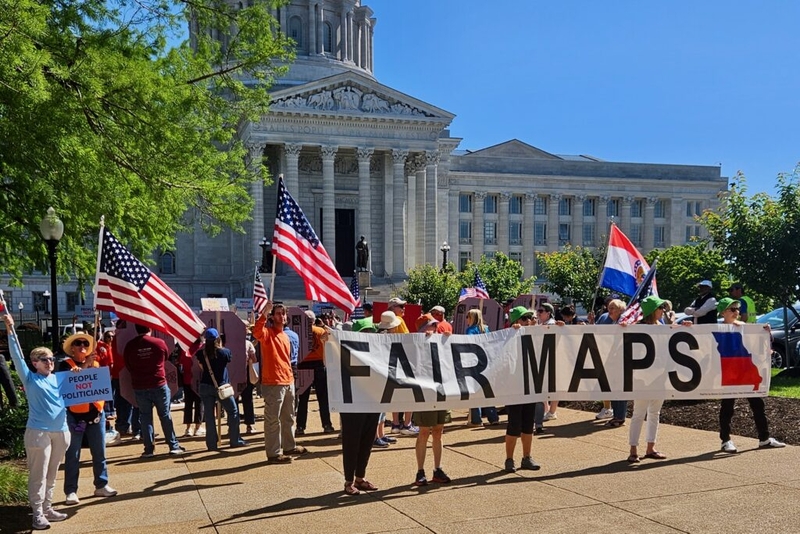
Supporters of a referendum on Missouri's gerrymandered redistricting map rally at the state Capitol Building Tuesday, May 12 after the Missouri Supreme Court heard arguments on two cases involving the redistricting map (Rudi Keller/Missouri Independent).
Experts across the country have been analyzing election results in light of efforts to use gerrymandering as a way to give politicians an edge in the most recent general election. Political scientists in Ohio and elsewhere say the efforts largely failed.
University of Cincinnati political science professor David Niven said Ohio came down to a failed political strategy with respect to redistricting, and also a cast of unappealing candidates on the ticket.
“One of the themes of this election is Republicans are just not built around the imperative to attract votes,” Niven said. “It’s why they care so passionately about map-drawing and reducing the number of ballot boxes.”
When the state was drawing congressional maps, Niven saw the GOP spotlighting two districts in particular: District 1 and District 9, home of two Democratic incumbents.
U.S. Rep. Marcy Kaptur maintained her District 9 seat, defeating Republican challenger and former state legislator Derrick Merrin with 53% of the vote in unofficial results.
In District 1, Democratic incumbent Greg Landsman defeated Republican Eric Conroy with nearly 54% of the vote, in unofficial results.
Even after putting “all their eggs in just two baskets,” as Niven put it, GOP candidate controversies added to the difficulties the party faced on Nov. 3.
“My goodness, Republicans didn’t do any favors with their candidate selection,” Niven said. “They really took a bad situation and made it worse for themselves.”
U.S. Rep. Max Miller, of Ohio’s 7th congressional district, faced heavy scrutiny after allegations of domestic violence amid his divorce from Emily Moreno, daughter of fellow Republican Ohio congressman, U.S. Sen. Bernie Moreno. Miller went on to lose his election to Democrat Brian Poindexter.
Republican governor candidate Vivek Ramaswamy faced outrage after a campaign ad featured Democratic candidate and now Gov.-elect Amy Acton’s estranged mother speaking out against her.
“The Ramaswamy ad had an effect in how people evaluated him, and I think there were probably a handful of Republicans who were turned off by him and just didn’t vote,” Niven said.
‘The flood has come over’
The Brennan Center for Justice at NYU Law held a post-election event discussing the impact of the midterms, and the stunning Republican losses nationwide. After efforts to change maps in multiple states like Texas and California via special legislative sessions or elections, and even the end of a years-long battle in Ohio just to get maps that had bipartisan agreement from the Ohio Redistricting Commission, the higher voter turnout and election participation acted as a poison pill to partisan gerrymanders.
“If we think of gerrymandering as a retaining wall, the flood has come over and the protective value of that wall is now negated,” said Peter Miller, senior research fellow at the Brennan Center. “…It looks like the efforts to pre-ordain the outcome were largely for bust, nothing much.”
Political science professor David Cohen, of the University of Akron, said the Ohio election results matched those across the country.
“The size of the blue wave that had come in just overwhelmed the gerrymandering that had happened, and I think you can say that on the federal and the state legislative side,” Cohen said.
Democrats were able to break the Republican supermajority by picking up seats in the Ohio House. Breaking the supermajority means a more challenging time in overriding vetoes from the governor.Peter Miller said as long as the people are able to have their voice heard, partisan gerrymandering can be held at bay. But that doesn’t mean a strong legislative stand isn’t needed, especially after various U.S. Supreme Court cases regarding redistricting have muddied the waters. Miller and others at the Brennan Center event brought up a Louisiana case in particular, in which the high court said the Voting Rights Act did not require the state to use race as a significant factor in drawing district maps.
“We’re going to have to at some point go to Congress and come up with some federal standard that either bans partisan gerrymandering, or some other way in which we get out of this swamp that the Supreme Court has now left us in,” Peter Miller said.
As the new year approaches, what the newly elected officials do with their power is what will decide whether voters were heard or not, especially when it comes to voting rights and representation.
Those who spoke at the Brennan Center event brought up legislative power to influence other statewide officials’ actions, including pushing policies to help with voting rights, and possibly discouraging more redistricting battles.
“I think in light of the election … there may be some hesitancy to dive whole hog into this endeavor,” Miller said. “Redistricting is an expensive effort in terms of time and resources, and at a certain point you just say ‘why are we doing this?’”
Cohen, however, sees redistricting as a priority for Ohio in the next year.
“What’s going to happen next year is you’re going to see another issue on the ballot reforming the process,” Cohen said. “This is the whole ballgame, this is the reason Republicans have had a monopoly on the legislature. In a state that is really a purple state, it’s just not normal that they would have supermajorities for 15 years.”
In order for that to change, Cohen said there has to be a “more reasonable process where the lines that are drawn result in many more competitive districts in the general election.”
“The people of Ohio deserve to be able to go into an election and to vote in a competitive environment and to know that their vote might actually make a difference,” he said.
While it’s difficult to garner voter support for an issue that’s been brought up on the ballot and in years of headlines as the fights over Ohio’s congressional and legislative maps went on, Cohen said the defeat of the most recent effort to reform redistricting had to do with Republican elected leaders inserting ballot language “that was intended to deceive.”
In 2027, the leader of the Ohio Ballot Board, the agency that approves ballot language that appears before voters, will be Democratic Secretary of State-Elect Allison Russo.
“I think Democrats understand that Ohio is not a blue state,” Cohen said. “I think the Democratic Party will be trying to push a non-partisan redistricting process.”
Should redistricting come back again in its current form, the November election had its impact there, too. The Ohio Redistricting Commission would now be a panel of four Democrats and three Republicans. The secretary of state and governor both have seats on the commission, along with appointees from both the House and Senate minority leaders. The other seats are filled with appointees from the Senate president, speaker of the House, and Republican Auditor-elect Frank LaRose.
There other ways in which the more purple-hued Ohio could enact change, according to experts.
Keesha Middlemass, a political science professor at Howard University brought up voter suppression efforts at the Brennan Center post-election discussion, and how secretaries of state nationwide could address it.
“You just think about Ohio and having one place to vote per county, regardless of population,” Middlemass said. “That is voter suppression; it may not feel like voter suppression to other people, but if you’re requiring some people in the state to wait two hours to vote, and other people can do it in 15 or 20 minutes, that is a form of voter suppression.”
Columbus, OH