Federal judge strikes Montana’s drag ban as unconstitutional
Nov 25, 2026 | 6:26 pm ET
Description
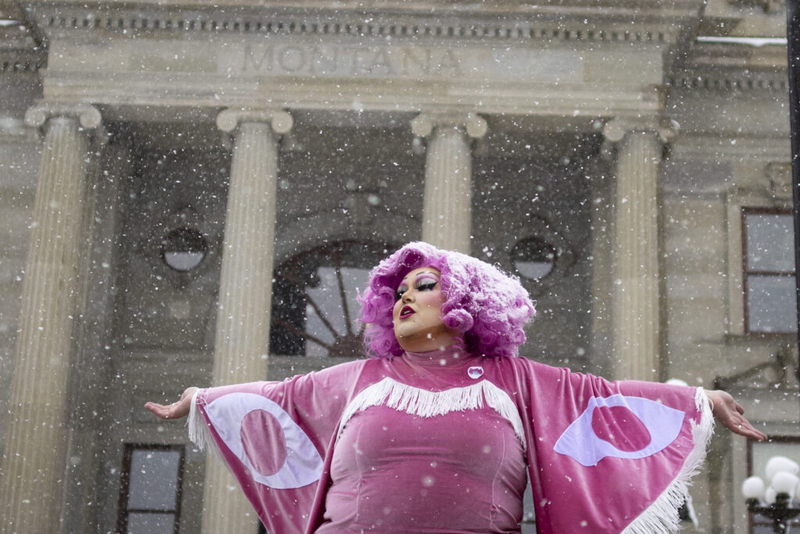
Raymi Samson performs as Eunice Exx during a drag show and protest in front of the Montana State Capitol in Helena on Thursday, April 13, 2023. (Photo by Mike Clark for the Daily Montanan)
A federal court found Montana’s 2023 drag ban to be unconstitutional and permanently stopped the state from enforcing it.
But the bill’s sponsor said Montana Republicans aren’t done trying to protect children from “sexually explicit performances.”
In an order Wednesday, Chief U.S. District Court Judge Brian Morris said House Bill 359 from the 2023 Montana Legislature violates constitutional protections of free speech, equal protection and due process.
Morris said the bill is missing some definitions, and others are too vague to be permissible.
For instance, he pointed to “drag queen,” defined as “a male or female performer who adopts a flamboyant or parodic feminine persona with glamorous or exaggerated costumes or makeup.”
The judge said the definition could cover many theatrical or artistic performances.
“It could include a performer portraying a character like Ursula from ‘The Little Mermaid.’ It could have included Dolly Parton herself,” the order said.
The U.S. Ninth Circuit Court of Appeals had affirmed a preliminary ban on the bill, signed by Republican Gov. Greg Gianforte.
Rep. Braxton Mitchell, R-Columbia Falls, sponsored the bill and said legislators continue to have an interest in protecting children from sexually explicit performances and “inappropriate drag story hours in public schools and libraries.”
“Once again, a far-left federal judge appointed by Barack Obama has struck down a common-sense law passed by Montana’s elected representatives,” Mitchell said in a text message.
He said a Google search will show why parents have concerns, and Montana Republicans “will not back down from protecting children.”
A group of plaintiffs led by the Imperial Sovereign Court of the State of Montana sued Attorney General Austin Knudsen; the superintendent of public instruction; a city official who had canceled a transgender woman’s talk at the Butte public library; and the City of Helena, which debated whether to grant a permit for Montana Pride events and whose city attorney said the law put the city in an untenable position.
The Imperial Sovereign Court of the State of Montana has a mission to educate and advocate for the LGBTQIA+ and allied community and promote tolerance through drag performances.
In a statement, Diana Bourgeois, of the Imperial Sovereign Court of the State of Montana, said drag artists all over Montana gathered at the Capitol in April 2023 to protest the attempts to “eradicate drag and drag artists” and hold a drag story hour.
“We swore that day that we would not be erased,” Bourgeois said in a statement from Upper Seven Law. “Today, with Upper Seven’s help, we have made good on that promise. Drag is not going anywhere, and we will continue to celebrate joyfully and authentically with our community.”
Upper Seven, a nonprofit law firm dedicated to holding the powerful to account, represented the plaintiffs.
A spokesperson for the attorney general did not comment on the order when reached by email.
The bill would have banned performances in drag and other costumes in schools, libraries, bars, theaters and other venues.
Under the law, convicted business owners would have faced fines of as much as $10,000 and license revocation, and public employees such as teachers would have faced fines of as much as $5,000 and license suspension.
The judge said the law unconstitutionally restricted content, failed to provide adequate notice of prohibited conduct, and wasn’t narrowly tailored to address a legitimate government interest.
The order also said the language in the bill made interpretation so subjective it would risk “seriously discriminatory enforcement.”
For example, the law would have banned “stripping,” but even a performer who removed outer layers of clothing might be in violation if they did so in a way “someone subjectively believes” was done “in a sexual manner,” the order said.
“Vagueness proves especially problematic for a law with expansive criminal and civil sanctions,” the order said.
It also said the law encouraged members of the public to “make individual judgments” about who is a “drag queen,” which is a problem.
“This vagueness creates significant risk of arbitrary enforcement against people who are not drag performers but who do not conform to traditional gender norms,” the order said.
For example, a transgender man who had surgery to remove breasts might be subject to enforcement “on the basis that the state considers his bare chest ‘female’ breasts,” the order said.
In a statement, plaintiff Montana Book Company co-owner Chelsia Rice said drag and costumes are “speech,” and the way people dress is political, artistic and “highly individual.”
“The decision today confirms that the First Amendment protects everyone, and the Montana Legislature is not allowed to make exceptions,” Rice said in a statement from Upper Seven.
The order noted the defendants suggested ways the court might revise the law, but the order said the court could not do so without deviating from the intent of the legislature.
Legislators are already submitting requests for bill drafts in advance of the 2027 Montana Legislature. One of those draft requests would revise laws on “hypersexualized shows,” but it is listed as being on hold, and the sponsor could not be reached for comment by email late Wednesday.
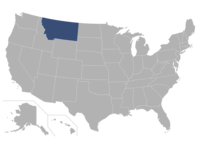
Helena, MT