Ohio law enforcement lines up behind Flock legislation, critics question records exemption
Nov 26, 2026 | 3:50 am ET
Description
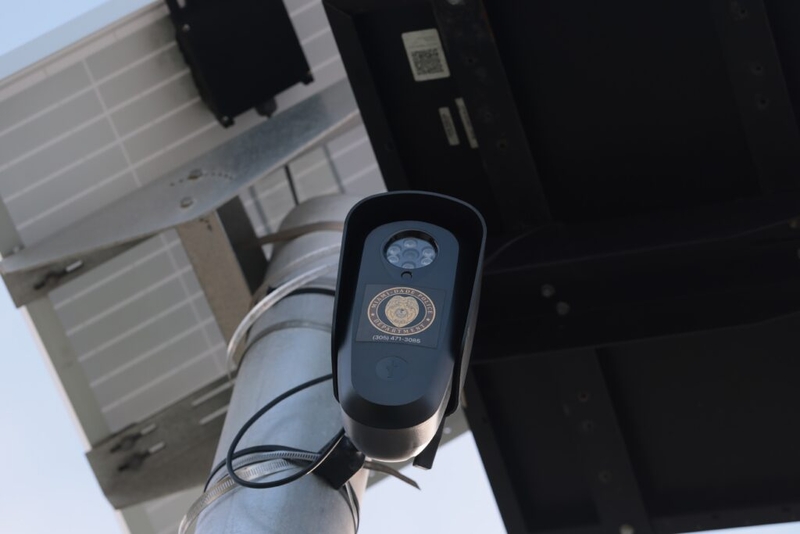
A Flock camera monitors passing traffic. (Photo by Joe Raedle/Getty Images)
An Ohio Republican lawmaker has a plan for reining in police misuse of Flock cameras, but the proposal has drawn sharp criticism over for a public records exemption that could make it more difficult for that abuse to come to light.
Lawmakers on both sides of the aisle have raised concerns about the license plate readers. Flock cameras in particular have been adopted by law enforcement agencies across the country, granting officers a vast network to draw on for investigations.
Police and many public officials hail the cameras as a vital tool in responding rapidly to criminal or missing persons cases. But critics see them as a sweeping warrantless surveillance network.
Reports in USA Today revealed one Columbus Police officer searched for the same license plate 272 times over the course of 13 months. Cleveland’s WEWS found more than 99.8% of the nearly 700,000 searches of Shaker Heights’ Flock network came from outside agencies including U.S. Immigration and Customs Enforcement.
Ohio state Rep. Kevin Miller, R-Newark, is sponsoring Ohio House Bill 725 which would make abuse of license plate reader networks a fifth-degree felony. The bill mandates deletion of data after 180 days unless it’s needed for an active investigation or legal proceedings and directs law enforcement agencies to develop rules for using data and to conduct regular audits.
Miller served with the Ohio Highway Patrol for more than 20 years, and his bill has the backing of Ohio’s prosecutors, sheriffs, police chiefs, patrolmen, and the fraternal order of police. The Ohio Mayors Alliance is on board, too, as are the Ohio Chamber of Commerce and the Ohio Business Roundtable.
Support and criticism
The bill’s backers spoke about license plate readers’ assistance in solving crimes. Retired Dublin police chief Heinz von Ekartsberg described how cameras helped solve a murder in Lorain. Columbus Division of Police Sergeant Travis Parker said camera data has played a role in 60% of his agency’s recent homicide arrests. They also touted the bill’s penalties — bringing misuse of license plate data in line with abuse of other law enforcement databases.
“That’s not anti-police; that’s professional policing,” Franklin County Sheriff’s Office Chief Deputy Rick Minerd said.
“Give law enforcement the tools,” he went on, “define the playing field, protect constitutional rights, require legal process when legal process is required, and hold people accountable when they intentionally step outside those boundaries.”
Miller defended the scope of the public records exemption. “If I’m a drug dealer,” he said, “I could have my buddy file a public records request to see if my plate has been searched.” But he floated a potential compromise in questions with representatives of Ohio’s police chiefs and sheriffs.
“Would your agency or your organization support an amendment that would allow public records requests for, let’s say the number of searches that a law enforcement agency conducted in a month, along with the reasoning for that search?” he asked von Ekartsberg.
The answers amounted to a qualified yes. The officials wouldn’t support the idea without seeing the changes in black and white, but they didn’t automatically oppose it either.
Miller also said Ohio’s Law Enforcement Collaborative is currently working on model policies for agencies’ use of license plate readers.
But the ACLU of Ohio pushed back sharply.
“What we have in Ohio is constant, warrantless mass surveillance of people that can and does reveal our whereabouts over time,” ACLU Legislative Director Gary Daniels told the House Public Safety Committee.
To Daniels, automated license plate readers are an ongoing violation of The Fourth Amendment. He acknowledged the U.S. Supreme Court hasn’t weighed in on automated license plate readers yet, but the justices have considered cases about tracking individuals with GPS, cell phones, and geo-fencing.
“Each and every time — three for three — those cases before the United States Supreme Court, the Supreme Court said that’s a search for Fourth Amendment purposes, get a warrant,” Daniels said.
The organization doesn’t believe automated license plate readers should be in use at all, but the bill’s proposed safeguards fall far short of what’s needed.
“At a bare minimum,” Daniels said, “Ohioans should know how often their government is using (automated license plate readers), and for what reasons, as well as any number of others, inside and outside Ohio, are accessing Ohio data.”
Still, Daniels thanked Miller for “taking a stab” at the issue. When Miller asked him about the narrower records exemption allowing general details about license plate reader searches, Daniels tried to redirect him. Law enforcement agencies already have a broad exemption for “confidential law enforcement investigatory records” — the sort of exemption that could apply in the case of Miller’s hypothetical drug dealer. The ACLU sees its records requests rejected regularly under that exemption, Daniels said.
But because Ohio public records law only requires agencies to share documents — not create or prepare them — the key to transparency is in refining audit requirements rather than the records exemption.
“I’m just saying I don’t know that it should exclusively fall under public records laws,” Daniels said. “Yes, use Ohio’s public records laws, but require the collection of certain data and then reporting it to some other body: city council, the attorney general, the general assembly, everybody, whomever. I think that gets us there.”
Follow Ohio Capital Journal Reporter Nick Evans on X or on Bluesky.
Columbus, OH