Amid blue wave, Oregon Gov. Tina Kotek won a swift reelection. Was the mandate in her favor?
Nov 06, 2026 | 9:00 am ET
Description
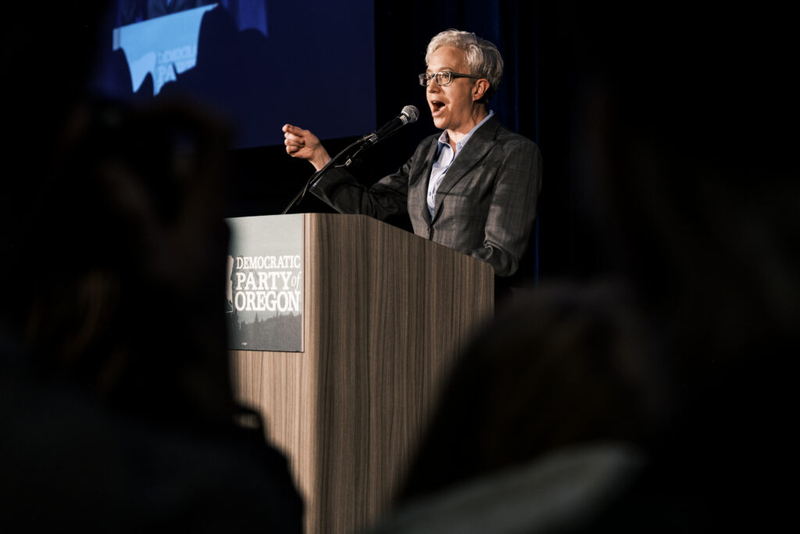
Oregon Gov. Tina Kotek speaks at the Oregon Democratic Party's election night watch party in Portland, Oregon, on Tuesday, Nov. 3, 2026. Her victory came amid a nationwide wave of support for Democratic candidates during the midterm elections. (Photo by Jordan Gale/Oregon Capital Chronicle)
Joined by her wife, her closest aides and allies and the Democratic party apparatus that buoyed her to reelection Tuesday, Oregon Gov. Tina Kotek offered a prompt caveat: The path to improve the quality of life in Oregon has only just begun.
“We know there is more work to do, and that’s what this race for governor has been about,” she told hundreds of supporters in downtown Portland. “It has been about who is going to build on the foundation of progress and move our state forward, and we are standing up for the state that we love.”
The governor’s acknowledgement that she and state lawmakers have more work ahead of them in the next four years to make good on her campaign vows underscored how Kotek faced Oregon-specific headwinds in the race against two-time Republican challenger state Sen. Christine Drazan of Canby.
For months, the governor focused on tying Drazan to the Trump administration, a move that prompted Drazan to accuse her of distracting from Oregon’s poor performance on issues such as education, homelessness and economic development.
But political analysts say Kotek’s strategy of linking her opponent to an unpopular national party and federal administration may have paid off, reflecting widespread Democratic victories across the nation that night in statewide races for governor and the U.S. Senate.
“Probably, Tina Kotek will learn from this, and I think she has an agenda that she wants to continue to build on,” said Christopher Stout, a professor of political science at Oregon State University. “I don’t know that she’ll claim that ‘I have a total mandate’ based off the results, but certainly national factors seeped into how people evaluated her candidacy.”
Kotek built upon her 2022 performance in key strongholds such as Multnomah and Washington counties as well as bellwether areas such as Clackamas County, Drazan’s home county and one the Republican won in 2022. Kotek is also leading in Deschutes County, which Drazan won in 2022, by about 5,000 votes.
The governor may have also benefitted from a lack of a well-funded third party candidate, such as 2022’s nonaffiliated gubernatorial challenger Betsy Johnson, a former Democratic state senator who won more than 8% of the vote in the last governor’s race. While Drazan had argued those voters would flock to her instead this time around, Kotek has so far been on track to win with more than 52% of the vote, an increase from the 47% of the vote she won in 2022.
Drazan, on the other hand, increased her share of the vote to more than 44%, about a 1% increase compared to 2022. Pacific Green Party candidate Brett Smith came in at a distant third with less than 3% of the vote. Elections officials still have a few hundred thousand ballots to count ahead of the Dec. 10 certification deadline.
“They (Republicans) had a credible chance to unseat, to win back the governor’s office for the first time in 40-plus years, and their turnout increased,” Stout said. “But the change in enthusiasm wasn’t as great as it was for Democrats, and so I think that made the race less competitive than it would have otherwise been.”
Kotek faces diverging coalitions ahead of next session
Oregon hasn’t elected a Republican governor since 1982, and only two members of the GOP have won statewide since 2000. But under Kotek’s watch, the Beaver State has struggled to curb persistent unemployment in the wake of the COVID-19 pandemic, seen a rise in statewide homelessness and made little progress on fourth-grade test scores, which rank among the worst in the nation compared to other states.
Discontent with progress on those issues was evident in political and public policy polling ahead of the election, which put Kotek among America’s least popular governors and Drazan within striking distance during the race. A May poll by the Oregonian/OregonLive found that 59% of voters in the Portland metropolitan area had a negative impression of the governor.
Political observers saw the governor’s prosperity council, which recommended this summer that the state work to reduce taxes and regulations, as a way to appeal to more business-friendly voters in the area. But Jake Weigler, a Portland-based Democratic political consultant, said that Kotek may have since also taken notice of the wave of progressive candidates entering Oregon politics during this campaign cycle.
He pointed out that the governor reversed course on her criticism of Multnomah County’s Preschool for All program, funded by a tax of 1.5% on single people making at least $125,000 and married couples with a combined income above $200,000. She earned the endorsement of the progressive Working Families Party, which declined to support her in the primary election.
“I think those conversations will be revisited in the legislative process, and it’ll probably be a tougher choice,” Weigler said. “In the campaign, she’s able to kind of do both, and I’m not sure that’s going to work out in the legislative cycle.”
Although Drazan did not win, she did manage to build upon President Donald Trump’s performance across the state in 2024. The Associated Press found that all but one county, Lincoln, appeared to shift toward Drazan in comparison to Trump’s performance in 2024, ranging from an increase of more than 1 point in Marion County in favor of Drazan to a 9.6 point increase in Clackamas County. She also improved upon her 2022 performance in multiple Eastern Oregon counties by a few percentage points.
Bryan Iverson, a Republican political consultant and husband of Rep. Vikki Breese-Iverson, R-Prineville, said that the election results were unsurprising given the national political trends in favor of Democrats.
He said that Drazan did a good job of “raising our ceiling” for Oregon Republicans by reaching more than 45% statewide, something no Republican gubernatorial candidate has achieved since former NBA player Chris Dudley received 47.8% of the vote in 2010.
While he applauded her approach to courting business groups and pulling from Kotek’s prosperity plan and advocating for lower taxes and regulations, he suggested that a more successful GOP candidate in the future would tailor that message more in favor of working-class Americans.
“The problem is that argument isn’t a populist message,” he said. “You’re talking to small business owners, you’re not talking to the employees at the small business.”
The Republican state senator, meanwhile, appears to still be processing the results. Although another GOP statewide candidate, state Sen. David Brock Smith, R-Port Orford, who ran for U.S. Senate, has conceded, Drazan has yet to formally concede the race. She instead issued a lengthy Wednesday statement acknowledging that news organizations have called the race in Kotek’s favor without declaring defeat.
“I don’t yet know what the coming days will bring. But I know that my love for Oregon is not measured by the outcome of an election, and my commitment to its people has never depended on a title,” she wrote. “There is a generation of Oregon kids growing up right now who will inherit the decisions we make today.”
A key roadmap for how those decisions will play out in Salem will soon be available, as Kotek is set to reveal her next two-year budget for the state in December.
Salem, OR