A look at how SC voters’ support shifted to flip the US Senate seat
Nov 06, 2026 | 6:30 am ET
Description
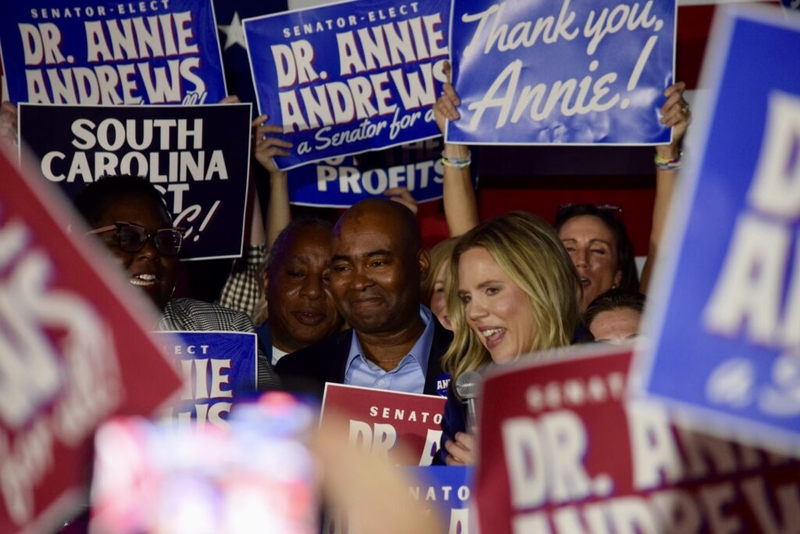
Dr. Annie Andrews celebrated with supporters in downtown Charleston Tuesday, Nov. 3, 2026, as the Associated Press declared her the winner of South Carolina's U.S. Senate Race. To her left is Jaime Harrison, former chairman of the Democratic National Committee, who lost his own bid for Senate against the late Sen. Lindsey Graham in 2020. (Photo by Jessica Holdman/SC Daily Gazette)
COLUMBIA — Senator-elect Annie Andrews made history with a voting shift for the Democrat across every South Carolina county, thanks to Republicans and independents splitting their ticket, an analysis of election data shows.
Andrews flipped South Carolina’s U.S. Senate seat with 51% of the vote, 4.5 percentage points more than GOP Sen. Darline Graham, according to unofficial results.
Record-breaking turnout and a surge in Democrats’ enthusiasm help explain her win in an election that brought a blue tsunami nationwide. Other states where Democrats flipped U.S. Senate seats long held by a Republican included Maine, North Carolina, and Texas.
Broken down by county, Andrews won more votes than the three-month incumbent in 25 of South Carolina’s 46 counties, including traditionally ruby red Greenville and York counties.
Democrats are also celebrating a flip in the coastal 1st Congressional District and a shockingly close finish in the 2nd District held by U.S. Rep. Joe Wilson since 2001.
In both races, the margin seems to fall just outside the 1-point-or-less spread that would trigger an automatic recount, according to unofficial results. As of early Friday, The Associated Press had yet to call either contest.
State Democratic Party officials point to shoe-leather campaigning in driving turnout across the state. Since the June primaries, the party’s outreach efforts included 6 million attempts to contact voters by phone or in person; 750 volunteers for the party knocked on doors in the last two weeks, Jay Parmley, state director, told reporters Wednesday.
“We are absolutely convinced that through the volunteer efforts, through the paid efforts, that this made a big difference here to capture this sort of national frustration, national mood,” he said.
“We made sure we had folks on the doors, just this constant door turn happening in the background,” added state party Chair Christale Spain.
But Democratic enthusiasm didn’t flip any other statewide office in South Carolina.
Republican Alan Wilson, Joe Wilson’s son, won the governor’s office with the same, 4.5-point margin as Andrews. While that’s the smallest winning spread for a GOP gubernatorial nominee since 2010, when Rep. Nikki Haley defeated Sen. Vincent Sheheen by 4.5 points, it shows Andrews’ win can’t be fully attributed to more Democrats showing up and unenthused Republicans staying home.
Wilson received a greater share of votes than Graham in every county.
In a state where voters don’t register by party, that’s clear evidence of Republicans crossing over to vote for Andrews over Graham.
Comparing 2024 to 2026
President Donald Trump, whose encouragement and endorsement of Graham prompted her to run, came to South Carolina twice in 10 days to rally support for the younger sister of the late U.S. Sen. Lindsey Graham, who Trump called his best friend. To bolster turnout, Trump told supporters repeatedly to pretend that he was on the ballot.
The results Tuesday show Trump’s popularity waning even in a state he won by nearly 18 percentage points two years ago.
Compared to his 2024 numbers, Darline Graham received a smaller percentage of votes in every county.
The most dramatic shift came in conservative Spartanburg County. Graham won the county, but with a winning margin 15.3 percentage points smaller than Trump’s.
Statewide, 30 counties saw Graham’s share of support at least 10 points below Trump’s winning percentage over Vice President Kamala Harris.
Beyond Spartanburg County, the biggest drops were in Kershaw County (14.3 points), Graham’s home county of Lexington (13.5 points), and Berkeley County (13.3 points).
Split tickets
The crossover vote was most evident in the seven counties won by Wilson in the governor’s race that went blue for Andrews in the U.S. Senate race: York, Greenville, Clarendon, Calhoun, Colleton, Barnwell, and Jasper.
The split tickets are at least partly due to GOP infighting over Graham’s nomination. Trump’s backing angered many Republicans, who saw it as interference in South Carolina’s decision, particularly supporters of U.S. Rep. Ralph Norman of Rock Hill, who lost to her in the runoff, days after Trump rallied for her in Myrtle Beach.
In that Aug. 25 contest, Norman won 12 conservative counties in the state’s northwest corner, including Anderson and York counties, the two places where Trump rallied ahead of the election to try to help her.
While Norman said he would personally vote for Graham, honoring a pledge to support the GOP nominee, he refused to campaign with her and made clear his entire family didn’t support her. His son, Warren Norman, endorsed Andrews. Some of Norman’s supporters launched a social media campaign asking conservatives to write in his name.
But ultimately, the “write in Ralph” effort didn’t make a difference.
Fewer than 4,900 people statewide wrote in someone’s name, according to the state Election Commission’s uncertified numbers.
How many voters specifically wrote Norman’s name is unknown. Counties aren’t required to separately count write-ins unless there’s enough to impact an election, according to the state agency.
The total write-ins surpassed tallies in U.S. Sen. Tim Scott’s 2022 re-election and Lindsey Graham’s 2020 re-election but not remotely enough to sway the outcome.
More than 91,000 votes separated Andrews from Graham.
The Libertarian and Constitution candidates also weren’t spoilers. The two, minor-party candidates received a combined total of less than 40,400.
Turnout and takeaways
The election broke the state’s record for the highest voter turnout in a non-presidential year by both percentage and total numbers.
According to the state Election Commission, 2 million voters cast ballots out of 3.4 million registered voters — a turnout of 60%. That breaks the previous record, set 24 years ago, by 5 percentage points. And it surpassed the 2018 record of 1.7 million total votes.
Those numbers were propelled by early voting, which also set a new record for a gubernatorial year.
More than 1 million people voted during the 12 days of early voting. That approaches a doubling of the 562,000 early votes cast in 2022, which is both the last time races for governor and a U.S. senator were on the ballot and the first election under the then-new early voting law.
According to political science professors across the state, Andrews’ win came down to a combination of Democratic enthusiasm, the Iran war and high prices angering voters across the political spectrum, Andrews’ focus on affordability and ability to deflect Republican arguments, and voters disliking the idea that Graham inherited her spot on the ballot, particularly conservatives upset at Trump over meddling in the primary.
“It was the perfect storm to kind of boost Annie Andrews and sink Darline Graham,” said Scott Huffmon, a Winthrop University professor and director of the Winthrop Poll.
In his post-election analysis for the Winthrop Poll newsletter, he summed up Andrews’ recipe for a win this way: “Take one lackluster candidate, one great candidate, one terrible economy, one big GOP family fight and mix well. Fold in angry independents. Bake at 2026.”
Whether this election means South Carolina will be seen as a “purple state” depends on whether Democrats can repeat their momentum, said Shannon Bridgmon, a political science professor at the University of South Carolina.
For now, she said, the state is more “pale red” than purple.
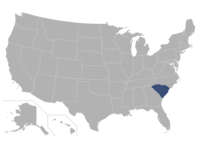
Columbia